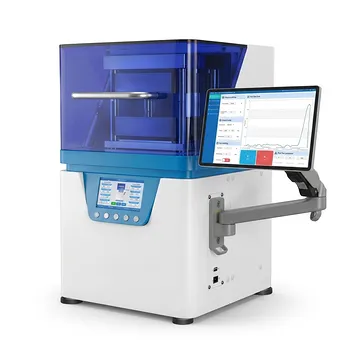
The laboratory hydraulic press is the critical instrument used to transform loose piezoelectric powders into a cohesive, high-density solid known as a "green body." By applying precise uniaxial pressure—often exceeding 80 MPa—within a specialized mold, the press ensures that powder particles are tightly packed with minimal internal voids. This initial compaction is the fundamental prerequisite for successful sintering, directly determining the final ceramic's density, mechanical strength, and electromechanical performance.
The laboratory hydraulic press serves as the bridge between raw chemical powders and functional ceramic hardware. Its primary role is to establish high initial bulk density and geometric uniformity, which dictates the quality of grain growth and the ultimate piezoelectric efficiency of the material.
The Transformation from Powder to Green Body
Defining the Geometric Foundation
The press uses high-precision molds to compress synthetic powders (such as PZT or Barium Titanate) into specific shapes, typically discs or pellets. This step provides the material with enough initial handling strength to undergo further processing without crumbling.
Expelling Air and Increasing Contact Points
By applying vertical force, the press forces air out from between the powder mass and brings particles into intimate physical contact. This increase in contact points is vital for the chemical reactions that occur later during the high-temperature sintering phase.
Achieving Microscopic Uniformity
Precise control over the hydraulic pressure ensures that the powder is distributed evenly, reducing density gradients across the disc. A uniform green body prevents warping or cracking during the cooling phase of production.
Impact on Final Material Performance
Optimization of the Piezoelectric Coefficient
High-pressure compaction significantly reduces porosity within the sample. Lower porosity allows the final ceramic to achieve piezoelectric coefficients and spontaneous polarization constants that are closer to their theoretical maximums.
Influence on Sintering and Grain Growth
The initial density provided by the press directly influences how grains grow during sintering. A well-pressed disc will result in a high-density ceramic with a refined microstructure, which is essential for superior electromechanical coupling.
Ensuring Structural Integrity
By ensuring particles are rearranged and tightly bonded within the mold, the press creates a micro-crack-free reaction substrate. This structural integrity is necessary for the ceramic to withstand the mechanical stresses encountered in high-performance sensors and transducers.
Advanced Roles in Multilayer Assembly
Interface Management in Composites
Beyond simple powder pressing, the hydraulic press is used to bond multilayer piezoelectric nanogenerators. It provides the simultaneous pressure and temperature needed to ensure tight physical contact between piezoelectric polymers, electrodes, and substrates.
Eliminating Insulation Breakdown
In stacked ceramic sheets, the press ensures that bonding agents like epoxy resin form an extremely thin, uniform layer. By eliminating internal air gaps and bubbles, the press prevents insulation breakdown and minimizes mechanical energy loss during operation.
Understanding the Trade-offs and Pitfalls
The Risk of Density Gradients
If pressure is applied too rapidly or unevenly, it can create internal stress within the disc. These gradients can cause the ceramic to crack or deform during the sintering process, rendering the sample useless.
Pressure Limitations and Over-compaction
While high pressure is beneficial, exceeding the material's limit can cause lamination defects. This occurs when the elastic recovery of the powder after releasing the pressure exceeds the strength of the green body, leading to horizontal cracks.
Tooling and Mold Wear
The use of high-precision molds requires constant maintenance. Abrasive ceramic powders can wear down mold surfaces over time, leading to dimensional inaccuracies and "flashing" where the powder escapes through gaps in the tooling.
How to Apply This to Your Project
Recommendations for Success
- If your primary focus is maximizing electrical output: Prioritize high-tonnage pressing (above 80 MPa) to achieve the highest possible bulk density before sintering.
- If your primary focus is multilayer transducer assembly: Focus on the press's ability to provide uniform, low-intensity pressure combined with temperature control to ensure thin, bubble-free bond lines.
- If your primary focus is material R&D and simulation: Use a press with high-precision digital gauges to ensure repeatable density, allowing your physical results to match your theoretical models.
Mastering the application of pressure via a laboratory hydraulic press is the single most important factor in ensuring a piezoelectric ceramic moves from a laboratory powder to a high-performance functional device.
Summary Table:
| Stage of Preparation | Role of the Hydraulic Press | Impact on Final Ceramic |
|---|---|---|
| Powder Compaction | Transforms loose powder into a solid 'green body' | Establishes geometric shape and bulk density |
| Air Removal | Expels air and maximizes particle contact points | Enhances chemical reactivity during sintering |
| Microstructure Control | Reduces density gradients and internal voids | Prevents warping, cracking, and porosity |
| Performance Tuning | Achieves high initial compaction (>80 MPa) | Maximizes piezoelectric coefficients and efficiency |
| Assembly | Manages interfaces in multilayer composites | Prevents insulation breakdown and energy loss |
Elevate Your Piezoelectric Research with KINTEK
Achieving the perfect green body density is critical for high-performance piezoelectric ceramics. KINTEK specializes in comprehensive laboratory pressing solutions designed for precision and repeatability.
Whether you are working on material R&D or advanced battery research, our extensive range includes:
- Manual & Automatic Presses: For versatile and high-throughput pellet pressing.
- Heated & Multifunctional Models: Perfect for multilayer assembly and interface management.
- Glovebox-Compatible & Isostatic Presses: Specialized cold and warm isostatic presses for uniform microscopic density.
Ready to eliminate density gradients and maximize your material's electromechanical coupling? Contact our experts today to find the ideal pressing solution for your lab!
References
- Hyun Soo Kim, Hyun‐Cheol Song. Piezoelectric DC Generator Through Sequential In‐Phase Polarization Variation. DOI: 10.1002/aenm.202503097
This article is also based on technical information from Kintek Solution Knowledge Base .
Related Products
- 24T 30T 60T Heated Hydraulic Lab Press Machine with Hot Plates for Laboratory
- Automatic Heated Hydraulic Press Machine with Heated Plates for Laboratory
- Laboratory Hydraulic Press 2T Lab Pellet Press for KBR FTIR
- Automatic Heated Hydraulic Press Machine with Hot Plates for Laboratory
- Automatic Heated Hydraulic Lab Press 120x120mm Plate Fully Automated Material Research Press
People Also Ask
- What role does a laboratory heated hydraulic press play in LTCC? Essential for High-Density Ceramic Lamination
- What is the primary function of a laboratory heated hydraulic press? Mastering Thermoplastic Carbon Fiber Composites
- Why reduce load when applying composite strengthening tabs? Protect Specimen Integrity and Data Accuracy
- What role does a laboratory heated hydraulic press play in PI/PA based SPE membranes? Optimize Solid Battery Performance
- What is the critical role of a laboratory heated hydraulic press? Mastering PVC Sample Prep for Testing