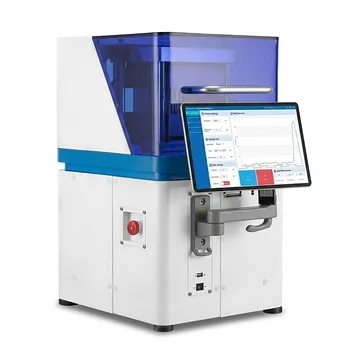
The laboratory press is a critical tool for ensuring the electrochemical and mechanical integrity of flexible supercapacitor electrodes. By applying precise, uniform pressure, it forces the active material, conductive additives, and binders into a dense, cohesive layer that adheres firmly to the current collector. This process transforms a loose mixture into a high-performance electrode by minimizing interfacial resistance and maximizing the physical stability required for flexible applications.
The core role of a laboratory press is to establish a high-quality electrical and mechanical interface between the active material and the current collector. This compaction process is vital for reducing internal resistance and ensuring the electrode remains functional during the bending and folding inherent to flexible devices.
Reducing Interfacial Resistance and Enhancing Conductivity
Optimizing Contact Between Materials
The primary function of the press is to ensure tight physical contact between the active electrode material, the electrolyte layer, and the current collector (such as nickel mesh or aluminum foil). Without sufficient pressure, micro-gaps between these layers act as barriers to electron flow, significantly hindering performance.
Lowering Equivalent Series Resistance (ESR)
By applying precise pressure, the laboratory press reduces the interfacial contact resistance, which directly lowers the device's Equivalent Series Resistance (ESR). This reduction is critical for improving charge transfer efficiency and ensuring the supercapacitor can handle high-rate charge and discharge cycles without significant energy loss.
Structural Integrity and Mechanical Stability
Preventing Material Delamination
Flexible supercapacitors undergo significant mechanical stress; the press ensures that active materials, binders, and conductive agents are tightly bonded to the current collector. This high-precision pressing prevents the active substances from detaching or delaminating during the repeated bending or electrochemical cycling of the device.
Ensuring Experimental Reproducibility
The use of a high-precision hydraulic press allows for the application of uniform and repeatable pressure across different samples. This consistency is essential for the reproducibility of experimental data, ensuring that performance variations are due to material properties rather than inconsistent assembly techniques.
Optimizing Energy and Power Density
Balancing Compaction with Ion Diffusion
A laboratory press allows researchers to adjust the thickness and carrier density of the electrode layers. Applying the "correct" amount of pressure helps balance the mass specific capacitance of the electrode with the connectivity of ion diffusion channels, allowing the material to maintain high rate performance.
Increasing Volumetric Energy Density
The pressing process achieves powder densification, which packs more active material into a smaller volume. By precisely controlling the compaction density, the press helps maximize the volumetric energy density of the supercapacitor, which is a key metric for portable and wearable electronics.
Understanding the Trade-offs
The pressure applied during the assembly stage must be carefully calibrated to avoid common pitfalls. While higher pressure generally reduces electrical resistance, excessive pressure can crush the porous structure of materials like activated carbon or Metal-Organic Frameworks (MOFs).
If these pores are collapsed, the electrolyte cannot penetrate the material effectively, which restricts ion diffusion and decreases the overall capacitance. Conversely, insufficient pressure leads to poor adhesion and high internal resistance, causing the device to fail prematurely under mechanical strain or high-power demands.
How to Apply This to Your Project
When utilizing a laboratory press for electrode assembly, your pressure settings should be dictated by your specific performance priorities.
- If your primary focus is High Rate Performance: Apply precise, moderate pressure to minimize contact resistance while preserving the open pore structure necessary for rapid ion transport.
- If your primary focus is Volumetric Energy Density: Utilize higher pressure to achieve maximum powder densification and reduce the total thickness of the electrode sheet.
- If your primary focus is Mechanical Longevity: Ensure the pressure is sufficient to fully embed the active material slurry into the current collector (e.g., nickel foam) to prevent delamination during bending.
The laboratory press ultimately serves as the definitive tool for transitioning from benchtop material synthesis to a robust, high-performance energy storage device.
Summary Table:
| Role | Key Benefit | Performance Impact |
|---|---|---|
| Compaction | Lowers Contact Resistance | Reduces ESR & Increases Efficiency |
| Adhesion | Prevents Delamination | Improves Mechanical Stability/Flexibility |
| Densification | Controls Electrode Thickness | Boosts Volumetric Energy Density |
| Reproducibility | Uniform Pressure | Ensures Consistent Experimental Data |
Drive your battery research forward with KINTEK’s advanced laboratory pressing solutions. We specialize in providing a complete range of manual, automatic, heated, and multifunctional models, alongside glovebox-compatible designs and cold/warm isostatic presses. These tools are essential for achieving the uniform compaction density and reduced interfacial resistance required for high-performance flexible supercapacitors. Trust KINTEK to help you transition from material synthesis to robust energy storage devices. Contact us today to explore our pressing solutions!
References
- Yuzhao Liu, Baohua Li. Robust Interfaces and Advanced Materials: Critical Designs and Challenges for High‐Performance Supercapacitors. DOI: 10.1002/eem2.70116
This article is also based on technical information from Kintek Solution Knowledge Base .
Related Products
- Laboratory Hydraulic Press Lab Pellet Press Button Battery Press
- Laboratory Hydraulic Press Lab Pellet Press Machine for Glove Box
- Laboratory Split Manual Heated Hydraulic Press Machine with Hot Plates
- Laboratory Hydraulic Pellet Press for XRF KBR FTIR Lab Press
- Laboratory Hydraulic Split Electric Lab Pellet Press
People Also Ask
- How is a laboratory hydraulic press used for HAP composite gels? Master Mineral Substrate Standardization
- What role does a laboratory hydraulic press play in reaction pellets? Optimizing Lunar Soil and Metal Fuel Density
- What role does a laboratory hydraulic press play in the preparation of piezoelectric ceramic discs for DC-PG? | KINTEK
- Why is a laboratory hydraulic press required for PBAT and PLA sample preparation? Achieve Flawless Characterization
- What role does a laboratory hydraulic press play in the assembly of all-solid-state battery test cells? Expert Guide