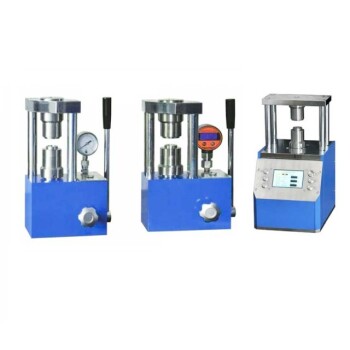
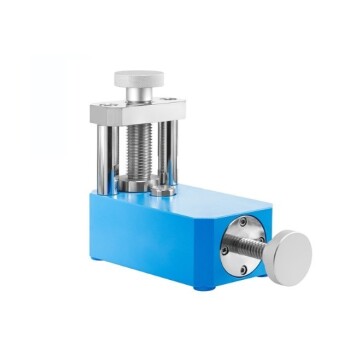
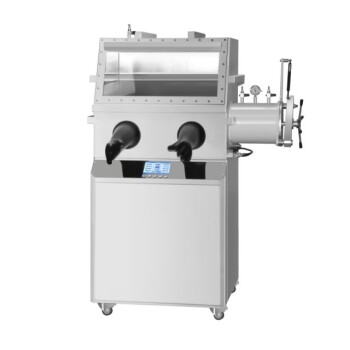
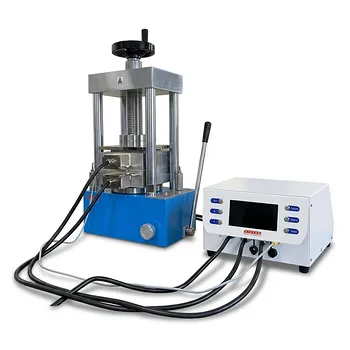
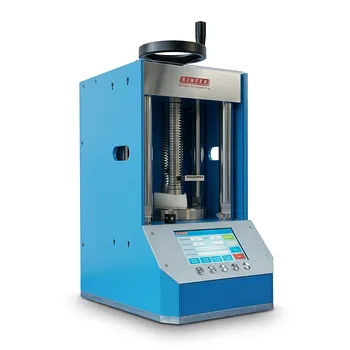
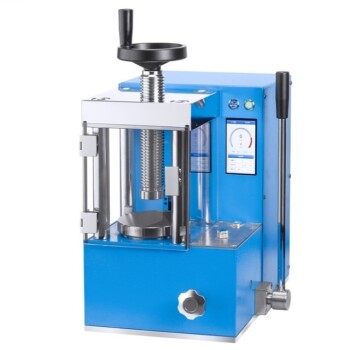
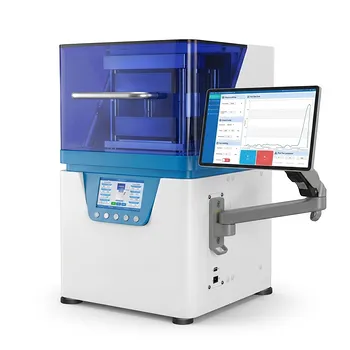
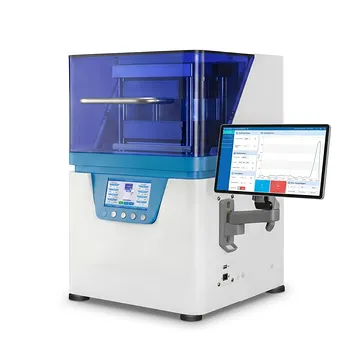
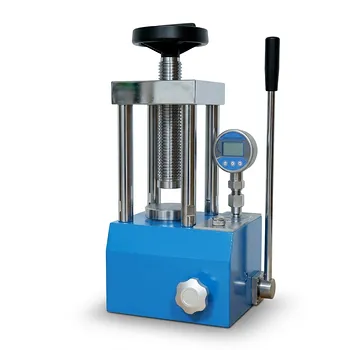
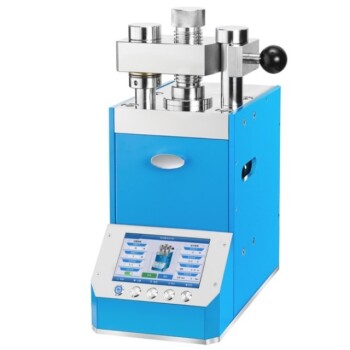
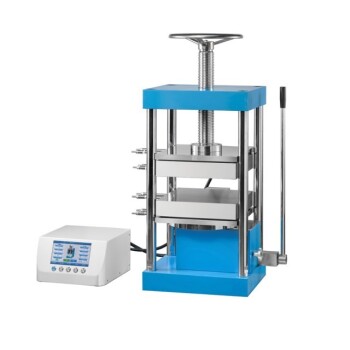
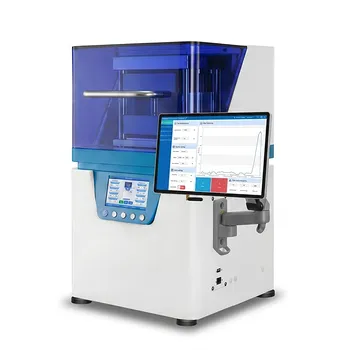
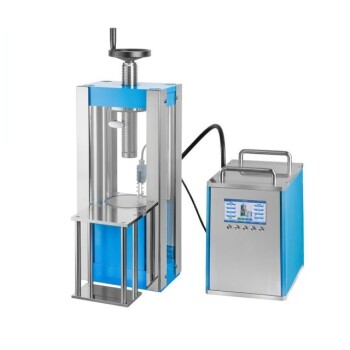
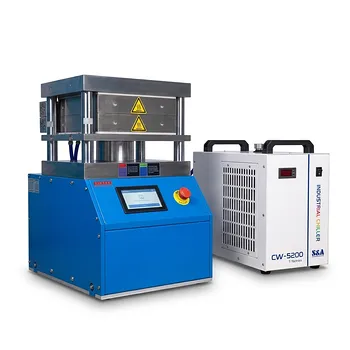
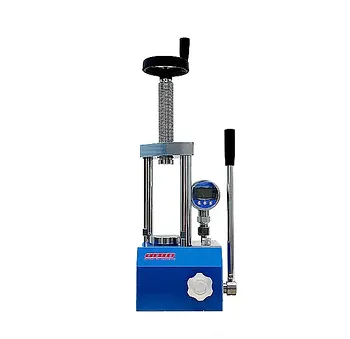
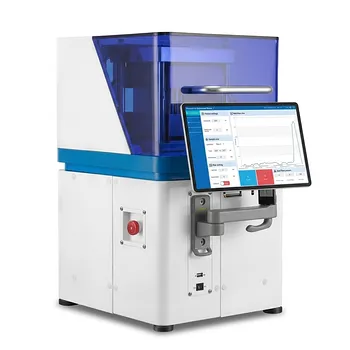
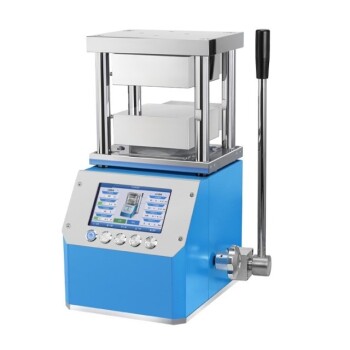
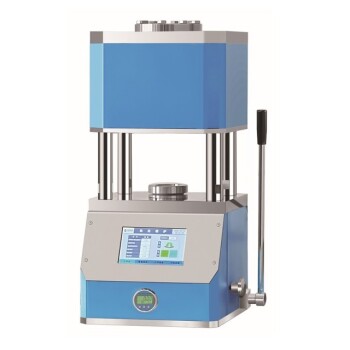
High-pressure application is the fundamental mechanical requirement for all-solid-state battery (ASSB) functionality. By using a laboratory hydraulic press, researchers compress solid electrolytes and electrode powders into a dense, integrated structure. This process eliminates internal voids and establishes the continuous solid-to-solid contact necessary for lithium-ion transport.
Core Takeaway: Because solid-state batteries lack the natural wetting action of liquid electrolytes, high mechanical pressure (ranging from 80 MPa to over 500 MPa) is required to physically "bridge" the gaps between particles, ensuring low interfacial impedance and efficient electrochemical operation.
Optimizing Physical Contact and Density
Eliminating Internal Porosity
Solid-state electrolyte particles and active materials are naturally irregular and surrounded by air gaps. A hydraulic press applies extreme force to crush these particles together, effectively eliminating internal pores and increasing the overall density of the electrolyte layer.
Promoting Mechanical Interlocking
High pressure—frequently reaching levels like 436.7 MPa—forces particles to undergo plastic deformation. This causes the solid electrolyte and electrode materials to interlock at a microscopic level, creating a single, highly dense structure that functions as a unified electrochemical cell.
Maximizing Surface Area Contact
Unlike liquid electrolytes that flow into every crevice, solids only touch at specific points. The hydraulic press forces these surfaces together to maximize the physical contact area at the solid-solid interfaces, which is the foundation for a working battery.
Establishing Ion Transport Pathways
Reducing Interfacial Impedance
The primary hurdle in ASSB performance is interfacial resistance. High pressure minimizes the physical distance between the electrolyte and the electrode layers, significantly reducing the impedance that would otherwise prevent the flow of energy.
Creating Continuous Ion Channels
By ensuring tight solid-to-solid contact, the press establishes continuous ion transport channels. These pathways allow lithium ions to move rapidly across grain boundaries and interfaces without encountering the "dead zones" common in poorly compressed cells.
Enhancing Grain Boundary Conductivity
In sulfide-based electrolytes specifically, pressures near 375 MPa are used to reduce grain boundary resistance. The force ensures that the boundaries between individual crystalline grains are sufficiently tight to allow for efficient lithium-ion transmission.
Understanding the Trade-offs
The Risk of Excessive Pressure
While high pressure is beneficial, exceeding the material's structural limits can lead to internal short circuits. For instance, extreme pressure can cause the lithium metal anode to "creep" or deform excessively, potentially penetrating the solid electrolyte layer.
Pressure Uniformity vs. Total Force
Applying high pressure effectively requires high-precision control rather than brute force alone. If the pressure is not perfectly uniform across the pellet surface, it creates "electrochemical dead zones" where ions cannot flow, leading to localized stress and reduced cycle life.
Implementing Pressure Strategies in Battery Assembly
Recommendations for Effective Assembly
The amount of pressure required depends heavily on the materials used and the desired battery performance.
- If your primary focus is maximizing ion conductivity: Use pressures at the higher end of the spectrum (e.g., 375 MPa to 500+ MPa) to ensure the highest possible density and minimal grain boundary resistance.
- If your primary focus is preventing anode degradation: Opt for a lower, more precise pressure (e.g., 80 MPa to 125 MPa) to maintain interface contact without forcing the lithium metal into the electrolyte structure.
- If your primary focus is long-term cycle life: Prioritize a hydraulic press that provides constant and uniform pressure throughout the duration of the compression cycle to avoid mechanical stresses.
By masterfully controlling mechanical force, researchers can overcome the inherent physical limitations of solid-state materials and unlock the true potential of next-generation energy storage.
Summary Table:
| Mechanism | Pressure Impact | Key Benefit |
|---|---|---|
| Void Elimination | Crushes air gaps and pores | Increases overall layer density |
| Interfacial Contact | Forces plastic deformation | Maximizes solid-to-solid surface area |
| Ion Transport | Reduces grain boundary resistance | Creates continuous lithium-ion channels |
| Mechanical Control | Precise force application | Prevents internal shorts and material creep |
Elevate Your Battery Research with KINTEK Precision
Achieving the perfect solid-to-solid interface requires more than just force—it requires precision. KINTEK specializes in comprehensive laboratory pressing solutions tailored for next-generation energy storage.
Whether you need manual, automatic, heated, multifunctional, or glovebox-compatible models, or advanced cold and warm isostatic presses, our equipment is designed to deliver the uniform pressure essential for high-performance battery assembly.
Contact us today to find the perfect pressing solution for your lab!
References
- Shih-Ping Cho, Wei‐Ren Liu. Interface Engineering of NCMA Cathodes with LATP Coatings for High-Performance Solid-State Lithium Batteries. DOI: 10.3390/nano15141057
This article is also based on technical information from Kintek Solution Knowledge Base .
Related Products
- Laboratory Hydraulic Press Lab Pellet Press Button Battery Press
- Laboratory Hydraulic Press 2T Lab Pellet Press for KBR FTIR
- Laboratory Hydraulic Press Lab Pellet Press Machine for Glove Box
- 24T 30T 60T Heated Hydraulic Lab Press Machine with Hot Plates for Laboratory
- Automatic Laboratory Hydraulic Press Lab Pellet Press Machine
People Also Ask
- How is a laboratory hydraulic press used for HAP composite gels? Master Mineral Substrate Standardization
- What role does a laboratory hydraulic press play in reaction pellets? Optimizing Lunar Soil and Metal Fuel Density
- What role does a laboratory hydraulic press play in the preparation of piezoelectric ceramic discs for DC-PG? | KINTEK
- What role does a laboratory hydraulic press play in the assembly of all-solid-state battery test cells? Expert Guide
- Why is a laboratory hydraulic press required for PBAT and PLA sample preparation? Achieve Flawless Characterization