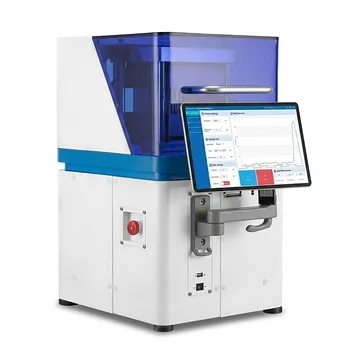
Precision in laboratory pellet pressing is the cornerstone of scalable biomass energy R&D. A laboratory press provides the technical bridge between raw biomass characterization and industrial-scale production by simulating the high-pressure, high-temperature environment of an extruder on a controlled, micro-scale. It allows researchers to isolate specific variables—such as pressure and temperature—to optimize the mechanical strength and energy density of wood pellets before committing to costly large-scale trials.
The laboratory press serves as a high-fidelity simulator that translates material science into industrial data, allowing for the precise optimization of lignin bonding and biomass formulations. By providing a controlled environment for batch testing, it ensures that wood pellet production is both scientifically rigorous and economically viable.
Simulating Industrial Environments on a Micro-Scale
Precise Control of Extrusion Variables
A laboratory press functions as a vital research tool by replicating the working environment of industrial-scale pellet extruders. It allows researchers to manipulate specific parameters, including pressure, temperature, and dwell time, with a level of precision impossible to achieve in a full-scale factory setting.
Optimizing Mechanical Strength and Density
The press applies high pressure to biomass powder to create pellets with specific mechanical strength and density. This process significantly increases the energy density of the biomass, making it easier to handle, transport, and utilize in energy applications.
Bridging the Gap to Industrialization
By generating precise pressure control data, laboratory presses support the transition to large-scale industrialization. This data allows engineers to predict how materials will behave in massive pellet mills, reducing the risk of equipment failure or poor product quality.
Optimizing Material Science and Formulations
Lignin Softening and Fiber Bonding
Wood pellets rely on lignin, a natural polymer, to act as a binder. The laboratory press allows researchers to study how different temperatures affect lignin softening and the resulting fiber bonding strength on a microscopic level.
Formulation Screening and Biomass Ratios
Researchers use the press for formulation screening, testing various ratios of biomass types (e.g., hardwood vs. softwood or agricultural residues). This determines the most efficient and cost-effective mixture for producing durable, high-quality pellets.
Creating a Uniform Internal Structure
The compression process ensures close contact between biomass particles, creating a uniform internal structure. This consistency is critical for experiments like microwave carbothermic reduction, where uniform density prevents uneven heating and enhances reaction efficiency.
Enhancing Analytical Accuracy and Repeatability
Support for Advanced Materials Characterization
Pellets created in a lab press are essential for spectroscopic analysis, including IR (Infrared) and X-ray spectroscopy (XRF). A compact press can produce the KBr pellets required for high-resolution analysis of a material's chemical composition.
Ensuring High Reproducibility
The robust construction of modern presses, featuring heavy-duty hydraulic systems and high-tensile steel, ensures high reproducibility. This means results can be consistently duplicated across different batches, which is a requirement for peer-reviewed research and quality control.
Versatility in Experimental Applications
Beyond simple pelletizing, these presses are used for preparing samples for SEM (Scanning Electron Microscopy) and XRD (X-ray Diffraction). This versatility makes them indispensable for studying the physical and chemical changes that occur during the densification of biomass.
Understanding the Trade-offs
Batch vs. Continuous Processing Limitations
While a laboratory press is excellent for isolating variables, it is typically a batch process, whereas industrial mills are continuous. This can lead to differences in friction and heat accumulation that researchers must account for when scaling up.
Material Preparation Requirements
The effectiveness of a laboratory press is highly dependent on sample preparation, such as particle size and moisture content. If the raw biomass is not ground to a consistent size before pressing, the resulting pellets may show artificial weaknesses that do not reflect the material's true potential.
Scale of Throughput
Laboratory presses are designed for precision over volume. While they are efficient for screening dozens of formulations, they cannot provide the throughput needed for pilot-scale combustion testing, which requires larger quantities of material.
How to Apply This to Your Project
Selecting the right approach for your laboratory press depends on your specific research objectives and the stage of your development cycle.
- If your primary focus is industrial scale-up: Use the press to generate a "pressure-density" curve for your specific biomass formulation to determine the minimum energy required for a durable pellet.
- If your primary focus is chemical characterization: Prioritize a press capable of producing high-clarity KBr pellets for FTIR or XRF analysis to ensure your chemical data is free from physical artifacts.
- If your primary focus is material innovation: Use the press to experiment with various binders and moisture levels in small batches to find the optimal recipe for new types of agricultural waste.
By integrating a laboratory press into your R&D workflow, you transform biomass from a variable raw material into a standardized, high-performance fuel source.
Summary Table:
| Research Pillar | Technical Advantage | Impact on R&D |
|---|---|---|
| Variable Control | Precise pressure, temp, & dwell time | Replicates industrial-scale extrusion |
| Material Science | Lignin softening & fiber bonding analysis | Increases energy density & mechanical strength |
| Analytical Accuracy | KBr pellet & sample prep for XRF/SEM | Ensures high reproducibility & chemical data |
| Scalability | Pressure-density curve generation | Reduces risk in industrial-scale transition |
Elevate Your Research Precision with KINTEK
Transform your biomass and material science R&D into scalable industrial success. KINTEK specializes in comprehensive laboratory pressing solutions tailored for high-fidelity simulations. Whether you are optimizing wood pellet formulations or conducting advanced battery research, our diverse range of equipment—including manual, automatic, heated, multifunctional, and glovebox-compatible models, as well as cold and warm isostatic presses—delivers the accuracy your projects demand.
Maximize your lab's efficiency and ensure scientifically rigorous results. Contact KINTEK today to find the perfect pressing solution!
References
- Jun S. Lee, S. Sokhansanj. Variability in Physical Properties of Logging and Sawmill Residues for Making Wood Pellets. DOI: 10.3390/pr12010181
This article is also based on technical information from Kintek Solution Knowledge Base .
Related Products
- Laboratory Hydraulic Press Lab Pellet Press Button Battery Press
- Laboratory Hydraulic Press Lab Pellet Press Machine for Glove Box
- Laboratory Split Manual Heated Hydraulic Press Machine with Hot Plates
- Laboratory Hydraulic Pellet Press for XRF KBR FTIR Lab Press
- Laboratory Hydraulic Split Electric Lab Pellet Press
People Also Ask
- How is a laboratory hydraulic press used for HAP composite gels? Master Mineral Substrate Standardization
- What role does a laboratory hydraulic press play in reaction pellets? Optimizing Lunar Soil and Metal Fuel Density
- What role does a laboratory hydraulic press play in the preparation of piezoelectric ceramic discs for DC-PG? | KINTEK
- Why is a laboratory hydraulic press required for PBAT and PLA sample preparation? Achieve Flawless Characterization
- What role does a laboratory hydraulic press play in the assembly of all-solid-state battery test cells? Expert Guide