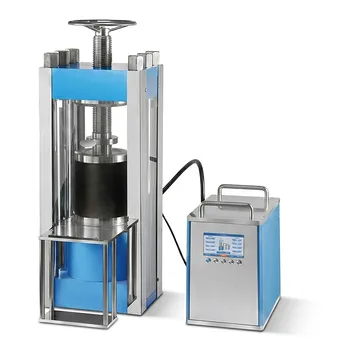
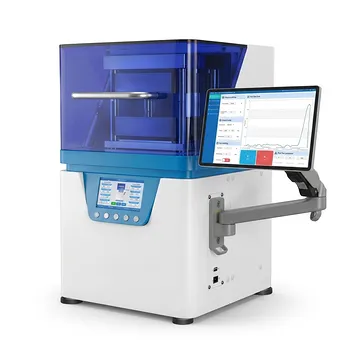
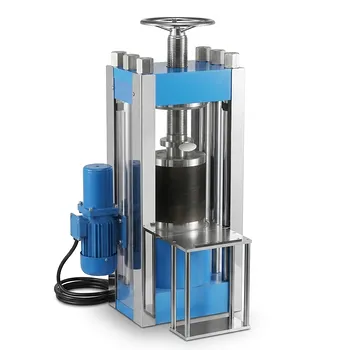
To achieve effective surface densification of Scots pine, a laboratory single-layer heated press provides two critical physical conditions: synchronized high temperatures and high mechanical pressure. Specifically, the equipment maintains precise temperatures reaching up to 250 °C and continuous pressure around 2.9 MPa. These conditions work in tandem to soften the wood's internal chemical matrix and physically compress its cellular structure to increase density.
Core Takeaway: The laboratory press acts as a precision instrument that uses high heat to plasticize the wood's lignin and hemicellulose while applying mechanical load to permanently collapse surface cells, resulting in a harder, more durable material.
Thermal Softening: The Role of Temperature
Reaching the Plastic State
The primary function of high temperature, often set at 250 °C, is to trigger a phase change in the wood's natural polymers. This heat softens the hemicellulose and lignin matrix, transitioning the wood from a rigid state into a plastic state.
Preparing the Cellular Structure
Without sufficient heat, Scots pine is prone to fracturing under pressure. The heat ensures the cell walls are pliable enough to undergo lateral compression without catastrophic structural failure.
Mechanical Transformation: The Role of Pressure
Driving Lateral Compression
Once the wood is softened, the press applies a continuous mechanical load of approximately 2.9 MPa. This force drives the lateral compression of wood cells, squeezing the empty spaces (lumens) within the surface layer.
Increasing Surface Density
The result of this sustained pressure is a significant increase in surface density. By reducing the volume of the wood while maintaining its mass, the press creates a much harder and more wear-resistant exterior.
Precision and Uniformity: Defining the Quality
Controlling Densification Depth
The laboratory press allows for precise pressure control, which is the primary factor in determining how deep the densification extends. Consistent pressure ensures that the densified layer is uniform across the entire surface of the Scots pine.
The Importance of Temperature Uniformity
Temperature uniformity across the heating plates is critical for a consistent finish. If the heat is uneven, the plasticization of the lignin will be irregular, leading to inconsistent surface hardness and potential warping.
Understanding the Trade-offs
Risk of Thermal Degradation
While high temperatures are necessary for plasticization, exceeding the optimal threshold can cause thermal degradation. If the wood is held at 250 °C for too long, it may lose structural integrity or undergo undesirable color changes.
Elastic Recovery and Spring-back
If the pressure and heat are not maintained for the correct duration, the wood may experience "spring-back." This occurs when the internal stresses are not fully relieved, causing the wood to partially return to its original thickness after the pressure is released.
How to Apply This to Your Project
When utilizing a single-layer heated press for wood modification, your settings should align with your specific material requirements.
- If your primary focus is maximum surface hardness: Prioritize reaching the full 2.9 MPa pressure while ensuring the temperature is high enough to fully plasticize the surface layer.
- If your primary focus is minimizing wood discoloration: Aim for the lower end of the effective temperature range and focus on temperature uniformity to avoid localized scorching.
- If your primary focus is depth of the densified layer: Ensure a longer dwell time under synchronized heat and pressure to allow the thermal energy to penetrate deeper into the Scots pine.
By precisely balancing high thermal energy with sustained mechanical force, the laboratory press transforms Scots pine into a high-performance material with enhanced surface characteristics.
Summary Table:
| Physical Condition | Operational Parameter | Primary Effect on Scots Pine |
|---|---|---|
| High Temperature | Up to 250 °C | Plasticizes lignin and hemicellulose for structural softening. |
| Mechanical Pressure | ~2.9 MPa | Drives lateral cell compression and permanently increases density. |
| Pressure Control | Precision Adjustable | Regulates the specific depth of the densified surface layer. |
| Thermal Uniformity | Consistent Across Plates | Ensures uniform hardness and prevents warping or scorching. |
Elevate Your Material Research with KINTEK Precision
Achieving the perfect densification of Scots pine requires more than just heat—it requires synchronized precision. At KINTEK, we specialize in comprehensive laboratory pressing solutions tailored for advanced material science and battery research.
Whether you need manual, automatic, heated, or multifunctional models, our equipment is designed to provide the uniformity and control necessary to prevent thermal degradation and elastic spring-back. Our range includes:
- Heated & Multifunctional Presses: Perfect for wood modification and polymer research.
- Glovebox-Compatible Models: Ideal for sensitive battery material testing.
- Cold and Warm Isostatic Presses: Widely applied in high-density material processing.
Ready to optimize your lab’s efficiency and output quality? Contact our experts today to find your perfect pressing solution!
References
- Benedikt Neyses, Dick Sandberg. <i>In-situ</i> penetration of ionic liquids during surface densification of Scots pine. DOI: 10.1515/hf-2020-0146
This article is also based on technical information from Kintek Solution Knowledge Base .
Related Products
- 24T 30T 60T Heated Hydraulic Lab Press Machine with Hot Plates for Laboratory
- Automatic Heated Hydraulic Press Machine with Hot Plates for Laboratory
- Automatic High Temperature Heated Hydraulic Press Machine with Heated Plates for Lab
- Cylindrical Lab Electric Heating Press Mold for Laboratory Use
- Automatic Heated Hydraulic Lab Press Machine 200x200 Plate Size for Battery Research and Materials Science
People Also Ask
- Function of a Laboratory Hydraulic Press with Heated Platens in SSE? Enhance Battery Density & Conductivity
- Why is a laboratory hydraulic press with heating plates required for PLA/TEC films? Achieve Precise Sample Integrity
- What role does a laboratory heated hydraulic press play in LTCC? Essential for High-Density Ceramic Lamination
- Why reduce load when applying composite strengthening tabs? Protect Specimen Integrity and Data Accuracy
- Why is a laboratory heated hydraulic press utilized during the lamination stage of NASICON green tapes?