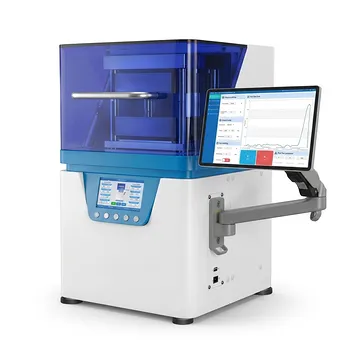
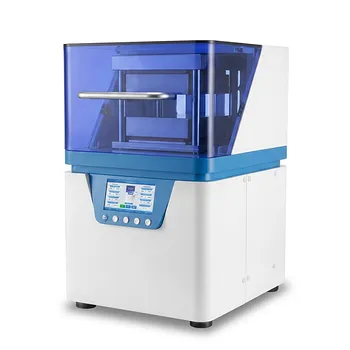
The laboratory hydraulic hot press is the decisive factor in transforming raw PLLA blends into high-performance biocomposite films. By applying synchronized heat and mechanical pressure, the press melt-presses pre-formed materials to ensure the full integration of the PLLA matrix with additives like PHB and CNC. This process is essential for eliminating internal defects, such as solvent residues and micropores, while precisely regulating the film’s crystallinity and thickness.
The laboratory hydraulic hot press serves as the bridge between raw chemical mixtures and standardized functional materials. It refines the internal structure of the biocomposite, ensuring that the resulting film is dense, uniform, and physically optimized for rigorous mechanical testing.
Optimizing Internal Material Integrity
Elimination of Solvent Residues and Micropores
In many preparation workflows, the hot press acts as a secondary processing stage following solvent casting. The application of high temperatures—often exceeding 170°C—effectively vaporizes and expels any remaining solvent residues that could compromise the film's purity. Simultaneously, high hydraulic pressure collapses internal micropores and air gaps, creating a high-density structure.
Facilitating Molecular Integration
The press forces the PLLA, plasticizers, and reinforcements (such as CNC) into a molten state where they can achieve full integration. Physical pressure ensures the melt flows uniformly, allowing different polymer phases to blend at the molecular level. This deep integration is what enables the composite to act as a single, cohesive material rather than a loose mixture of components.
Removal of Internal Voids
By using progressive pressurization—often scaling from 50 to 150 bar—the equipment ensures the molten material completely fills the mold cavity. This stage is critical for removing trapped air bubbles that would otherwise act as stress concentrators. The result is a defect-free internal structure that significantly improves the reliability of subsequent thermal and mechanical data.
Regulating Physical and Mechanical Properties
Controlling Crystallinity Behavior
The programmed heating and cooling cycles of a hydraulic press are vital for regulating the crystallization behavior of the PLLA matrix. By managing the rate at which the film cools, researchers can dictate the ratio of crystalline to amorphous regions. This control directly influences the final film's mechanical strength, barrier properties, and optical clarity.
Ensuring Dimensional Uniformity
Precision molding allows for the production of films with minimal thickness deviation, often targeting specific benchmarks like 0.15 mm or 100 µm. Maintaining a uniform cross-section is mandatory for complying with ASTM standards for tensile and flexural testing. Without this precision, variations in thickness would lead to inconsistent stress distribution and inaccurate performance data.
Enhancing Surface Quality and Ductility
The combination of high-pressure molding and smooth release sheets results in films with superior surface quality. This process is particularly important for achieving high-elongation mechanical properties, as it ensures the polymer chains are properly oriented and packed. A smooth, dense surface also minimizes the risk of premature failure during physical handling or environmental exposure.
Understanding the Trade-offs
Thermal Degradation vs. Flowability
While high temperatures are necessary to ensure the polymer melt flows and fills the mold, excessive heat can lead to thermal degradation of the PLLA chains. Researchers must balance the need for low viscosity with the risk of reducing the molecular weight of the polymer. Precise temperature compensation is required to maintain this narrow processing window.
Pressure Intensity and Material Stress
Applying extreme pressure (e.g., 400 bar) ensures a dense film but can also induce internal residual stresses if not managed correctly. If the pressure is released too quickly or if the cooling is uneven, the film may warp or become brittle. Progressive pressurization and controlled cooling stages are necessary to mitigate these structural risks.
Making the Right Choice for Your Goal
To achieve the best results with a laboratory hydraulic hot press, the processing parameters must align with your specific research or production objectives.
- If your primary focus is mechanical reliability: Prioritize progressive pressurization and long pressure-holding stages to ensure the total elimination of internal voids and air bubbles.
- If your primary focus is crystallinity control: Focus on the programmable cooling cycles, as the rate of temperature decrease is the primary driver of the polymer's crystalline structure.
- If your primary focus is standardized testing: Utilize precision-machined molds and constant pressure to ensure minimal thickness deviation and compliance with ASTM dimensional requirements.
By mastering the synchronized thermal and mechanical actions of the hot press, you ensure that your PLLA biocomposite films transition from experimental mixtures to high-quality, reproducible engineering materials.
Summary Table:
| Key Role | Impact on PLLA Biocomposite Film | Critical Control Factor |
|---|---|---|
| Defect Elimination | Vaporizes solvent residues and collapses internal micropores. | High Temperature (>170°C) & Pressure |
| Molecular Integration | Ensures deep blending of PLLA matrix with additives like CNC. | Molten state flow & uniform force |
| Crystallinity Control | Dictates mechanical strength, barrier properties, and clarity. | Programmed cooling rate cycles |
| Dimensional Uniformity | Ensures consistent thickness (e.g., 0.15mm) for ASTM compliance. | Precision molds & constant pressure |
Elevate Your Biocomposite Research with KINTEK Precision
Achieving high-performance PLLA films requires uncompromising control over thermal and mechanical variables. KINTEK specializes in comprehensive laboratory pressing solutions designed to bridge the gap between raw mixtures and standardized engineering materials.
Whether your work involves PLLA biocomposites or advanced battery research, we offer a versatile range of equipment to meet your specific needs:
- Manual & Automatic Heated Presses for precise film molding.
- Multifunctional & Glovebox-Compatible Models for sensitive environments.
- Cold & Warm Isostatic Presses for specialized material density requirements.
Ensure your research yields reproducible, defect-free results with industry-leading technology.
Contact KINTEK today to find the ideal pressing solution for your lab!
References
- Ahmed Mohamed El‐Hadi. Increase the elongation at break of poly (lactic acid) composites for use in food packaging films. DOI: 10.1038/srep46767
This article is also based on technical information from Kintek Solution Knowledge Base .
Related Products
- 24T 30T 60T Heated Hydraulic Lab Press Machine with Hot Plates for Laboratory
- Automatic Large Format Laboratory Heated Hydraulic Press 400x400mm Plate Capacity
- Automatic Heated Hydraulic Lab Press 120x120mm Plate Fully Automated Material Research Press
- Automatic Heated Hydraulic Press Machine with Hot Plates for Laboratory
- Automatic Hydraulic Hot Press with Large Plate and Precision Temperature Control for Advanced Material Sample Preparation and Industrial Research
People Also Ask
- Why is a laboratory heated hydraulic press essential for PHB films? Achieve Flawless Material Characterization
- Why reduce load when applying composite strengthening tabs? Protect Specimen Integrity and Data Accuracy
- Function of a Laboratory Hydraulic Press with Heated Platens in SSE? Enhance Battery Density & Conductivity
- Why is a laboratory heated hydraulic press utilized during the lamination stage of NASICON green tapes?
- What role does a laboratory heated hydraulic press play in LTCC? Essential for High-Density Ceramic Lamination