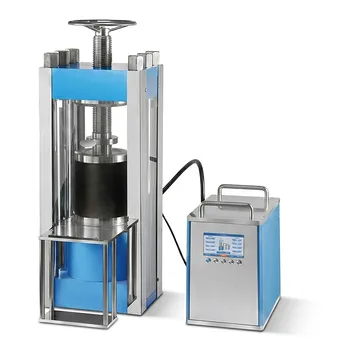
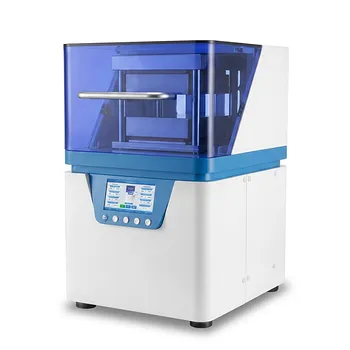
A laboratory heated platen press acts as the critical catalyst that transforms raw cottonseed meal from a loose protein-based mixture into a high-performance adhesive bond. By simultaneously applying precise thermal energy and mechanical force, the press facilitates the chemical curing and physical penetration necessary to join wood specimens into a single, structural unit.
The laboratory heated platen press provides the controlled environment required for thermal denaturation and mechanical interlocking, ensuring that cottonseed meal adhesives transition from a liquid or powder state into a robust, cross-linked solid.
Catalyzing the Chemical Transformation
Thermal Denaturation of Proteins
The primary role of the press is to provide the heat—often around 130 °C to 150 °C—required to denature the protein components within the cottonseed meal. This heat causes the complex protein chains to unfold, exposing reactive functional groups that were previously tucked away inside the molecular structure.
Activating Cross-Linking Reactions
Once the proteins are unfolded, the sustained temperature triggers chemical cross-linking. If cross-linking agents are present, the press provides the activation energy needed for these agents to form covalent bonds with the protein side chains, creating a water-resistant and rigid adhesive matrix.
Driving Molecular Flow
Under the heat of the platens, the protein-based adhesive reaches a state of plasticization. This allows the adhesive to flow evenly across the wood surface, ensuring maximum contact at the molecular level before the curing reaction locks the structure in place.
Engineering the Physical Interface
Creating Mechanical Interlocking
The press applies a specific unit pressure, such as 2 MPa, to force the adhesive deep into the wood fiber voids and cell lumens. This creates a "hook and eye" effect known as mechanical interlocking, which significantly increases the shear strength of the resulting joint.
Eliminating Internal Air Voids
High-pressure application ensures that internal air pockets and bubbles are expelled from the bond line. Removing these voids is essential for creating a dense, continuous glue line that can effectively distribute mechanical stress across the wood specimens.
Optimizing Wood Surface Contact
Wood is rarely perfectly flat at a microscopic level. The compressive force of the platen press overcomes surface irregularities, bringing the wood fibers into intimate contact with the adhesive to ensure chemical bonds can form across the entire interface.
Ensuring Specimen Standardization
Achieving Uniform Thickness
Precise control over the platen gap allows researchers to produce specimens with stable geometric dimensions. This uniformity is critical for standardized mechanical testing, as variations in bond line thickness can lead to inconsistent data.
Simulating Industrial Conditions
The laboratory press allows professionals to replicate the high-temperature and high-pressure environments found in industrial plywood or CLT (Cross-Laminated Timber) manufacturing. This simulation is vital for evaluating how cottonseed meal adhesives will perform in real-world production cycles.
Densification of the Bond Line
In some experiments, the press is used to achieve thermomechanical densification, where the wood cell walls near the bond line are softened and collapsed. This increases the local density of the wood, providing a stronger "foundation" for the adhesive to anchor into.
Understanding the Trade-offs
Risk of Thermal Degradation
While heat is necessary for curing, excessive temperatures or prolonged press times can lead to the thermal degradation of both the protein adhesive and the wood fibers. This can embrittle the bond, leading to a loss of fracture toughness and premature failure.
Over-Penetration and Starved Joints
If the applied pressure is too high relative to the adhesive's viscosity, the cottonseed meal may be forced too deeply into the wood. This results in a "starved joint," where insufficient adhesive remains at the interface to create a continuous bond.
Internal Stress and Springback
Rapidly releasing pressure before the adhesive has fully cooled or cured can lead to internal stresses. If the wood cells were significantly compressed, they may attempt to "spring back," potentially rupturing the newly formed adhesive bonds if they have not yet reached full strength.
How to Apply This to Your Project
Recommendations for Success
- If your primary focus is maximum bond strength: Prioritize the balance between pressure and viscosity to ensure deep penetration without creating a starved joint.
- If your primary focus is water resistance: Ensure the platen temperature is high enough to fully trigger the cross-linking reactions between the protein and the resin.
- If your primary focus is wood densification: Utilize higher pressures (up to 10 MPa) and temperatures (150 °C+) to plasticize the wood cell walls during the bonding cycle.
- If your primary focus is standardized testing: Use a metal mold or fixed spacers within the press to guarantee a uniform specimen thickness across all samples.
By mastering the precise synchronization of heat and pressure, you can unlock the full structural potential of sustainable, protein-based adhesives.
Summary Table:
| Key Role | Physical/Chemical Mechanism | Research Outcome |
|---|---|---|
| Thermal Catalyst | Protein denaturation & cross-linking activation | High-strength, water-resistant bonds |
| Mechanical Force | Adhesive penetration into wood fiber voids | Robust mechanical interlocking |
| Gap Control | Precise platen spacing and pressure settings | Uniform dimensions & standardized data |
| Densification | Thermomechanical collapse of wood cell walls | Enhanced local density and anchors |
Maximize Your Research Precision with KINTEK Press Solutions
To unlock the full potential of protein-based adhesives and advanced material bonding, you need the right tools. KINTEK specializes in comprehensive laboratory pressing solutions designed to meet the rigorous demands of material science and battery research.
From manual and automatic models to advanced heated, multifunctional, and glovebox-compatible presses, we provide the control you need for consistent, industrial-grade results. Our expertise extends to cold and warm isostatic presses, ensuring your lab is equipped for any challenge.
Ready to elevate your lab's performance? Contact Our Material Solutions Experts Today to find the perfect press for your specific research needs!
References
- Zhongqi He, Joseph Uknalis. Effects of Particle Size on the Morphology and Water- and Thermo-Resistance of Washed Cottonseed Meal-Based Wood Adhesives. DOI: 10.3390/polym9120675
This article is also based on technical information from Kintek Solution Knowledge Base .
Related Products
- 24T 30T 60T Heated Hydraulic Lab Press Machine with Hot Plates for Laboratory
- Automatic Heated Hydraulic Lab Press Machine 200x200 Plate Size for Battery Research and Materials Science
- Automatic High Temperature Heated Hydraulic Press Machine with Heated Plates for Lab
- Automatic Heated Hydraulic Press Machine with Hot Plates for Laboratory
- Automatic Heated Hydraulic Press Machine with Heated Plates for Laboratory
People Also Ask
- Function of a Laboratory Hydraulic Press with Heated Platens in SSE? Enhance Battery Density & Conductivity
- Why is a laboratory hydraulic press with heating plates required for PLA/TEC films? Achieve Precise Sample Integrity
- What role does a laboratory heated hydraulic press play in LTCC? Essential for High-Density Ceramic Lamination
- Why reduce load when applying composite strengthening tabs? Protect Specimen Integrity and Data Accuracy
- What is the critical role of a laboratory heated hydraulic press? Mastering PVC Sample Prep for Testing