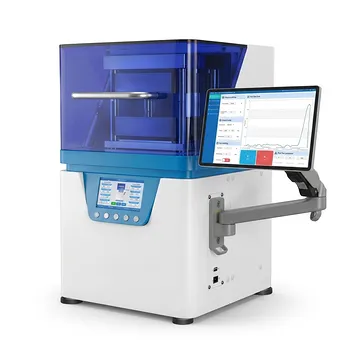
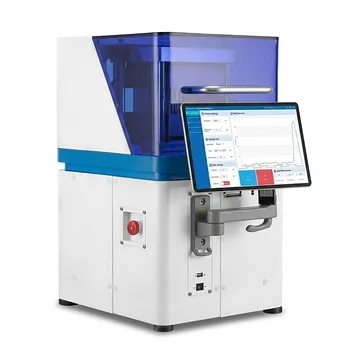
Precision simulation and control are the primary functions of a laboratory hydraulic press when determining optimal unit pressure. By providing a highly regulated environment—typically between 2 MPa and 3 MPa—the press allows researchers to observe how specific pressures influence particleboard density and surface characteristics. This data is essential for identifying the exact pressure required to accelerate surface particle compression and achieve the desired mechanical properties in the final product.
A laboratory hydraulic press serves as a high-fidelity simulator that identifies the "sweet spot" of unit pressure where particle density, internal bond strength, and surface hardness are maximized without compromising material integrity or energy efficiency.
Mapping the Vertical Density Profile
Influencing Surface Hardness
The laboratory press enables researchers to study how unit pressure moves the maximum density zone closer to the board's surface. Higher unit pressures accelerate the compression of surface particles, which is critical for enhancing the board’s load-bearing capacity. By testing various pressure levels, technicians can determine the exact force needed to create a hard, durable exterior.
Achieving Target Thickness and Density
Precisely controlled pressures, sometimes reaching up to 70 bar, allow the press to compact loose mats into solid boards of predefined dimensions. This mechanical compaction reduces internal voids and establishes the physical structural foundation of the board. The laboratory environment ensures that these density targets are repeatable and consistent before moving to full-scale production.
Managing Mat Integrity and Bonding
The Role of Air Expulsion
During the pre-pressing stage, the hydraulic press applies vertical pressure at room temperature to expel air from within the mat. This increases the initial contact area between wood particles and prevents the mat from cracking or delaminating. If air is not correctly managed during this phase, it can be suddenly expelled during high-temperature pressing, causing structural failure.
Facilitating Chemical and Physical Bonds
The press provides the high, uniform pressure necessary to force fibers into close alignment, promoting physical interlocking. Simultaneously, the pressure works in tandem with heat (often up to 200°C) to trigger the chemical curing of resins like urea-formaldehyde. This dual action determines the internal bond strength and modulus of rupture, which are key indicators of a board's quality.
Understanding the Trade-offs
Balancing Pressure and Material Damage
While increasing unit pressure generally improves density and strength, there is a point of diminishing returns. Excessive pressure can crush wood fibers or poppy straw fragments, potentially weakening the internal structure rather than strengthening it. Finding the optimal pressure requires balancing the need for compaction with the preservation of the raw material's inherent mechanical properties.
Pressure vs. Energy Consumption
Higher pressures require more energy and more robust machinery, which increases operational costs. Laboratory testing identifies the minimum effective pressure required to meet industrial standards. This prevents manufacturers from wasting energy on excessive force that does not provide a proportional increase in board quality.
How to Apply This to Your Manufacturing Process
To determine the optimal unit pressure for your specific material and adhesive combination, consider the following goals:
- If your primary focus is surface durability: Use the laboratory press to test pressures at the higher end of the 2-3 MPa range to shift the density profile toward the outer layers.
- If your primary focus is preventing delamination: Focus on the pre-pressing phase to ensure air is fully expelled at room temperature before applying heat.
- If your primary focus is maximizing internal bond strength: Coordinate pressing time with high-pressure levels to ensure the resin cures while fibers are in maximum physical contact.
- If your primary focus is working with non-traditional fibers (e.g., coconut or straw): Use the press to establish a unique pressure-to-density curve, as these materials often require different compaction forces than standard wood sawdust.
By utilizing a laboratory hydraulic press to isolate these variables, you can transition from experimental batches to industrial production with total confidence in your structural integrity.
Summary Table:
| Key Factor | Function of Laboratory Press | Impact on Particleboard Quality |
|---|---|---|
| Pressure Simulation | Regulates pressure between 2 MPa - 3 MPa | Determines optimal density & surface hardness |
| Density Profiling | Targets specific vertical density zones | Enhances load-bearing capacity & durability |
| Pre-pressing | Expels air at room temperature | Prevents internal cracking and delamination |
| Chemical Curing | Combines heat (up to 200°C) and pressure | Maximizes internal bond strength & resin efficiency |
| Material Safety | Identifies the threshold for fiber damage | Preserves mechanical properties while saving energy |
Elevate Your Research Precision with KINTEK
Maximize your material performance and manufacturing efficiency with KINTEK’s advanced laboratory pressing solutions. Whether you are determining the optimal pressure for wood composites or pioneering new frontiers in battery research, our comprehensive range of equipment—including manual, automatic, heated, multifunctional, and glovebox-compatible models, as well as cold and warm isostatic presses—is engineered to deliver unmatched accuracy.
Ready to find the perfect 'sweet spot' for your production process? Contact KINTEK today to explore how our specialized pressing technology can transform your laboratory outcomes!
References
- Agnieszka Laskowska. Characteristics of the Pressing Process and Density Profile of MUPF-Bonded Particleboards Produced from Waste Plywood. DOI: 10.3390/ma17040850
This article is also based on technical information from Kintek Solution Knowledge Base .
Related Products
- Laboratory Hydraulic Press Lab Pellet Press Machine for Glove Box
- Laboratory Hydraulic Press 2T Lab Pellet Press for KBR FTIR
- 24T 30T 60T Heated Hydraulic Lab Press Machine with Hot Plates for Laboratory
- Laboratory Hydraulic Press Lab Pellet Press Button Battery Press
- Laboratory Hydraulic Pellet Press for XRF KBR FTIR Lab Press
People Also Ask
- How does a laboratory hydraulic press contribute to the preparation of Li3-3xScxSb samples? Optimize Ionic Conductivity
- What is the function of a laboratory hydraulic press in FT-IR of curcumin-coated MWCNTs? Achieve Optical Clarity.
- Why is a laboratory hydraulic press required for compression molding boron-siloxane? Solve High-Loading Density Challenges
- What role does a laboratory hydraulic press play in the preparation of piezoelectric ceramic discs for DC-PG? | KINTEK
- What role does a laboratory hydraulic press play in reaction pellets? Optimizing Lunar Soil and Metal Fuel Density