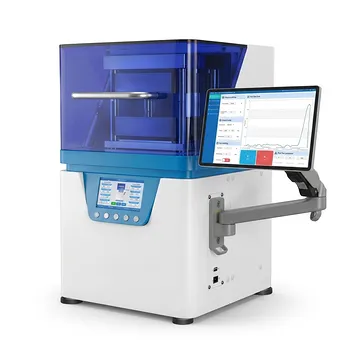
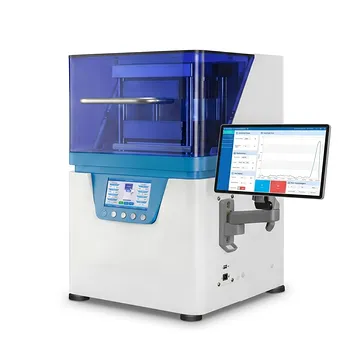
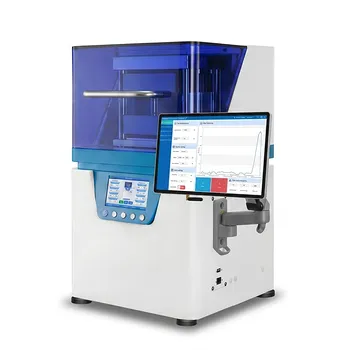
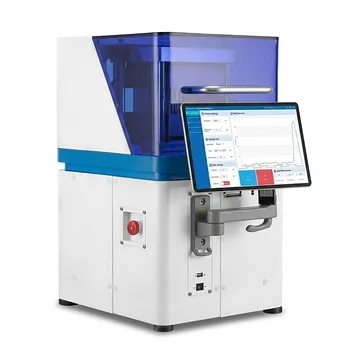
In the fabrication of Microbial Fuel Cell (MFC) electrodes, the laboratory hydraulic press serves as the mechanical bridge between raw composite coatings and functional conductive surfaces. It provides the precise, uniform pressure required to fuse active materials like carbon nanotubes (CNT) and chitosan onto carbon paper substrates, eliminating micro-voids that would otherwise cause electrode failure.
The laboratory hydraulic press is essential for transforming loose composite coatings into high-performance electrodes by maximizing interfacial contact and minimizing interfacial impedance. Through controlled compaction, it ensures structural integrity and electrical continuity, which are critical for sustaining power output in MFC environments.
Enhancing Electrical Connectivity and Electronic Transport
Eliminating Internal Micro-Voids
The primary function of the hydraulic press is the removal of micro-voids within the composite layer. By applying high-precision pressure, the press forces active materials like CNTs into the valleys of the carbon paper substrate.
This process creates a dense, uniform solid contact layer that prevents the loss of electronic connectivity during operation. Without this step, pockets of air or gaps would act as insulators, severely hampering the flow of electrons from the microbes to the current collector.
Reducing Interfacial Impedance
High interfacial impedance is a major bottleneck in MFC performance, often leading to energy loss during high-current discharge. The hydraulic press significantly lowers this resistance by ensuring "tight" contact between the active substance, the binders (chitosan), and the conductive agents.
This mechanical compaction creates a robust conductive network where electronic transport impedance is minimized. This allows the electrode to maintain conductive consistency, which is vital for the long-term stability of the cell.
Structural Transformation and Material Consolidation
Optimizing Compaction Density
Using the press for calendering (compaction) allows researchers to control the compaction density of the electrode layer. For materials like CNT/chitosan composites, finding the ideal density is a balancing act between physical thickness and mechanical strength.
Precise pressure control enables the formation of thin sheets of a predetermined density. This ensures that the effective utilization of the electric double layer is maximized, which supports more efficient chemical-to-electrical energy conversion.
Ensuring Mechanical Stability
Microbial Fuel Cell electrodes must withstand being submerged in liquid media while supporting biofilm growth and electron transfer. The hydraulic press enhances the mechanical structural stability of the material by tightly anchoring the composite to the carbon paper or fiber cloth.
This permanent physical bond prevents the active layer from delaminating or "flaking off" during high-current cycles. A stable substrate is required for the subsequent application of membranes or additional catalyst layers.
Understanding the Trade-offs
High Pressure vs. Reduced Porosity
While high pressure minimizes contact resistance, it can also lead to over-compaction, which significantly reduces porosity. In MFCs, a certain level of porosity is required for mass transport and providing space for the microbial community to interact with the electrode.
Mechanical Integrity vs. Ion Transport
Excessive compaction may collapse the hierarchical porous structure necessary for ion transport. If the pressure is too high, the electrode becomes a solid block that limits the diffusion of substrates to the biofilm, potentially decreasing the overall power density despite having high conductivity.
How to Apply This to Your Project
Maximizing Electrode Efficiency
To achieve the best results with your laboratory hydraulic press, consider the specific requirements of your MFC design. Each material combination responds differently to the compression process.
- If your primary focus is maximizing electronic conductivity: Apply higher levels of constant pressure (e.g., 5 MPa or more) to ensure a dense, low-impedance interface between the CNTs and the substrate.
- If your primary focus is promoting biofilm surface area: Utilize moderate pressure to consolidate the material while maintaining a specific level of porosity for microbial infiltration and ion transport.
- If your primary focus is long-term durability: Focus on the uniform distribution of pressure during the pressing cycle to prevent uneven density, which can cause local structural failure over time.
By mastering the precise application of pressure, you can transition from inconsistent lab samples to high-performance, stable composite electrodes.
Summary Table:
| Key Function | Technical Benefit | MFC Performance Impact |
|---|---|---|
| Void Elimination | Removes internal micro-voids | Ensures continuous electronic flow |
| Impedance Reduction | Minimizes interfacial resistance | Increases power output stability |
| Compaction Control | Optimizes electrode density | Enhances chemical-to-electrical conversion |
| Mechanical Anchoring | Stabilizes composite substrates | Prevents delamination during operation |
Elevate Your MFC Research with KINTEK Precision Pressing
At KINTEK, we understand that the integrity of your composite electrodes defines the success of your Microbial Fuel Cell research. We specialize in comprehensive laboratory pressing solutions tailored for high-performance material science, offering:
- Manual & Automatic Presses for versatile lab requirements.
- Heated & Multifunctional Models to optimize binder fusion and material consolidation.
- Glovebox-Compatible Systems specifically designed for oxygen-sensitive battery research.
- Cold & Warm Isostatic Presses (CIP/WIP) for achieving uniform density in complex materials.
Our equipment provides the precise, uniform pressure control required to minimize interfacial impedance and maximize the structural stability of your electrodes. Contact KINTEK today to find the ideal pressing solution for your application and accelerate your energy research results!
References
- Andrea Pantusin, Carlos Banchón. Producción de bioenergía a partir de lodo residual en celdas microbianas combustibles. DOI: 10.33448/rsd-v14i4.48596
This article is also based on technical information from Kintek Solution Knowledge Base .
Related Products
- Laboratory Hydraulic Press Lab Pellet Press Machine for Glove Box
- Laboratory Hydraulic Press 2T Lab Pellet Press for KBR FTIR
- 24T 30T 60T Heated Hydraulic Lab Press Machine with Hot Plates for Laboratory
- Laboratory Hydraulic Press Lab Pellet Press Button Battery Press
- Laboratory Hydraulic Pellet Press for XRF KBR FTIR Lab Press
People Also Ask
- How does a laboratory hydraulic press contribute to the preparation of Li3-3xScxSb samples? Optimize Ionic Conductivity
- What is the function of a laboratory hydraulic press in FT-IR of curcumin-coated MWCNTs? Achieve Optical Clarity.
- Why is a laboratory hydraulic press required for compression molding boron-siloxane? Solve High-Loading Density Challenges
- What role does a laboratory hydraulic press play in the preparation of piezoelectric ceramic discs for DC-PG? | KINTEK
- What role does a laboratory hydraulic press play in reaction pellets? Optimizing Lunar Soil and Metal Fuel Density