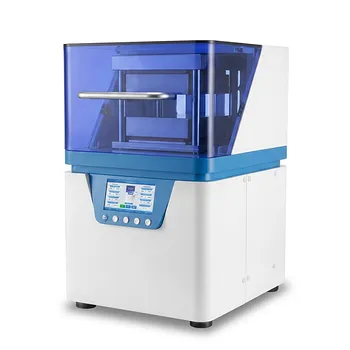
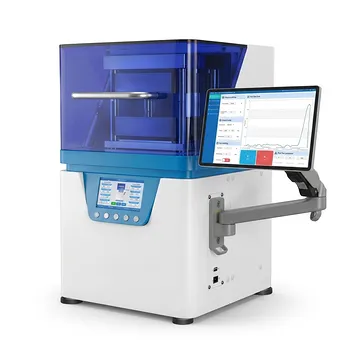
The laboratory manual heating press is the primary instrument used to transform raw Polylactic Acid (PLA) into standardized, high-quality scaffold precursors. By applying precisely controlled thermal energy and mechanical pressure, the press converts granules or powders into dense, 2D sheets with uniform thickness (typically 220–250 µm). This process creates a flat, structurally stable substrate that is essential for advanced fabrication stages, such as femtosecond laser microstructuring.
The manual heating press ensures the production of bubble-free, dimensionally accurate PLA sheets by utilizing multi-stage pressure and venting cycles. This foundational step is critical for achieving the consistent density and mechanical integrity required for successful tissue engineering scaffolds.
Achieving Structural and Dimensional Precision
Controlled Thermal Melting
The press heats PLA raw materials to specific temperatures, typically between 180°C and 210°C, to reach a fluid state. This precise temperature regulation ensures sufficient flow of the polymer without causing thermal degradation.
Uniform Thickness and Density
By applying constant, high pressure—often reaching 10 MPa or several tons—the press forces the melt to spread evenly within a mold. This results in precursors with a highly consistent thickness (such as 0.2 mm) and a flat surface, which are necessary for predictable laser processing.
Multi-Stage Venting Cycles
A critical role of the manual press is the execution of venting cycles to eliminate internal air bubbles and voids. This multi-stage pressure application ensures the resulting PLA sheet is dense and free of structural defects that could compromise the scaffold's performance.
Enhancing Material Properties for Scaffolding
Encapsulation of Functional Additives
In specialized scaffold preparation, the press ensures that blowing agents or salt particles are tightly and uniformly encapsulated within the PLA matrix. This tight packing is vital for creating a uniform cellular structure or specific porosity levels during subsequent expansion or leaching stages.
Preservation of Polymer Morphology
Unlike injection molding, which subjects materials to high shear stress, a heating press utilizes static pressure. This gentler approach preserves the original morphology of additives or granules, ensuring that the mechanical properties of the composite can be accurately assessed.
Control of Crystallinity
The combination of high-temperature molding and rapid quenching (cooling) can be used to inhibit the static crystallization of PLA. This results in amorphous specimens that provide a standardized baseline for mechanical testing and further micro-patterning.
Understanding the Trade-offs
Manual Variability and Throughput
While the manual press offers exceptional control for research, it is subject to operator variability in pressure application speed and timing. Additionally, it is a low-throughput method compared to automated industrial processes, making it better suited for prototype development than mass production.
Thermal Lag and Edge Effects
Achieving perfect thermal equilibrium across the entire platen surface can be challenging. Users must be aware of potential edge effects, where the thickness or crystallinity of the PLA sheet may vary slightly at the perimeter of the mold compared to the center.
How to Apply This to Your Project
Optimizing Your Pressing Protocol
To achieve the best results for your PLA scaffold precursors, align your press settings with your specific fabrication goals.
- If your primary focus is laser microstructuring: Prioritize achieving a perfectly flat surface and a thickness of 220–250 µm to maintain the laser's focal point.
- If your primary focus is porosity control: Use the press to apply high mechanical loads to salt particle beds or blowing agents to ensure maximum packing density before the expansion phase.
- If your primary focus is mechanical characterization: Focus on venting cycles and bubble elimination to ensure that test results reflect the material properties rather than internal structural flaws.
By mastering the balance of heat, pressure, and timing, you transform raw PLA into a high-performance foundation for sophisticated tissue engineering applications.
Summary Table:
| Key Function | Processing Benefit | Typical Parameter |
|---|---|---|
| Thermal Melting | Precise polymer flow without degradation | 180°C – 210°C |
| Pressure Application | Uniform 2D sheet thickness and density | 10 MPa (220–250 µm) |
| Venting Cycles | Eliminates internal air bubbles and voids | Multi-stage pulsing |
| Static Pressure | Preserves additive morphology & crystallinity | Low shear stress |
| Quenching | Produces amorphous baseline specimens | Rapid cooling step |
Optimize Your Material Research with KINTEK
From preparing high-precision PLA scaffold precursors to advancing battery research, KINTEK specializes in comprehensive laboratory pressing solutions. We offer a wide range of manual, automatic, heated, multifunctional, and glovebox-compatible models, as well as cold and warm isostatic presses designed for high-performance applications.
How KINTEK Empowers Your Lab:
- Unmatched Precision: Achieve the exact thickness and structural integrity required for laser microstructuring and mechanical testing.
- Versatile Solutions: Whether you are working with delicate polymers or dense battery electrodes, our presses provide the specific thermal and mechanical control you need.
- Research-Grade Quality: Our equipment is built to eliminate structural defects like air voids, ensuring your results reflect true material properties.
Expertly transform your raw materials into high-performance foundations—contact KINTEK today to find the ideal pressing solution for your laboratory!
References
- Liliya Angelova, Ivan Buchvarov. Design of femtosecond microstructured poly lactic acid temporal scaffolds coated with hydroxyapatite by pulse laser deposition method for bone tissue regeneration. DOI: 10.1007/s11082-024-06500-w
This article is also based on technical information from Kintek Solution Knowledge Base .
Related Products
- Manual Heated Hydraulic Lab Press with Integrated Hot Plates Hydraulic Press Machine
- Laboratory Manual Heated Hydraulic Press Machine with Hot Plates
- Laboratory Split Manual Heated Hydraulic Press Machine with Hot Plates
- Automatic Hydraulic Heat Press Machine with Multi Stage Programmable Control and Integrated Water Cooling Plate Size 180x180mm
- Automatic Heated Hydraulic Lab Press with Programmable Touch Screen Controls and Precision Temperature Regulation
People Also Ask
- Why is a laboratory hydraulic press with heating plates required for PLA/TEC films? Achieve Precise Sample Integrity
- Why is a manual hydraulic heated lab press essential for compleximer materials? Unlock Advanced Material Synthesis
- Function of a Laboratory Hydraulic Press with Heated Platens in SSE? Enhance Battery Density & Conductivity
- What role does a lab manual hydraulic press play in Li9B19S33 ionic conductivity? Optimize Pellet Characterization
- What are the main benefits of performing proper maintenance on a heated lab press? Ensure Accuracy & Safety