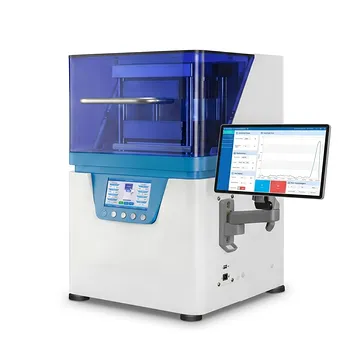
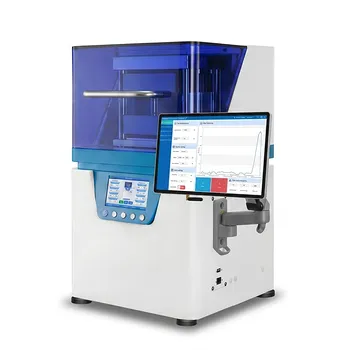
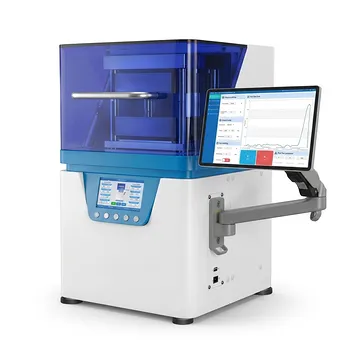
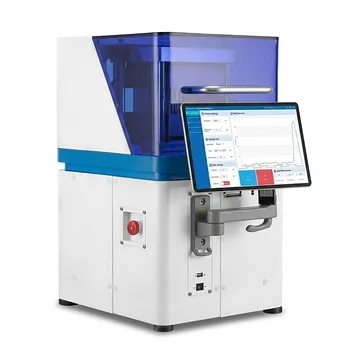
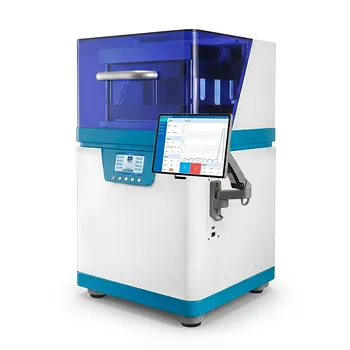
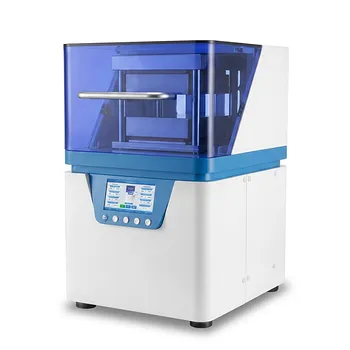
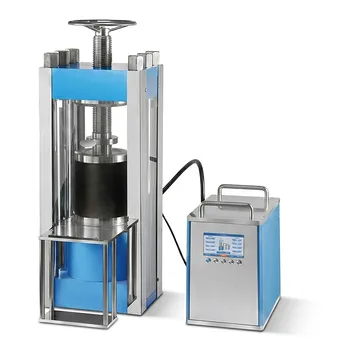
The necessity of a heated laboratory hydraulic press lies in its ability to standardize the physical characteristics of fertilizer tablets. By providing simultaneous control over temperature (60–90 °C) and compressive force, the press transforms composite materials into tablets with uniform dimensions and density. This precision ensures a consistent surface area-to-volume ratio, which is the fundamental driver for predictable and repeatable nutrient release rates.
Core Takeaway: A heated laboratory hydraulic press is essential because it eliminates physical variables—such as irregular density, air pockets, and dimensional shifts—ensuring that the speed of nutrient release is determined by the fertilizer's chemical formulation rather than structural inconsistencies.
Standardizing Geometric Precision for Data Reliability
The Role of Surface Area-to-Volume Ratio
In controlled-release fertilizers, the rate at which nutrients enter the soil is directly dictated by the amount of surface area exposed to moisture. A laboratory press ensures that every tablet has standardized dimensions, such as a diameter of 9.4 mm and a thickness of 1.3 mm.
Without this level of geometric consistency, experimental data becomes unreliable. Variations in size between samples would lead to different release speeds, making it impossible to determine if a performance change is due to the fertilizer's chemistry or its physical shape.
Ensuring Repeatability in Experimental Trials
Consistency is the cornerstone of scientific evaluation. By using compression molding, researchers can produce hundreds of identical samples that behave predictably under testing conditions.
This repeatability allows for the accurate modeling of nutrient release mechanisms over time. It ensures that the "slow-release" effect is a result of intentional design rather than accidental variations in tablet thickness.
The Synergistic Effect of Heat and Pressure
Enabling Molecular Bonding and Physical Interlocking
The application of controlled heat (ranging from 60–90 °C) is critical for softening composite materials, such as bio-polymers or wax-based binders. This softening allows particles to bond more effectively through physical interlocking and intermolecular forces when pressure is applied.
Pressure alone may not be sufficient to create a stable tablet from dry or high-melting-point materials. The thermal energy provided by the heated plates facilitates a "hot-press" forming process that creates a more cohesive internal structure.
Eliminating Structural Defects
High-precision pressure control is vital for removing residual air trapped within the powder or granules. If air is not effectively eliminated, the tablets may suffer from lamination or capping, where the tablet splits into horizontal layers.
Uniform pressure ensures the tablet reaches an appropriate hardness and structural integrity. This prevents the tablets from crumbling during handling, storage, or application in the field.
Regulating Release Kinetics through Compaction
Controlling Pressing Density
The nutrient release rate is not just about the outer surface; it is also about the internal porosity of the tablet. By precisely adjusting the hydraulic pressure, researchers can control the pressing density of the composite.
A higher pressing density results in a more compact internal structure, which limits the rate at which water can penetrate the tablet. This provides an additional lever for engineers to "tune" the fertilizer for specific agricultural needs.
Maximizing Active Ingredient Stability
The physical stability provided by a hydraulic press protects the active ingredients within the fertilizer. By compacting the material into a dense, uniform mass, the internal nutrients are shielded from premature environmental degradation.
This stability ensures that the fertilizer maintains its integrity throughout its shelf life. It also ensures that the release begins only when the tablet is deployed in the soil and exposed to moisture.
Understanding the Trade-offs and Limitations
Risks of Thermal Degradation
While heat is necessary for forming the tablet, excessive temperatures can be detrimental. If the press exceeds the thermal stability threshold of the mineral nutrients or organic binders, it may cause chemical degradation, reducing the fertilizer's efficacy.
The Balancing Act of Pressure
Applying too much pressure can lead to tablets that are excessively brittle or dense, potentially stalling the nutrient release entirely. Conversely, insufficient pressure results in a low-density tablet that may dissolve too rapidly, failing the "controlled-release" objective.
Material Compatibility
Not all fertilizer composites respond identicaly to heat and pressure. Variations in compressibility (often measured by Carr’s Index) mean that each specific formulation requires a unique "recipe" of temperature and force to achieve the desired mechanical strength.
How to Optimize Pressing for Your Specific Goal
To achieve the best results when producing laboratory-grade fertilizer tablets, you must align your press settings with your primary performance metric.
- If your primary focus is consistent release data: Prioritize geometric standardization by using high-precision molds to maintain exact diameter and thickness across all samples.
- If your primary focus is long-term slow release: Focus on maximizing pressing density through higher hydraulic force to minimize internal porosity and slow moisture infiltration.
- If your primary focus is physical durability: Increase the forming temperature toward the higher end of the 60–90 °C range to ensure superior physical interlocking and eliminate air gaps.
By mastering the balance of heat and pressure, you turn a simple compression task into a sophisticated method for controlling agricultural chemistry.
Summary Table:
| Key Feature | Impact on Fertilizer Tablets | Critical Parameters |
|---|---|---|
| Geometric Precision | Standardizes surface area-to-volume ratio for data reliability | Diameter & Thickness |
| Controlled Heat | Softens binders to enable molecular bonding & interlocking | 60–90 °C |
| High Pressure | Eliminates air pockets and prevents structural defects (lamination) | Compressive Force |
| Density Control | Regulates internal porosity to tune nutrient release kinetics | Pressing Density |
Elevate Your Research with Precision Pressing Solutions
Achieving consistent results in agricultural science or battery research requires equipment that eliminates variables. KINTEK specializes in comprehensive laboratory pressing solutions tailored to your specific material needs.
Our range includes:
- Manual & Automatic Models: For flexibility and high-throughput repeatability.
- Heated & Multifunctional Presses: Perfect for creating controlled-release composites and advanced material bonding.
- Isostatic Presses (Cold & Warm): For uniform density in complex shapes.
- Glovebox-Compatible Systems: For sensitive materials requiring controlled environments.
Don't let structural inconsistencies compromise your data. Contact KINTEK today to find the ideal press for your laboratory and ensure your nutrient release or battery performance studies are built on a foundation of precision.
References
- Siwen Bi, Margaret J. Sobkowicz. Degradable Controlled Release Fertilizer Composite Prepared via Extrusion: Fabrication, Characterization, and Release Mechanisms. DOI: 10.3390/polym12020301
This article is also based on technical information from Kintek Solution Knowledge Base .
Related Products
- 24T 30T 60T Heated Hydraulic Lab Press Machine with Hot Plates for Laboratory
- Automatic Heated Hydraulic Lab Press with Programmable Touch Screen Controls and Precision Temperature Regulation
- Automatic Heated Hydraulic Lab Press 120x120mm Plate Fully Automated Material Research Press
- Automatic Large Format Laboratory Heated Hydraulic Press 400x400mm Plate Capacity
- Automatic Heated Hydraulic Press Machine with Hot Plates for Laboratory
People Also Ask
- Function of a Laboratory Hydraulic Press with Heated Platens in SSE? Enhance Battery Density & Conductivity
- Why is a laboratory hydraulic press with heating plates required for PLA/TEC films? Achieve Precise Sample Integrity
- What role does a laboratory heated hydraulic press play in LTCC? Essential for High-Density Ceramic Lamination
- Why Use a Laboratory Heated Hydraulic Press for SSAB CCM? Optimize Solid-State Battery Interfacial Bonding
- Why is a laboratory heated hydraulic press utilized during the lamination stage of NASICON green tapes?