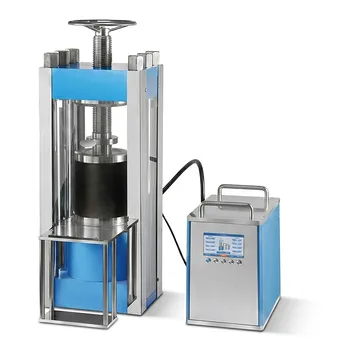
A high-pressure electric heated laboratory press is essential for SBR sample preparation because it provides the precise thermal and mechanical energy required to transform raw compounds into stable, dense sheets. By maintaining a constant environment of high temperature (typically 160°C) and high pressure (up to 100 bar), the press eliminates internal air bubbles and ensures the rubber achieves a dense microstructure. This level of control is critical for creating specimens with regular geometric dimensions, which are foundational for accurate electron beam irradiation and mechanical testing.
The laboratory press serves as the bridge between raw chemical compounds and standardized test specimens by facilitating the vulcanization process. It ensures structural homogeneity and dimensional accuracy, which are the primary requirements for reliable and repeatable material science data.
Structural Transformation and Molecular Integrity
Initiating the Vulcanization Reaction
The primary role of the heated press is to provide the thermal energy needed to trigger chemical cross-linking. At temperatures around 160°C, the rubber compound shifts from a linear molecular structure into a three-dimensional network. This transformation is what gives Styrene-Butadiene Rubber (SBR) its final physical properties, such as elasticity and tensile strength.
Eliminating Internal Defects
High pressure is used to force the rubber compound to flow into every corner of the mold cavity, effectively excluding air. This process eliminates internal air pockets or "voids" that would otherwise act as failure points during testing. Without this pressure, the resulting sample would be porous and physically inconsistent.
Creating a Uniform Cross-linked Network
The synchronization of heat and pressure ensures that the vulcanization reaction occurs uniformly throughout the specimen. Consistent pressure drives the bidirectional cross-linking reaction, ensuring the final cross-link density is stable from the center of the sheet to its edges.
Achieving Geometric and Physical Precision
Ensuring Dimensional Stability
Precision-forming equipment allows researchers to produce sheets of standard thickness and high flatness. This geometric regularity is vital because variations in thickness can skew the results of subsequent physical property tests, such as hardness or tensile strength.
Optimizing Material Density
The combination of high pressure (often reaching 200 kg/cm²) and heat ensures the rubber compound reaches its maximum potential density. A dense microstructure is a prerequisite for any study involving the material's internal architecture, particularly when evaluating its structural response to external stressors.
Facilitating Radiation Uniformity
For samples destined for electron beam irradiation, uniformity is paramount. The laboratory press creates a specimen with such high structural consistency that the radiation can penetrate the material evenly, ensuring the resulting data reflects the material's properties rather than flaws in the sample preparation.
Understanding the Trade-offs
Temperature and Pressure Calibration
While high heat is necessary for vulcanization, excessive temperature or prolonged exposure can lead to thermal degradation of the SBR polymer chains. Finding the balance between "scorch" (premature vulcanization) and a full cure requires precise timing and temperature control.
Pressure Distribution Limitations
Even in high-end presses, the distribution of pressure across the platen may not be perfectly uniform if the equipment is poorly maintained. This can lead to thickness gradients across a single rubber sheet, which compromises the reliability of samples cut from different sections of the same batch.
Mold Design Constraints
The quality of the final SBR sample is heavily dependent on the mold used within the press. If the mold does not allow for proper flash escape (excess material) while maintaining pressure, the internal density of the rubber may be inconsistent, leading to "knit lines" or structural weak spots.
Applying This to Your Project
Recommendations for Sample Preparation
To achieve the best results with SBR samples, your approach should be dictated by your end-testing goals.
- If your primary focus is mechanical property evaluation: Prioritize the consistency of the vulcanization degree by ensuring the press maintains a perfectly constant temperature for the entire duration of the cure.
- If your primary focus is electron beam irradiation: Focus on eliminating internal air bubbles by utilizing the highest recommended pressure settings to ensure a flawless internal microstructure.
- If your primary focus is standardized comparison: Use high-precision molds to ensure standard thickness and flatness, which guarantees that your results are repeatable across different batches.
The laboratory press is not merely a heater; it is a precision instrument that determines the ultimate structural viability of your SBR specimens.
Summary Table:
| Process Component | SBR Sample Requirement | Technical Benefit |
|---|---|---|
| Temperature Control | Constant ~160°C | Triggers cross-linking for elastic molecular networks |
| High Pressure | Up to 100 bar / 200 kg/cm² | Eliminates internal air bubbles and ensures high density |
| Precision Molding | Flat Platen Heating | Guarantees dimensional stability and standard thickness |
| Uniformity | Synchronized Heat/Pressure | Ensures consistent cross-link density across the specimen |
Optimize Your Material Science Research with KINTEK
Achieve the structural homogeneity and dimensional accuracy your testing demands. KINTEK specializes in comprehensive laboratory pressing solutions, offering manual, automatic, heated, multifunctional, and glovebox-compatible models, as well as cold and warm isostatic presses widely applied in battery research and polymer development.
Ready to enhance your lab's efficiency and specimen reliability?
References
- Katarzyna S. Bandzierz, Dariusz M. Bieliński. Effect of electron beam irradiation on structure and properties of styrene-butadiene rubber. DOI: 10.1016/j.radphyschem.2017.12.011
This article is also based on technical information from Kintek Solution Knowledge Base .
Related Products
- Warm Isostatic Press for Solid State Battery Research Warm Isostatic Press
- Cylindrical Lab Electric Heating Press Mold for Laboratory Use
- Automatic High Temperature Heated Hydraulic Press Machine with Heated Plates for Lab
- Special Shape Lab Press Mold for Laboratory Applications
- Automatic Heated Hydraulic Press Machine with Hot Plates for Laboratory
People Also Ask
- Why must composite cathodes be sealed in vacuum lamination bags for WIP? Ensure Battery Stability and Density
- How do sacrificial volume materials (SVM) maintain microchannels in isostatic pressing? Ensure Structural Integrity
- What is the function of elastic molds in warm isostatic pressing? Achieve Uniform Density in Composite Particles
- What is the role of the flexible material in warm isostatic pressing? Key to Uniform Density & Precision
- What is the significance of temperature control in Warm Isostatic Pressing? Unlock Uniform Densification and Process Stability