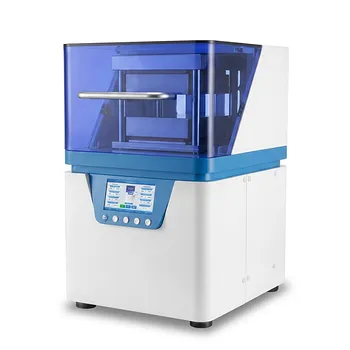
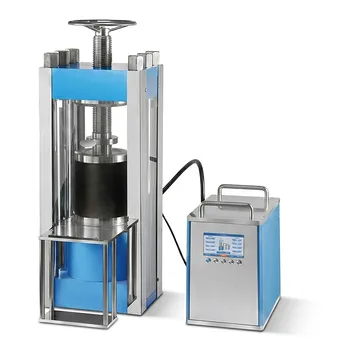
The vulcanization of fluoroelastomer (FKM) compounds requires a high-pressure heated platen press to simultaneously trigger chemical cross-linking and ensure physical densification. This specific combination of thermal energy and mechanical force is necessary to transform raw, plastic-like rubber into a durable, high-performance elastomer. Without the synchronized application of heat and pressure, the material would fail to fill mold geometries, retain internal air pockets, and lack the structural integrity required for industrial applications.
Core Takeaway: A high-pressure heated press is the essential catalyst for fluoroelastomer production because it provides the heat to initiate the three-dimensional cross-linking network while applying the pressure necessary to eliminate voids and guarantee dimensional precision.
The Synergy of Heat and Mechanical Pressure
Triggering the Chemical Cross-Linking Reaction
Fluoroelastomer compounds are chemically inert until thermal energy is introduced to activate vulcanizing agents, such as peroxides. The heated platens provide a stable environment, typically between 160°C and 180°C, which breaks down these agents to begin the formation of a three-dimensional molecular network.
Facilitating Material Flow and Mold Filling
At high temperatures, the polymer matrix reaches a molten state, allowing it to flow into complex mold cavities and redistribute around nanofillers. High mechanical pressure (often 10 to 15 MPa) is required to overcome the viscosity of the compound, ensuring every gap is filled and the final specimen matches the intended geometric dimensions.
Eliminating Internal Voids and Micropores
Under high pressure, internal air bubbles and gases generated during the chemical reaction are forced out or dissolved into the matrix. This "deep densification" prevents the formation of a porous, sponge-like internal structure, which is critical for maintaining high density and surface quality.
Impact on Material Performance and Integrity
Defining Basic Mechanical Properties
The initial construction of the cross-linking network happens entirely within the press, setting the foundation for the material's elasticity and strength. This pressurized environment ensures that the molecular bonds are uniform throughout the specimen, preventing weak spots that could lead to premature failure.
Enhancing Interfacial Adhesion
In nanocomposites or reinforced fluoroelastomers, high pressure facilitates the physical interlocking of the polymer matrix with fibers or nanosheets. This results in superior bonding strength and structural integrity, allowing the composite to withstand extreme mechanical stress and environmental conditions.
Maximizing Dielectric and Physical Strength
By purging the material of voids and micropores, the press significantly improves the breakdown strength and physical durability of the fluoroelastomer. A dense, void-free material is less likely to crack or fail under the high-pressure and high-temperature environments where FKM is typically utilized.
Understanding the Trade-offs and Pitfalls
The Risk of Thermal Degradation
While heat is necessary for vulcanization, excessive temperature or prolonged exposure can lead to "scorching" or thermal degradation of the polymer chains. Operators must precisely calibrate the press to balance rapid curing with the preservation of the material's chemical properties.
Pressure-Induced Flash and Material Waste
Applying excessive pressure can force material out of the mold seals, creating "flash" (excess waste) that must be manually trimmed. This not only increases production costs but can also lead to dimensional inaccuracies if the mold plates begin to deflect under the load.
Complexity of Cycle Timing
The primary vulcanization stage must be timed perfectly; removing the pressure too early can cause the material to "blow" or expand as trapped gases escape. Conversely, over-curing in the press can make the material overly brittle, reducing its effectiveness in dynamic sealing applications.
How to Optimize Your Vulcanization Process
Recommendations for Targeted Results
- If your primary focus is Dimensional Precision: Ensure your press is calibrated for uniform pressure distribution across the entire platen surface to prevent thickness variations.
- If your primary focus is High-Strength Nanocomposites: Prioritize higher pressure settings (up to 15 MPa) to ensure the polymer matrix thoroughly penetrates and bonds with nanofillers.
- If your primary focus is Surface Finish and Aesthetics: Maintain a consistent, high-temperature environment to ensure the compound reaches a low-viscosity state for smooth mold replication.
- If your primary focus is Rapid Production Throughput: Use a press with high-precision thermal controls to safely maximize temperature and reduce the cycle time without scorching the material.
By mastering the balance of synchronized heat and pressure, you ensure that every fluoroelastomer component meets the rigorous demands of high-performance engineering.
Summary Table:
| Vulcanization Element | Primary Function | Impact on FKM Performance |
|---|---|---|
| Thermal Energy (160-180°C) | Activates chemical cross-linking agents | Transforms raw rubber into a durable elastomer |
| Mechanical Pressure (10-15 MPa) | Facilitates material flow and mold filling | Ensures dimensional precision and geometric accuracy |
| Void Elimination | Purges internal air pockets and gases | Prevents porosity and enhances dielectric strength |
| Densification | Facilitates interfacial bonding with fillers | Maximizes structural integrity and mechanical stress resistance |
Elevate Your Fluoroelastomer Research with KINTEK Precision
Don't compromise on the integrity of your high-performance materials. KINTEK specializes in comprehensive laboratory pressing solutions designed to meet the rigorous demands of fluoroelastomer vulcanization and advanced battery research.
Our versatile range includes:
- Manual & Automatic Presses: For consistent, repeatable pressure application.
- Heated & Multifunctional Models: To ensure precise thermal control during cross-linking.
- Glovebox-Compatible Systems: For specialized, inert atmosphere research.
- Cold & Warm Isostatic Presses: Ideal for achieving maximum material density.
Whether you are refining FKM compounds or developing next-generation battery components, our experts are ready to help you find the ideal setup for your workflow.
Contact KINTEK Today to Optimize Your Lab Pressing Solutions!
References
- Javad Heidarian, Aziz Hassan. Improving heat aging and mechanical properties of fluoroelastomer using carbon nanotubes. DOI: 10.1515/pjct-2016-0050
This article is also based on technical information from Kintek Solution Knowledge Base .
Related Products
- Automatic High Temperature Heated Hydraulic Press Machine with Heated Plates for Lab
- Heated Hydraulic Press Machine With Heated Plates For Vacuum Box Laboratory Hot Press
- Laboratory Manual Heated Hydraulic Press Machine with Hot Plates
- Automatic Hydraulic Hot Press with Large Plate and Precision Temperature Control for Advanced Material Sample Preparation and Industrial Research
- Laboratory Split Manual Heated Hydraulic Press Machine with Hot Plates
People Also Ask
- Function of a Laboratory Hydraulic Press with Heated Platens in SSE? Enhance Battery Density & Conductivity
- What are the requirements for electrode pressing with high-viscosity ionic liquids like EMIM TFSI? Optimize Performance
- How does a laboratory heated hydraulic press facilitate PBN sample prep for WAXS? Achieve Precise X-Ray Scattering
- What are the industrial applications of heated hydraulic presses? Master Heat & Force for Precision Manufacturing
- Why is a laboratory hydraulic press with heating plates required for PLA/TEC films? Achieve Precise Sample Integrity