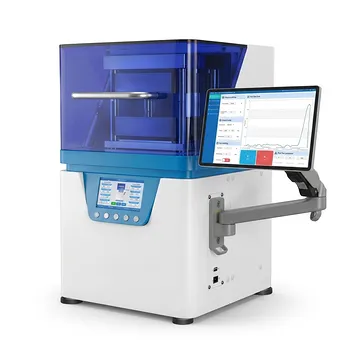
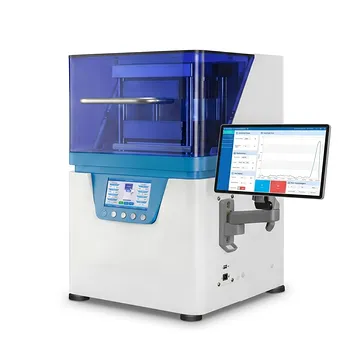
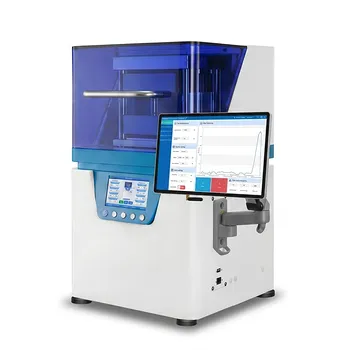
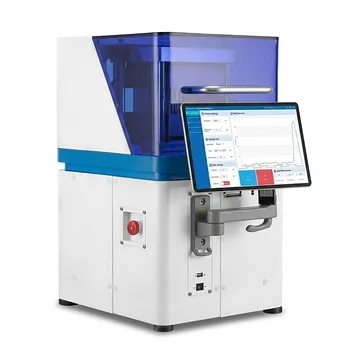
Compressed powder pellets are the standard for characterizing solid-state electrolytes. A laboratory hydraulic press is necessary to apply controlled high pressure (such as 140 atm) to transform $Pb_xSr_{1-x}SnF_4$ fluoride powders into dense, geometrically regular polycrystals. This densification is critical for reducing internal porosity and maximizing electrical contact between particles, ensuring that subsequent Electrochemical Impedance Spectroscopy (EIS) measures the material's intrinsic ionic conduction rather than air gaps or physical resistance.
Core Takeaway: Using a hydraulic press eliminates macroscopic voids and grain boundary resistance within the powder, allowing researchers to measure the true movement of ions through the $Pb_xSr_{1-x}SnF_4$ lattice instead of being hindered by poor particle-to-particle contact.
Eliminating Measurement Artifacts Through Densification
The Role of Porosity in Signal Distortion
In its loose powder form, $Pb_xSr_{1-x}SnF_4$ contains significant air gaps that act as insulators. These voids force ions to take circuitous paths or stop altogether, which artificially lowers the measured conductivity.
Maximizing Particle-to-Particle Contact
High pressure causes the fluoride particles to undergo rearrangement, fragmentation, and plastic deformation. This structural change creates a "green body" where particles are tightly interlocked, facilitating a continuous path for ion migration.
Reducing Grain Boundary Resistance
The resistance found at the junction of two particles, known as grain boundary resistance, can overshadow the bulk conductivity of the material. A hydraulic press minimizes these interfaces, ensuring the current primarily travels through the bulk material for a more accurate reading.
Ensuring Geometric and Structural Integrity
Achieving Precise Geometric Regularity
Standardized testing requires samples to have a specific thickness and diameter to calculate conductivity values like Siemens per centimeter ($S/cm$). The press utilizes precision molds to create cylindrical polycrystals with uniform dimensions, which are essential for reproducible data.
Structural Stabilization for Testing
A "green pellet" must be self-supporting and mechanically strong enough to withstand handling and electrode attachment. The uniaxial compaction provided by the press creates a dense internal structure that prevents the sample from crumbling during the electrochemical test.
Foundation for Subsequent Heat Treatment
If the material requires further sintering, the initial high-pressure molding is a prerequisite. This initial densification ensures that the subsequent high-temperature processes result in a coherent, high-density ceramic rather than a porous, fractured mass.
Understanding the Trade-offs
Risk of Material Alteration
While high pressure is necessary, excessive force can lead to lattice strain or unwanted phase transitions in fluoride materials. Researchers must balance the need for density with the risk of physically or chemically altering the $Pb_xSr_{1-x}SnF_4$ crystalline structure.
Non-Uniform Density Distribution
Uniaxial pressing (pressure from one direction) can sometimes lead to density gradients within the pellet. The edges or center of the pellet might have slightly different porosities, which can cause subtle "signal scattering" during impedance spectroscopy if not carefully managed.
How to Apply This to Your Project
Recommendations for Sample Preparation
To ensure your laboratory results are both accurate and reproducible, consider the following goals:
- If your primary focus is Intrinsic Material Properties: Use the highest pressure possible (aligned with literature, e.g., 140 atm to 400 MPa) that does not cause phase degradation to minimize grain boundary interference.
- If your primary focus is Structural Integrity: Ensure the use of precision-ground steel dies and a slow release of pressure to prevent the "capping" or cracking of the $Pb_xSr_{1-x}SnF_4$ pellet.
- If your primary focus is Comparative Analysis: Maintain a strictly consistent pressure and dwell time (the time the sample is under load) across all samples to ensure that variations in data reflect material composition rather than preparation differences.
Properly executed hydraulic pressing is the bridge between a raw synthesized powder and a scientifically valid measurement of ionic mobility.
Summary Table:
| Feature | Impact on PbxSr1-xSnF4 Testing |
|---|---|
| Densification | Minimizes internal porosity and air gaps that act as insulators. |
| Contact Optimization | Maximizes particle-to-particle contact for continuous ion migration. |
| Grain Boundary Control | Reduces interface resistance to reveal intrinsic bulk conductivity. |
| Geometric Precision | Produces uniform cylindrical pellets required for $S/cm$ calculations. |
| Mechanical Strength | Creates self-supporting "green bodies" for handling and electrode attachment. |
Unlock High-Precision Results with KINTEK Pressing Solutions
For researchers working on $Pb_xSr_{1-x}SnF_4$ and other advanced solid-state electrolytes, sample consistency is the key to breakthrough data. KINTEK specializes in high-performance laboratory pressing solutions designed to meet the rigorous demands of battery research.
Whether you need manual, automatic, heated, or multifunctional models, or specialized cold and warm isostatic presses, our equipment ensures optimal densification and geometric regularity for your samples. Our systems are also available in glovebox-compatible configurations to protect sensitive materials from atmospheric interference.
Ready to eliminate measurement artifacts and enhance your lab's efficiency? Contact KINTEK today to explore our comprehensive range of presses and find the perfect fit for your research goals!
References
- Anton Nahornyi, А. А. Омельчук. СИНТЕЗ ТА ЕЛЕКТРОПРОВІДНІСТЬ ФТОРПРОВІДНИХ ФАЗ SrSnF4 ТА PbxSr1-xSnF4. DOI: 10.15421/jchemtech.v33i1.311813
This article is also based on technical information from Kintek Solution Knowledge Base .
Related Products
- Laboratory Hydraulic Press Lab Pellet Press Machine for Glove Box
- Laboratory Hydraulic Press 2T Lab Pellet Press for KBR FTIR
- 24T 30T 60T Heated Hydraulic Lab Press Machine with Hot Plates for Laboratory
- Laboratory Hydraulic Press Lab Pellet Press Button Battery Press
- Laboratory Hydraulic Pellet Press for XRF KBR FTIR Lab Press
People Also Ask
- How does a laboratory hydraulic press contribute to the preparation of Li3-3xScxSb samples? Optimize Ionic Conductivity
- What is the function of a laboratory hydraulic press in FT-IR of curcumin-coated MWCNTs? Achieve Optical Clarity.
- Why is a laboratory hydraulic press required for compression molding boron-siloxane? Solve High-Loading Density Challenges
- What role does a laboratory hydraulic press play in the preparation of piezoelectric ceramic discs for DC-PG? | KINTEK
- What role does a laboratory hydraulic press play in reaction pellets? Optimizing Lunar Soil and Metal Fuel Density