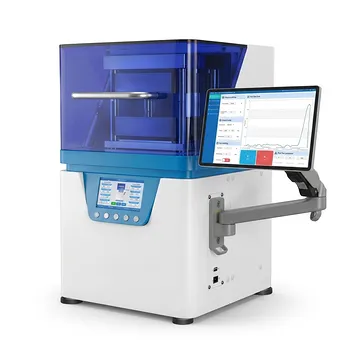
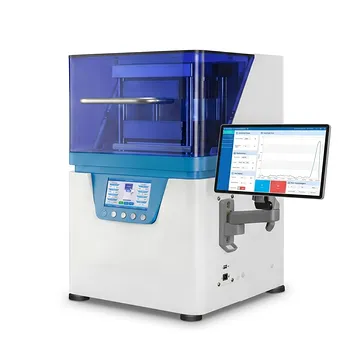
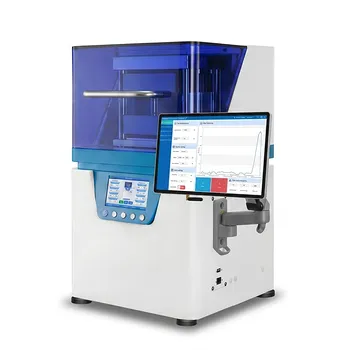
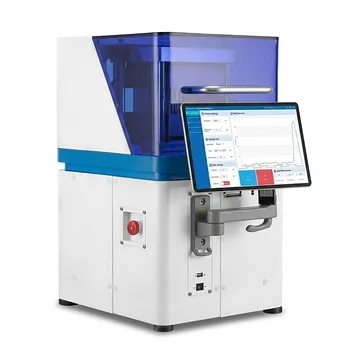
The laboratory hydraulic press is the critical instrument for creating a high-precision press-fit connection between silicon nitride ceramic samples and their steel housing. This process embeds the ceramic into a 100Cr6 steel matrix to provide essential pre-stress support and external protection. Without this precise mechanical reinforcement, the inherently brittle silicon nitride core would succumb to edge stress concentrations and crack when subjected to industrial upsetting forces reaching 1400 kN.
Core Takeaway: A laboratory hydraulic press is required to transform a brittle ceramic component into a functional test mold by mechanically pre-stressing it within a steel matrix. This assembly ensures the ceramic can withstand massive compressive loads that would otherwise cause immediate structural failure.
Managing Material Brittleness Through Pre-stressing
The Role of the Steel Matrix
Silicon nitride is chosen for its hardness and thermal properties, but its brittleness is a significant liability in high-pressure environments. By using a hydraulic press to force the ceramic into a 100Cr6 steel matrix, engineers create a constrained environment. The steel exerts constant inward pressure, which counteracts the internal tensile stresses that typically lead to ceramic fracture.
Preventing Edge Stress Concentrations
When a test mold is subjected to massive forces—up to 1400 kN—the pressure is rarely perfectly uniform. These "upsetting forces" can create localized stress at the edges of the ceramic sample. The press-fit assembly ensures that these concentrations are absorbed by the tougher steel matrix rather than the ceramic, effectively shielding the core from catastrophic cracking.
Establishing the Structural Foundation
From Loose Powder to Green Body
Beyond the final embedding, the hydraulic press is essential for the initial preparation of the silicon nitride. It applies axial pressure (typically around 20 MPa) to compress mixed powders into a "green body." This preliminary step ensures the particles are arranged correctly and possess the basic mechanical strength required for handling and subsequent sintering.
Eliminating Voids and Trapped Air
The stability of a hydraulic press allows for the gradual removal of air trapped between powder particles. By applying a consistent load—often reaching 150 kN for compaction—the press increases the number of contact points between particles. This reduces internal porosity, which is vital for achieving a dense, high-strength final product after the sintering phase.
Understanding the Trade-offs
Precision vs. Material Fatigue
While a tight press-fit is necessary for support, excessive interference during the embedding process can pre-damage the ceramic. If the hydraulic press applies force unevenly or exceeds the calculated tolerance of the steel matrix, it can introduce micro-cracks before the mold is even used. Precision control of the tonnage and alignment is therefore non-negotiable.
Cold Pressing Limitations
Using a hydraulic press for "cold-pressing" green bodies provides shape, but not final density. It is a foundational step, not a finishing one. The resulting green body is still relatively fragile and requires high-temperature liquid-phase sintering or cold isostatic pressing to achieve the full hardness associated with silicon nitride.
How to Apply This to Your Project
Making the Right Choice for Your Goal
To ensure the success of your silicon nitride test mold assembly, consider the specific stage of your process:
- If your primary focus is Final Assembly: Use the hydraulic press to achieve a high-precision press-fit into a 100Cr6 steel matrix to provide the pre-stress needed for 1400 kN loads.
- If your primary focus is Powder Preparation: Utilize the press to create green bodies at approximately 20 MPa, ensuring you have a specific diameter and thickness (e.g., 35mm x 5mm) for consistent sintering results.
- If your primary focus is Sample Standardization: Apply consistent tonnage (e.g., 150 kN) and holding times to minimize internal porosity and ensure the flatness required for accurate mechanical testing.
The laboratory hydraulic press acts as the bridge between fragile raw materials and a robust, industrial-grade testing component.
Summary Table:
| Process Stage | Key Function | Technical Benefit |
|---|---|---|
| Embedding Treatment | High-precision press-fitting | Pre-stresses brittle ceramics to resist 1400 kN loads |
| Powder Preparation | Axial compaction (20 MPa) | Creates uniform "green bodies" for sintering |
| Structural Finishing | Void & air removal (150 kN) | Minimizes porosity to ensure high-strength material density |
| Material Support | Steel matrix assembly | Shields ceramic edges from catastrophic stress concentrations |
Elevate Your Material Research with KINTEK's Precision Pressing Solutions
Achieving the perfect press-fit for silicon nitride molds requires uncompromising control and reliability. KINTEK specializes in comprehensive laboratory pressing solutions tailored for high-performance research and industrial testing.
Whether you need manual, automatic, heated, multifunctional, or glovebox-compatible models, or specialized cold and warm isostatic presses widely applied in battery research, we provide the precision tools necessary to transform brittle materials into robust testing components.
Contact our experts today to find the ideal pressing solution for your lab!
References
- Vyacheslav Goryany, Olga Myronova. Warm upsetting tests with cylindrical molybdenum and wolfram samples. DOI: 10.5937/zasmat1704498g
This article is also based on technical information from Kintek Solution Knowledge Base .
Related Products
- Laboratory Hydraulic Press Lab Pellet Press Machine for Glove Box
- Laboratory Hydraulic Press 2T Lab Pellet Press for KBR FTIR
- 24T 30T 60T Heated Hydraulic Lab Press Machine with Hot Plates for Laboratory
- Laboratory Hydraulic Press Lab Pellet Press Button Battery Press
- Laboratory Hydraulic Pellet Press for XRF KBR FTIR Lab Press
People Also Ask
- How does a laboratory hydraulic press contribute to the preparation of Li3-3xScxSb samples? Optimize Ionic Conductivity
- What is the function of a laboratory hydraulic press in FT-IR of curcumin-coated MWCNTs? Achieve Optical Clarity.
- Why is a laboratory hydraulic press required for compression molding boron-siloxane? Solve High-Loading Density Challenges
- What role does a laboratory hydraulic press play in reaction pellets? Optimizing Lunar Soil and Metal Fuel Density
- What role does a laboratory hydraulic press play in the preparation of piezoelectric ceramic discs for DC-PG? | KINTEK