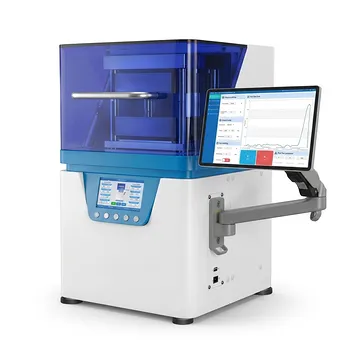
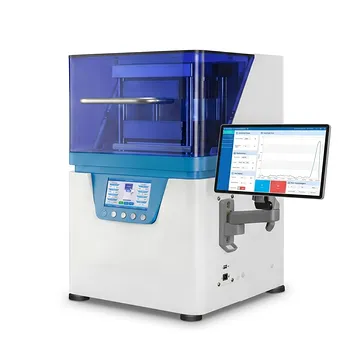
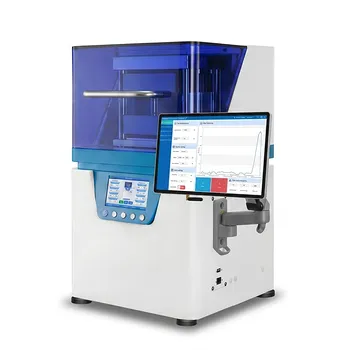
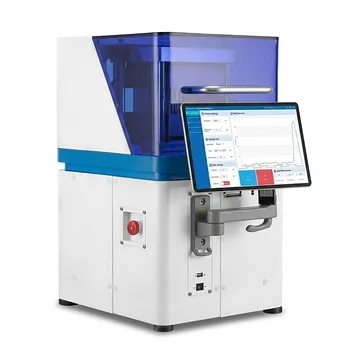
The use of a laboratory hydraulic press for Li4Ti5O12 (LTO) electrode formation is critical because it provides the precise, high-tonnage force required to transform a loose coating into a dense, high-performance conductive network. By applying specific pressures (often reaching 5 tons or higher), the press ensures intimate contact between active material particles and the current collector while simultaneously optimizing the electrode's internal porosity for rapid lithium-ion diffusion.
Core Takeaway: High-tonnage pressure control is the physical prerequisite for bridging the gap between a raw material coating and a functional battery component. It minimizes interfacial resistance and secures the mechanical integrity of the electrode, which is essential for the high-rate charging and discharging capabilities characteristic of LTO.
Optimizing Electrical and Ionic Pathways
Reducing Interfacial Contact Resistance
LTO particles must be in constant, tight contact with one another and the conductive agents to facilitate electron flow. A hydraulic press applies precise and uniform pressure to eliminate gaps between these particles, significantly lowering the internal resistance of the electrode sheet.
Optimizing Internal Porosity
While density is important, an electrode that is too compact will prevent the electrolyte from wetting the material. High-precision control allows researchers to reach the "sweet spot" of porosity, ensuring there is enough void space for lithium-ion transport while maintaining a high enough density for energy storage.
Enhancing Lithium-Ion Transport Rates
By refining the contact tightness, the hydraulic press directly improves the electrochemical reaction activity within the LTO layer. This architectural optimization is what allows LTO batteries to maintain their performance during high-current charging and discharging cycles.
Mechanical Stability and Data Reliability
Strengthening the Current Collector Bond
The bond between the active LTO layer and the aluminum foil current collector must be exceptionally strong to survive repeated cycling. High-tonnage pressing forces the material to adhere more effectively, preventing delamination or peeling that would lead to premature battery failure.
Ensuring Uniform Areal Density
Precise pressure control ensures that the electrode sheet has a consistent thickness and density across its entire surface. This uniformity is vital for maintaining a constant contact area with the separator and electrolyte, which reduces experimental variables.
Precision Disk Forming and Consistency
When equipped with precision molds, a hydraulic press can punch electrode materials into discs with consistent diameters (e.g., 10 mm). This ensures a perfect fit within coin cell cases (like the CR2032), minimizing experimental errors and ensuring that data is reproducible across multiple tests.
Understanding the Trade-offs
The Risk of Over-Compaction
Applying excessive pressure can lead to "over-compaction," where the porosity is reduced to the point that the electrolyte cannot penetrate the electrode. This creates a "dead" zone in the battery where lithium ions cannot move, ironically increasing resistance and decreasing capacity.
Particle Damage and Morphology
Extremely high pressures, while sometimes necessary for solid-state applications, can inadvertently crush the hierarchical structures of certain LTO morphologies. If the primary particles are fractured, the structural stability of the material during cycling may be compromised, leading to faster degradation.
Applying Precise Pressure to Your Project
Recommendations Based on Research Goals
- If your primary focus is high-rate performance: Use moderate to high pressure (approx. 5 tons) to maximize particle contact while strictly monitoring the resulting porosity to ensure electrolyte access.
- If your primary focus is volumetric energy density: Aim for higher compaction pressures to minimize the electrode thickness, though you must verify that the ionic transport remains sufficient.
- If your primary focus is all-solid-state LTO batteries: Utilize extreme pressures, potentially reaching hundreds of megapascals (e.g., 430 MPa), to eliminate interface gaps between the LTO and the solid electrolyte.
Ultimately, the laboratory hydraulic press serves as the bridge between material synthesis and electrochemical reality, providing the mechanical force necessary to create a stable, conductive, and efficient electrode architecture.
Summary Table:
| Key Feature | Impact on LTO Electrode Formation |
|---|---|
| Precision Pressure | Reduces interfacial resistance and facilitates electron flow. |
| Porosity Optimization | Balances electrode density with rapid lithium-ion diffusion. |
| Mechanical Bonding | Strengthens adhesion to current collectors, preventing delamination. |
| Areal Consistency | Ensures uniform thickness and density for reproducible test data. |
Elevate your battery research with KINTEK’s comprehensive laboratory pressing solutions. Whether your project requires manual, automatic, heated, multifunctional, or glovebox-compatible models—or specialized cold and warm isostatic presses—we provide the precision high-tonnage control essential for high-performance Li4Ti5O12 electrode architecture. Contact us today to find your ideal pressing solution!
References
- Lingping Kong, Jennifer L. M. Rupp. Unveiling Coexisting Battery‐Type and Pseudocapacitive Intercalation Mechanisms in Lithium Titanate. DOI: 10.1002/aenm.202503080
This article is also based on technical information from Kintek Solution Knowledge Base .
Related Products
- Laboratory Hydraulic Press Lab Pellet Press Button Battery Press
- Laboratory Hydraulic Press 2T Lab Pellet Press for KBR FTIR
- Laboratory Hydraulic Press Lab Pellet Press Machine for Glove Box
- 24T 30T 60T Heated Hydraulic Lab Press Machine with Hot Plates for Laboratory
- Automatic Laboratory Hydraulic Press Lab Pellet Press Machine
People Also Ask
- How is a laboratory hydraulic press used for HAP composite gels? Master Mineral Substrate Standardization
- What role does a laboratory hydraulic press play in the preparation of piezoelectric ceramic discs for DC-PG? | KINTEK
- What role does a laboratory hydraulic press play in reaction pellets? Optimizing Lunar Soil and Metal Fuel Density
- What role does a laboratory hydraulic press play in the assembly of all-solid-state battery test cells? Expert Guide
- Why is a laboratory hydraulic press required for PBAT and PLA sample preparation? Achieve Flawless Characterization