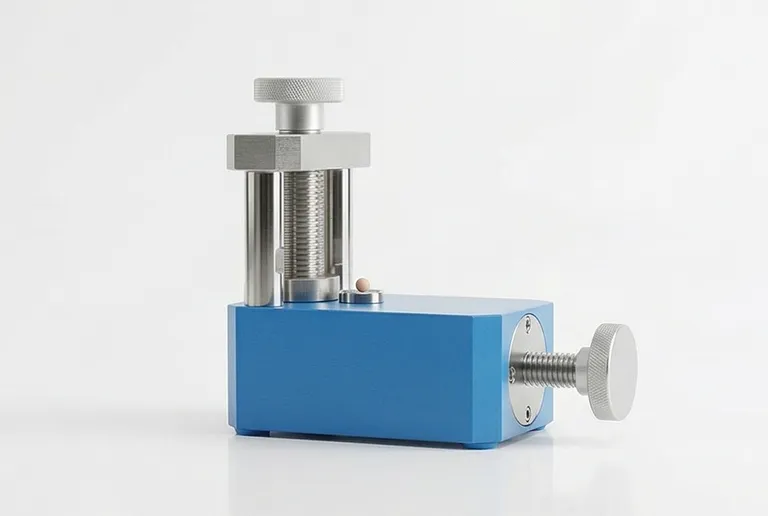
The Invisible Bridge Between Powder and Part
In the world of materials science, there is a precarious moment of transition. It is the moment when a loose, chaotic heap of copper-based composite powder must become a "green compact"—a solid object held together by nothing more than the physical intimacy of its own particles.
This state is fragile. If the compaction fails, the subsequent sintering process will merely memorialize those failures in metal.
The laboratory hydraulic press is not merely a tool of brute force; it is a precision instrument of persuasion. It exists to overcome the "bridging effect," where particles stubbornly resist settling, and to force a microscopic reconciliation that dictates the final density, strength, and life of the component.
The Mechanics of Microscopic Persuasion
To understand the press, one must understand the resistance of the material. At a macroscopic level, we see a die and a piston. At the microscopic level, we see a battle against internal cavities and particle friction.
Overcoming the Bridging Effect
Powder particles have a natural tendency to form bridges, leaving unwanted voids within the mass. These air pockets are the enemies of structural integrity.
- The Solution: Controlled axial pressure drives particle rearrangement.
- The Result: By forcing air out, the press eliminates the internal porosity that causes catastrophic failure during thermal expansion.
The Plasticity Threshold
Between 350 MPa and 600 MPa, something transformative happens. The pressure exceeds the deformation resistance of the copper particles. They don't just move; they change shape. This plastic deformation flattens contact surfaces, increasing the bonding area. This is the birth of "green strength"—the mechanical stability required for a part to be handled without crumbling.
Sintering is a Memory of Compaction
There is a common misconception that the sintering furnace "fixes" a bad compact. In reality, the furnace only develops what the press has already established.
Establishing Atomic Pathways
Sintering relies on atomic diffusion. If the hydraulic press has not established tight, uniform physical contact, the atoms cannot travel. Uniform pressure distribution ensures that intermetallic phases form consistently. Without it, you face macroscopic deformation and "die springing"—the elastic energy stored in a poorly pressed part that causes it to fracture the moment it is released.
The Role of Holding Time
Time is as critical as pressure. Holding a load—sometimes for 15 minutes in a laboratory setting—allows the powder mass to reach a state of equilibrium. It ensures that the "green" state is not a temporary posture, but a stable foundation.
Specialized Strategies for Advanced Composites
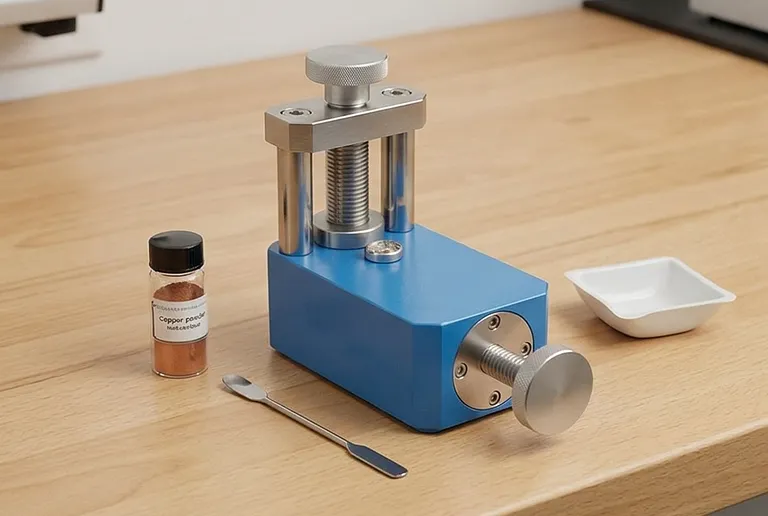
Different materials require different philosophies of force. Whether you are working with high-entropy alloys or metal-matrix composites, the press must be calibrated to the objective.
| Compaction Phase | Mechanism | Key Quality Benefit |
|---|---|---|
| Rearrangement | Overcoming "bridging" | Maximizes initial green density |
| Plastic Deformation | Particle flattening (400-600 MPa) | Increases contact area and green strength |
| Uniform Distribution | Stable axial force | Prevents delamination/cracking |
| Skeletal Control | Porosity regulation (e.g., W-Cu) | Optimizes capillary action for infiltration |
Precision in Porosity
In specialized applications like Tungsten-Copper (W-Cu) composites, the press acts as a gatekeeper. By precisely controlling the pressure, engineers create a continuous porous skeleton. This skeleton determines the efficiency of capillary action during molten copper infiltration. Too much pressure closes the gates; too little, and the structure collapses.
The Engineer’s Choice: Precision over Power
At KINTEK, we understand that a press is only as good as its control. Our solutions are designed to manage the delicate balance between maximum density and material integrity.
From manual and automatic models for rapid prototyping to heated and glovebox-compatible presses for sensitive battery research, we provide the environment where powder becomes architecture. For those seeking the ultimate in uniform density, our Cold and Warm Isostatic Presses (CIP/WIP) eliminate the friction losses inherent in uniaxial pressing, ensuring every millimeter of the compact is identical.
The integrity of your final alloy is decided long before it reaches the furnace. It is decided under the steady, silent pressure of the laboratory press.
To optimize your powder compaction workflow and ensure the success of your next material innovation, Contact Our Experts.
Related Products
- Automatic High Temperature Heated Hydraulic Press Machine with Heated Plates for Lab
- Manual Heated Hydraulic Lab Press with Integrated Hot Plates Hydraulic Press Machine
- Heated Hydraulic Press Machine with Heated Plates for Vacuum Box Laboratory Hot Press
- Laboratory Hydraulic Press 2T Lab Pellet Press for KBR FTIR
- Laboratory Hydraulic Press Lab Pellet Press Machine for Glove Box
Related Articles
- The Architecture of Slow: Why Physical Precision Dictates Chemical Destiny
- The Architecture of Certainty: Why the Laboratory Press is the Anchor of Material Science
- The Vanishing Boundary: The Hidden Thermodynamics of LTCC Lamination
- The Alchemy of 160°C: Why Precision Pressing is the Silent Backbone of Rubber Science
- The Invisible Forge: Why the Laboratory Press is the Soul of Nano-Composites



















