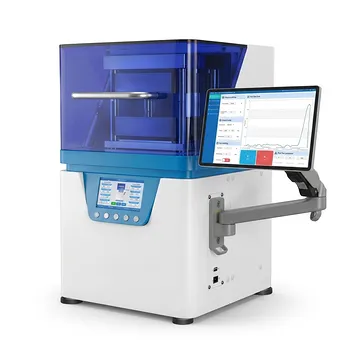
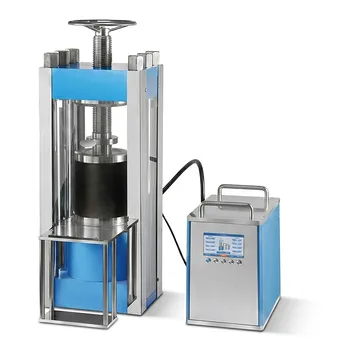
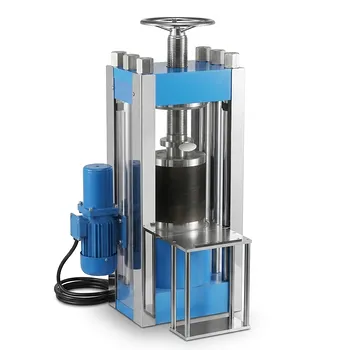
A heated laboratory press enhances GPE membrane quality by providing synchronized temperature and pressure gradients. This dual-action process softens the polymer matrix to ensure the molecular-level penetration of electrolyte salts while simultaneously purging internal microbubbles. The result is a highly dense, uniform, and mechanically robust film that maximizes ionic conductivity and improves the interface between the electrolyte and the electrodes.
The heated laboratory press acts as the critical bridge between raw polymer-salt mixtures and functional electrolytes. By leveraging thermo-mechanical coupling, it transforms a loose composite into a dense, homogenous, and defect-free membrane essential for high-performance electrochemical devices.
The Role of Thermo-Mechanical Coupling
Softening and Molecular Rearrangement
The primary function of heat in the press is to transition the polymer matrix (such as PEO or PVDF) into a molten or softened rheological state. This increased mobility allows polymer chains to rearrange and flow, facilitating the thorough encapsulation of electrolyte salts and ceramic fillers.
Eliminating Internal Micro-Defects
Applying high pressure while the polymer is softened forces out microscopic bubbles and density irregularities. This consolidation process ensures the resulting membrane is compact and free of internal voids that would otherwise hinder ion movement or cause mechanical failure.
Achieving Dimensional Precision
The press provides the control necessary to produce films with uniform thickness, often reaching targets as precise as 120 μm. This uniformity is vital for maintaining consistent electrochemical performance across the entire surface area of a battery cell.
Enhancing Electrochemical and Mechanical Performance
Optimizing Ion Transport Efficiency
By ensuring a molecular-level distribution of salts and plasticizers, the heat pressing process reduces internal resistance. This uniform salt penetration creates a more efficient ion conduction network, which significantly improves the film's interfacial ionic conductivity.
Improving Interfacial Contact Quality
The simultaneous application of heat and pressure optimizes the interfacial wetting between the electrolyte and the electrode surfaces (such as lithium or zinc metal anodes). This "tight physical contact" reduces contact resistance and ensures a more stable flow of ions during charge and discharge cycles.
Strengthening Mechanical Integrity
The pressing process creates a mechanically robust and flexible supporting layer. For polysaccharide-based or composite electrolytes, this thermo-mechanical treatment promotes cross-linking and density, which are essential for preventing dendrite penetration and ensuring long-term durability.
Understanding the Trade-offs
Thermal Degradation Risks
While heat is necessary for softening, excessive temperatures can lead to the thermal degradation of the polymer matrix or the electrolyte salts. Precise temperature compensation is required to stay within the material's stable thermal window.
Pressure Sensitivity
Applying excessive pressure can lead to over-thinning of the membrane or the "squeezing out" of liquid plasticizers in certain gel formulations. Conversely, insufficient pressure will fail to eliminate microbubbles, leading to a porous, low-quality film.
Processing Complexity
Achieving the "optimal rheological state" requires a delicate balance of timing and cooling. If the pressure is released before the film has sufficiently stabilized, the material may warp or develop internal stresses that compromise its flatness.
How to Apply This to Your Project
The effectiveness of a heated laboratory press depends on aligning its parameters with your specific material requirements.
- If your primary focus is Ion Conductivity: Prioritize synchronized temperature control to ensure the polymer reaches a fully softened state, allowing for the most thorough salt penetration and distribution.
- If your primary focus is Mechanical Durability: Focus on the pressure gradient to maximize film density and eliminate all internal micro-voids that could act as structural weak points.
- If your primary focus is Solvent-Free Fabrication: Utilize the press at higher temperatures (e.g., 70°C for PEO) to melt the polymer sufficiently to encapsulate ceramic particles without the need for chemical solvents.
By mastering the balance of heat and pressure, you can consistently produce high-performance electrolyte membranes that meet the rigorous demands of modern electrochemical applications.
Summary Table:
| Key Improvement Area | Mechanism of Action | Impact on Membrane Quality |
|---|---|---|
| Molecular Distribution | Thermal softening of polymer matrix | Homogeneous encapsulation of salts and ceramic fillers. |
| Structural Integrity | High-pressure consolidation | Eliminates internal microbubbles and voids for high density. |
| Dimensional Precision | Controlled compression | Ensures uniform thickness (up to 120 μm) for consistent performance. |
| Interfacial Contact | Simultaneous heat and pressure | Optimizes wetting between electrolyte and electrode surfaces. |
| Ionic Conductivity | Enhanced ion conduction network | Reduces internal resistance for faster ion transport. |
Elevate Your Battery Research with KINTEK Precision
Achieving the perfect gel polymer electrolyte requires exact control over heat and pressure. KINTEK specializes in comprehensive laboratory pressing solutions designed specifically for advanced material science and battery research.
Whether you need manual, automatic, heated, or multifunctional models, our equipment ensures the thermo-mechanical precision necessary for high-performance GPE membranes. We also offer glovebox-compatible units and specialized cold/warm isostatic presses to fit your specific lab environment and research goals.
Ready to optimize your membrane preparation? Contact KINTEK today to find the perfect pressing solution for your lab!
References
- Yuzhao Liu, Baohua Li. Robust Interfaces and Advanced Materials: Critical Designs and Challenges for High‐Performance Supercapacitors. DOI: 10.1002/eem2.70116
This article is also based on technical information from Kintek Solution Knowledge Base .
Related Products
- 24T 30T 60T Heated Hydraulic Lab Press Machine with Hot Plates for Laboratory
- Automatic Large Format Laboratory Heated Hydraulic Press 400x400mm Plate Capacity
- Automatic Heated Hydraulic Lab Press Machine 200x200 Plate Size for Battery Research and Materials Science
- Automatic Heated Hydraulic Lab Press with Programmable Touch Screen Controls and Precision Temperature Regulation
- Heated Hydraulic Press Machine with Heated Plates for Vacuum Box Laboratory Hot Press
People Also Ask
- Function of a Laboratory Hydraulic Press with Heated Platens in SSE? Enhance Battery Density & Conductivity
- Why is a laboratory hydraulic press with heating plates required for PLA/TEC films? Achieve Precise Sample Integrity
- What role does a laboratory heated hydraulic press play in LTCC? Essential for High-Density Ceramic Lamination
- What is the primary function of a laboratory heated hydraulic press? Mastering Thermoplastic Carbon Fiber Composites
- What is the critical role of a laboratory heated hydraulic press? Mastering PVC Sample Prep for Testing