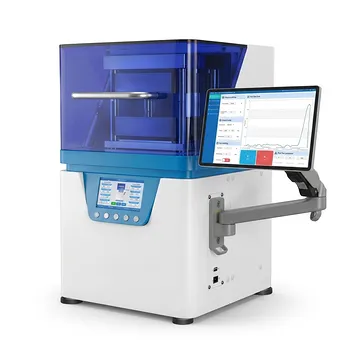
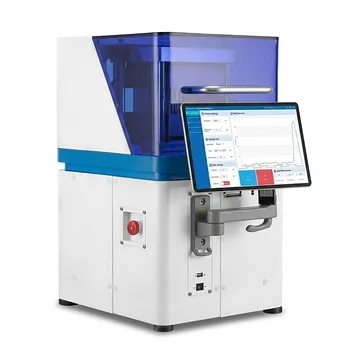
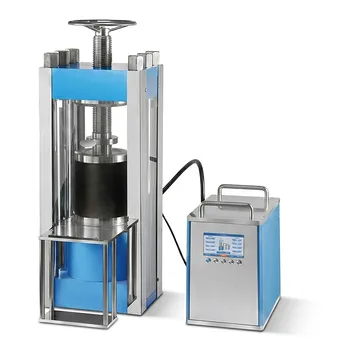
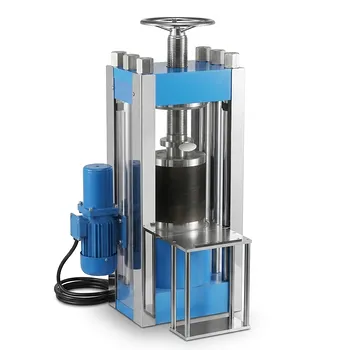
Precision thermal and mechanical control is the catalyst for high-performance plywood bonding. A high-precision laboratory hot press ensures quality by applying synchronized heating (120°C) and pressure (1 MPa) to the wood assembly. This controlled environment allows bio-polyurethane adhesives to penetrate deeply into veneer fibers and triggers the critical chemical cross-linking between isocyanate groups and wood hydroxyls.
The laboratory hot press ensures bonding quality by simultaneously facilitating deep mechanical anchoring and accelerated chemical curing. This dual-action process creates a high-strength interface that provides superior peel resistance and structural integrity in the finished bio-polyurethane plywood.
The Mechanisms of Interface Formation
Deep Mechanical Anchoring
The application of constant, high pressure forces the bio-polyurethane adhesive into the microporous structure of the wood veneer fibers. This penetration creates a "root system" of adhesive that, once cured, provides a robust mechanical interlock between the layers.
Chemical Cross-linking Acceleration
The high-precision heating system provides the thermal kinetic energy required to initiate and accelerate chemical reactions. Specifically, it facilitates the bonding of isocyanate groups in the adhesive with the hydroxyl groups naturally present in the wood fibers.
Elimination of Internal Voids
By providing uniform compression, the hot press ensures that the adhesive flows adequately to fill all gaps within the mold cavity. This process expels air and volatiles, resulting in a dense composite free from internal voids that would otherwise weaken the structure.
The Role of Precise Parameter Control
Thermal Consistency and Curing
Maintaining a stable temperature, such as 120°C, is vital for the uniform curing of the resin matrix. Consistent heat ensures that the entire plywood sheet reaches the necessary state for polymerization at the same time, preventing internal stress.
Pressure Regulation and Density
High-precision hydraulic systems allow for exact pressure output (e.g., 1.5 N/mm² to 2 MPa) to ensure tight contact between veneers. This precision is fundamental for maintaining thickness consistency and achieving the desired final geometric dimensions of the plywood.
Stabilization of Bio-Fillers
When using bio-polyurethane modified with reinforcements like cellulose nanofibrils (CNF), the press ensures these fillers are properly integrated. The stable pressurized environment translates the microscopic reinforcement of the fillers into macroscopic bonding strength.
Understanding the Trade-offs
Risk of Thermal Degradation
While heat is necessary for curing, excessive temperatures can degrade the bio-polyurethane or damage the delicate wood fibers. Finding the exact thermal equilibrium is a delicate balance; too much heat may cause the wood to become brittle or lead to interlayer cracking.
Pressure-Induced Crushing
Applying excessive pressure can lead to the collapse of the wood's cellular structure, resulting in internal density inconsistencies. Conversely, insufficient pressure prevents the adhesive from re-melting and penetrating the fibers, leading to poor peel strength.
The Timing Factor
The duration of the press cycle is as critical as the temperature and pressure settings. A cycle that is too short results in incomplete cross-linking, while a cycle that is too long can waste energy and potentially lead to the thermal breakdown of the adhesive bond.
How to Apply This to Your Project
Recommendations for Material Success
- If your primary focus is Peel Resistance: Prioritize the synchronization of temperature and pressure to ensure the bio-polyurethane fully penetrates the wood's micropores for maximum anchoring.
- If your primary focus is Dimensional Stability: Focus on the precision of the hydraulic pressure to ensure uniform thickness and to eliminate voids that cause warping.
- If your primary focus is Chemical Integrity: Carefully calibrate the heat to 120°C to facilitate isocyanate-hydroxyl cross-linking without triggering thermal degradation of the bio-based components.
Mastering the interplay of heat and pressure turns a simple adhesive application into a permanent, high-strength structural bond.
Summary Table:
| Key Feature/Mechanism | Target Specification | Role in Bonding Quality |
|---|---|---|
| Temperature Control | Stable 120°C | Facilitates isocyanate-hydroxyl cross-linking & resin curing. |
| Pressure Regulation | 1.0 - 2.0 MPa | Forces adhesive into wood micropores for mechanical interlocking. |
| Void Elimination | Uniform Compression | Expels air and volatiles to create a dense, void-free composite. |
| Thermal Equilibrium | Precise Balancing | Prevents thermal degradation while ensuring complete polymerization. |
| Dimensional Control | Precise Hydraulics | Ensures thickness consistency and ideal geometric dimensions. |
Maximize Your Material Strength with KINTEK Precision Hot Presses
Achieving superior bonding in bio-polyurethane composites requires the perfect synergy of thermal and mechanical control. KINTEK specializes in comprehensive laboratory pressing solutions tailored for high-stakes research and development.
Our extensive range of equipment empowers researchers to master the wood-biopolymer interface:
- Versatile Pressing Options: Choose from manual, automatic, heated, and multifunctional models.
- Specialized Applications: Glovebox-compatible presses and cold/warm isostatic models for battery research and advanced material science.
- Unmatched Precision: Ensure deep mechanical anchoring and flawless chemical cross-linking with industry-leading temperature and pressure stability.
Ready to eliminate internal voids and elevate your plywood's structural integrity?
Contact KINTEK today for a custom pressing solution!
References
- Sena Maulana, Muhammad Adly Rahandi Lubis. Adhesion and Cohesion Performance of Polyurethane Made of Bio‐Polyol Derived from Modified Waste Cooking Oil for Exterior Grade Plywood. DOI: 10.1002/mame.202400225
This article is also based on technical information from Kintek Solution Knowledge Base .
Related Products
- Laboratory Split Manual Heated Hydraulic Press Machine with Hot Plates
- 24T 30T 60T Heated Hydraulic Lab Press Machine with Hot Plates for Laboratory
- Heated Hydraulic Press Machine with Heated Plates for Vacuum Box Laboratory Hot Press
- Automatic Hydraulic Hot Press with Large Plate and Precision Temperature Control for Advanced Material Sample Preparation and Industrial Research
- Laboratory Manual Heated Hydraulic Press Machine with Hot Plates
People Also Ask
- Why is a laboratory hydraulic press with heating plates required for PLA/TEC films? Achieve Precise Sample Integrity
- What role does a laboratory heated hydraulic press play in LTCC? Essential for High-Density Ceramic Lamination
- Why reduce load when applying composite strengthening tabs? Protect Specimen Integrity and Data Accuracy
- Why is a laboratory heated hydraulic press required? Ensure Precise Vulcanization for NBR/EPDM Nanocomposites
- Why Use a Laboratory Heated Hydraulic Press for SSAB CCM? Optimize Solid-State Battery Interfacial Bonding