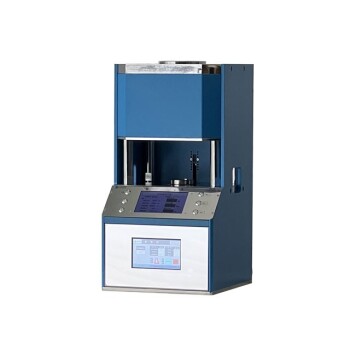
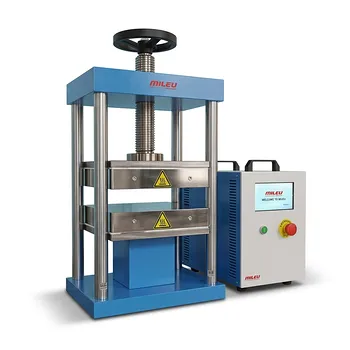
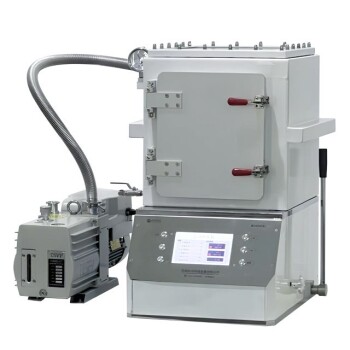
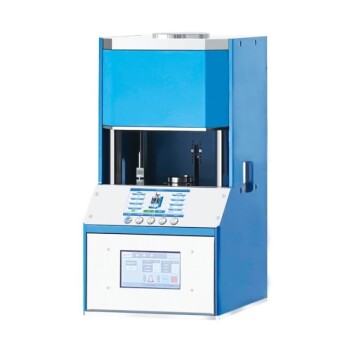
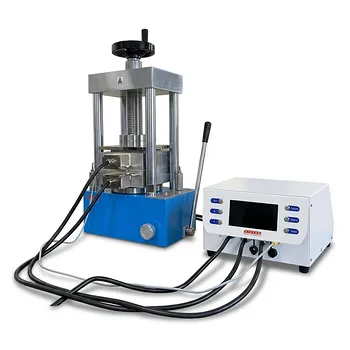
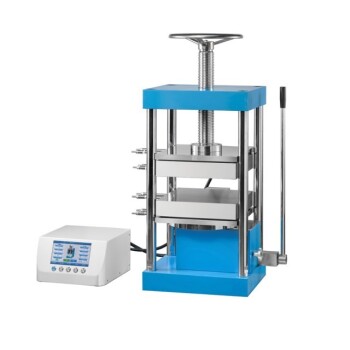
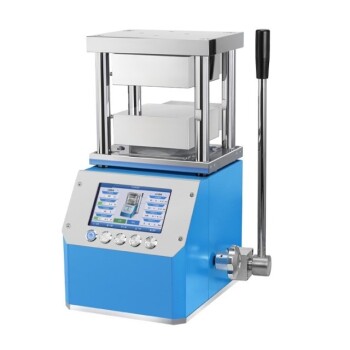
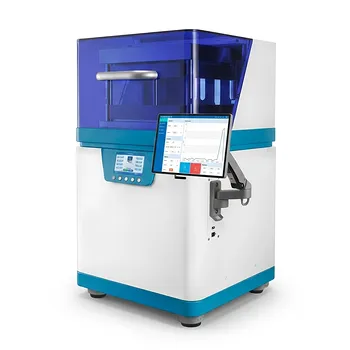
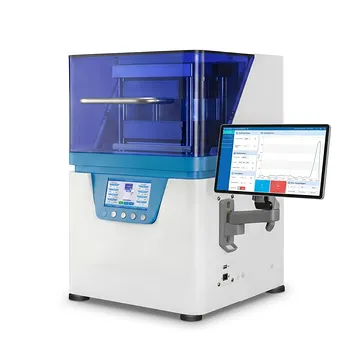
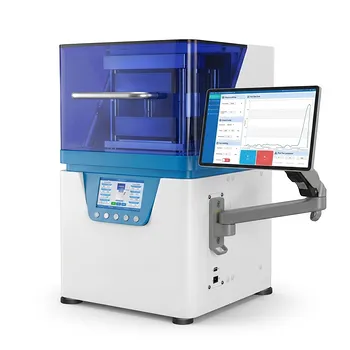
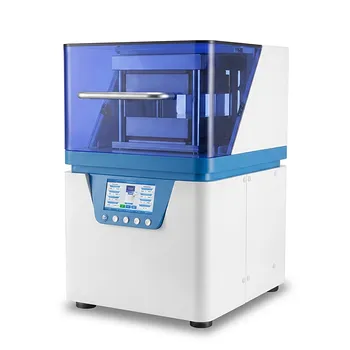
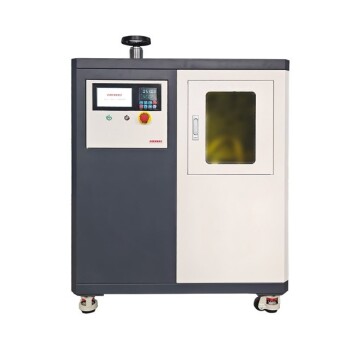
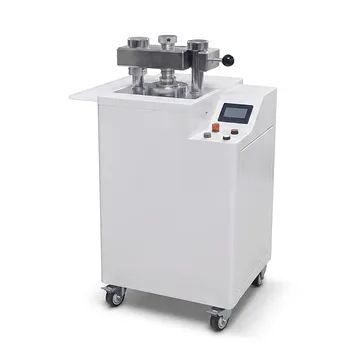
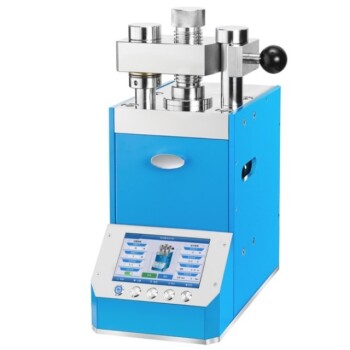
The electrically heated plate vulcanizing press ensures product quality by providing a dual-control environment of precise high temperature and uniform hydraulic pressure. This controlled setting triggers the chemical cross-linking reaction within the XNBR (Carboxylated Nitrile Butadiene Rubber) matrix, transforming linear macromolecules into a stable three-dimensional spatial network. By maintaining these conditions, the press eliminates internal stresses and ensures the final composite meets strict density and geometric specifications.
Core Takeaway: The vulcanizing press serves as a precision reactor that converts raw XNBR compounds into high-performance elastomers. Its primary function is to maintain a stable thermal and physical field, which is the foundational requirement for achieving full molecular cross-linking and structural integrity.
The Role of Thermal Precision in Molecular Cross-linking
Achieving Complete Network Formation
The press typically maintains a high-temperature environment, often between 150°C and 160°C, to drive the peroxide or sulfur-initiated reactions. This heat is essential for the rubber molecular chains to bond effectively, creating the three-dimensional network that gives XNBR its characteristic elasticity and strength.
Optimizing Vulcanization Timing
Precise temperature control allows engineers to determine the ideal vulcanization time for the specific composite. A stable thermal field prevents "under-curing," which leaves the material weak, or "over-curing," which can lead to thermal degradation and brittleness.
Enhancing Flame Retardancy and Resistance
In nanocomposites, the stability of the spatial network directly impacts flame retardancy efficiency and high-temperature performance. A uniform heat distribution ensures that the additives are effectively integrated into the vulcanized structure.
Pressure Dynamics and Physical Integrity
Eliminating Internal Defects and Porosity
The press applies continuous, high-pressure—often cited at 30 bar or 1500 psi—to the material held within a steel mold. This high-pressure environment is critical for eliminating internal air bubbles and ensuring the formation of a dense, defect-free sheet structure.
Ensuring Dimensional Consistency
By applying uniform hydraulic force, the press produces specimens with specified thickness and geometry, such as 2 mm sheets. This precision is vital for meeting mechanical performance testing standards and ensuring the material fits its intended engineering application.
Reducing Surface Roughness
Stable pressure ensures that the XNBR compound conforms perfectly to the surface of the steel mold. This results in vulcanized products characterized by low surface roughness and high structural density, which are essential for sealing and friction applications.
Understanding the Trade-offs
Thermal Gradients and Edge Effects
Despite precision controls, larger plates can suffer from thermal gradients where the edges are cooler than the center. If not properly calibrated, this can lead to non-uniform vulcanization across a single sheet, affecting the consistency of the batch.
The Risk of Excessive Pressure
While high pressure is necessary for density, excessive hydraulic force can lead to "flash"—excess material leaking from the mold. This not only wastes material but can also cause dimensional inaccuracies and require additional post-processing.
Material Stress and Cooling
Rapidly removing a sample from a high-temperature press can introduce thermal shock. If the cooling process is not managed alongside the heating cycle, the material may develop internal stresses that lead to warping or micro-cracking over time.
How to Apply This to Your Project
When utilizing an electrically heated plate vulcanizing press for XNBR composites, your primary focus should dictate your operational parameters:
- If your primary focus is mechanical strength: Prioritize the stability of the thermal field at 160°C to ensure a high-density, three-dimensional spatial network.
- If your primary focus is dimensional precision: Focus on maintaining a constant hydraulic pressure of at least 30 bar to eliminate internal porosity and ensure thickness accuracy.
- If your primary focus is laboratory testing standards: Ensure the mold and press are calibrated to produce samples with low surface roughness and a uniform 2 mm thickness.
By mastering the balance between heat-driven chemical reactions and pressure-driven physical molding, you ensure the production of XNBR composites that meet the most rigorous industrial standards.
Summary Table:
| Key Factor | Operational Role | Impact on Product Quality |
|---|---|---|
| Thermal Precision | Maintains 150°C - 160°C | Ensures full 3D molecular cross-linking and strength |
| Uniform Pressure | High-pressure (30 bar/1500 psi) | Eliminates internal air bubbles and porosity |
| Dimensional Control | Precision steel molds | Guarantees consistent thickness and low surface roughness |
| Process Timing | Optimized vulcanization cycles | Prevents under-curing or thermal degradation |
Elevate Your Material Research with KINTEK Precision
Achieve superior structural integrity and consistency in your XNBR composites with KINTEK’s comprehensive laboratory pressing solutions. We specialize in providing high-performance equipment tailored for advanced material science and battery research, including:
- Manual & Automatic Heated Presses for precise thermal management.
- Multifunctional & Glovebox-Compatible Models for specialized environments.
- Cold and Warm Isostatic Presses for high-density material requirements.
Ensure your samples meet the most rigorous industrial standards with our stable thermal and physical field technology. Contact our experts today to find the perfect pressing solution for your laboratory!
References
- Mirosława Prochoń. Influence of modified biopolymers on thermal properties and biodegradation processes of carboxylated nitrile-butadiene (XNBR) nanocomposities. DOI: 10.1007/s10973-020-09355-x
This article is also based on technical information from Kintek Solution Knowledge Base .
Related Products
- Automatic High Temperature Heated Hydraulic Press Machine with Heated Plates for Lab
- Split Automatic Heated Hydraulic Press Machine with Heated Plates
- Heated Hydraulic Press Machine With Heated Plates For Vacuum Box Laboratory Hot Press
- Automatic Heated Hydraulic Press Machine with Heated Plates for Laboratory
- 24T 30T 60T Heated Hydraulic Lab Press Machine with Hot Plates for Laboratory
People Also Ask
- Function of a Laboratory Hydraulic Press with Heated Platens in SSE? Enhance Battery Density & Conductivity
- What are the requirements for electrode pressing with high-viscosity ionic liquids like EMIM TFSI? Optimize Performance
- How does a laboratory heated hydraulic press facilitate PBN sample prep for WAXS? Achieve Precise X-Ray Scattering
- What are the industrial applications of heated hydraulic presses? Master Heat & Force for Precision Manufacturing
- Why is a laboratory hydraulic press with heating plates required for PLA/TEC films? Achieve Precise Sample Integrity