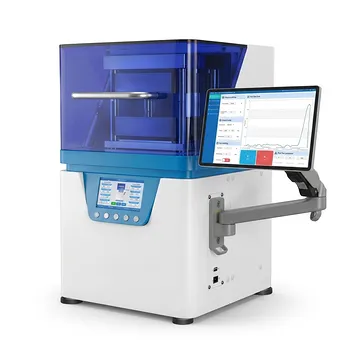
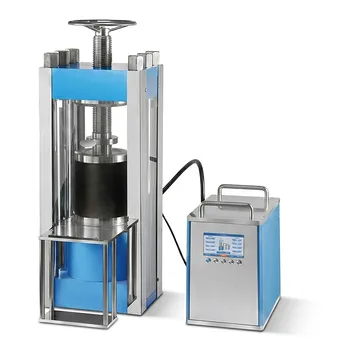
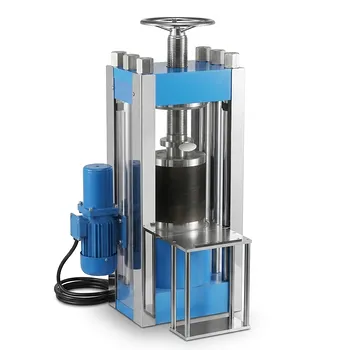
A heated laboratory press is the cornerstone of material characterization, providing the essential thermal and mechanical control required to transform raw composite mixtures into standardized test specimens. By simultaneously applying precise heat and high-tonnage pressure, the press ensures that specimens possess uniform thickness, maximum density, and a defect-free internal structure. These factors are critical for producing reliable, repeatable data in downstream tests such as UL94 flammability, tensile strength, and cone calorimetry.
Core Takeaway: The heated laboratory press functions as a precision molding environment that eliminates internal air pockets, regulates polymer crystallization, and ensures geometric consistency. Its primary purpose is to remove material variables, ensuring that test results reflect the properties of the composite itself rather than flaws in the sample preparation.
Achieving Structural Integrity Through Pressure and Heat
Elimination of Internal Voids and Micro-porosity
One of the most critical functions of the press is pressurized degassing, which removes residual air trapped within pellets, powders, or granules. By applying staged pressure increases—often ranging from 50 kN to 300 kN—the machine forces out air bubbles that would otherwise act as stress concentrators or insulation gaps. This process eliminates density gradients and micro-porosity, which is vital for the accuracy of electrical and mechanical performance testing.
Enhancing Interfacial Bonding and Density
The combination of high temperature and mechanical force facilitates diffusion bonding between composite components, such as polymer matrices and biochar or fiber fillers. Operating the press near or above the glass transition point or melting point (e.g., 170°C to 220°C) allows the material to flow into a dense, cohesive mass. This maximizes the interfacial bonding strength, ensuring the resulting specimen represents the true potential of the composite's chemistry.
Geometric Standardization and Surface Quality
Uniform Thickness and Flatness
Standardized tests like the Limiting Oxygen Index (LOI) or ASTM tensile tests require specimens with highly specific dimensions, such as a 0.5 mm thickness. The heated press uses precision-ground platens and metal molds to compress kneaded materials into sheets with uniform thickness and smooth surfaces. This geometric stability ensures that the cross-sectional area remains constant across different samples, which is a prerequisite for calculating stress and energy release rates.
Reproducible Geometric Dimensions
A lab press allows researchers to replicate the exact same molding conditions—pressure, temperature, and time—across multiple batches. This repeatability ensures that every specimen for a specific study has stable geometric dimensions, significantly reducing data scatter. Without this consistency, it becomes impossible to determine if a change in test results is due to the material's composition or a variation in sample shape.
Regulating Internal Material Morphology
Controlled Crystallization Behavior
For semi-crystalline polymers like Poly(lactic acid) (PLA), the cooling phase is just as important as the heating phase. Precision presses feature programmed cooling systems that regulate the rate at which a sample returns to room temperature. This control is essential for managing the crystallization behavior of the polymer, which directly influences the specimen's final hardness, brittleness, and thermal stability.
Sintering and Phase Management
In advanced composite manufacturing, the press serves as a sintering station for powders and low-melting-point alloys. By maintaining a stable environment of high temperature and pressure, the press allows for the controlled phase transformation of materials. This ensures that the internal structural density is optimized for specialized tests like cone calorimetry, where the material's response to heat must be predictable and uniform.
Understanding the Trade-offs
The Risk of Thermal Degradation
While high temperatures are necessary for material flow, excessive heat or prolonged "dwell time" in the press can lead to thermal degradation of the polymer matrix. This can break down molecular chains, resulting in skewed data that suggests the material is weaker or less stable than it actually is. Finding the "process window" where the material is molten enough to flow but not hot enough to degrade is a significant technical challenge.
Pressure-Induced Internal Stresses
Applying too much pressure too quickly can trap residual internal stresses within the specimen as it solidifies. If these stresses are not relieved through a controlled cooling cycle, the specimen may warp or crack when removed from the mold. Furthermore, if the pressure is insufficient, the sample may suffer from thickness variations, leading to inconsistent results during mechanical characterization.
How to Apply This to Your Project
Recommendations for Specimen Preparation
When preparing composite samples, your approach should be dictated by the specific requirements of your downstream analysis.
- If your primary focus is mechanical performance (e.g., tensile or impact): Prioritize staged pressure increases and precise cooling rates to ensure high interfacial bonding and the elimination of stress-concentrating micro-voids.
- If your primary focus is thermal or flammability testing (e.g., UL94 or LOI): Focus on achieving absolute thickness uniformity and a smooth surface finish to ensure the flame front propagates consistently across all samples.
- If your primary focus is electrical or density characterization: Utilize the highest stable pressure and pressurized degassing cycles to remove all internal air pockets and eliminate density gradients.
By mastering the balance of temperature, pressure, and time, the heated laboratory press transforms a raw mixture into a definitive, high-fidelity representation of a material's true properties.
Summary Table:
| Critical Function | Technical Benefit | Impact on Test Accuracy |
|---|---|---|
| Pressurized Degassing | Eliminates internal voids and micro-porosity | Prevents stress concentration and density gradients |
| Thermal Control | Regulates crystallization and interfacial bonding | Ensures consistent mechanical and thermal stability |
| Geometric Precision | Maintains uniform thickness and surface flatness | Provides stable cross-sections for ASTM/UL94 standards |
| Controlled Cooling | Relieves internal stresses and manages phase growth | Prevents warping and reduces experimental data scatter |
Elevate Your Specimen Preparation with KINTEK
Precision in material characterization starts with the right equipment. KINTEK specializes in comprehensive laboratory pressing solutions designed to eliminate material variables and deliver high-fidelity results. Our extensive range includes:
- Manual & Automatic Presses: For versatile, repeatable force application.
- Heated & Multifunctional Models: Ideal for polymer crystallization and complex composite molding.
- Glovebox-Compatible & Isostatic Presses: Specialized cold and warm isostatic solutions widely applied in advanced battery research and sensitive material handling.
Don't let sample flaws compromise your data. Contact KINTEK today to find the perfect press for your research needs and ensure every specimen meets the highest standards of excellence.
References
- Thuy Tien Nguyen Thanh, Katalin Bocz. Effect of clay minerals on the flame retardancy of polylactic acid/ammonium polyphosphate system. DOI: 10.1007/s10973-022-11712-x
This article is also based on technical information from Kintek Solution Knowledge Base .
Related Products
- 24T 30T 60T Heated Hydraulic Lab Press Machine with Hot Plates for Laboratory
- Automatic Large Format Laboratory Heated Hydraulic Press 400x400mm Plate Capacity
- Automatic Heated Hydraulic Lab Press Machine 200x200 Plate Size for Battery Research and Materials Science
- Automatic Heated Hydraulic Lab Press with Programmable Touch Screen Controls and Precision Temperature Regulation
- Heated Hydraulic Press Machine with Heated Plates for Vacuum Box Laboratory Hot Press
People Also Ask
- Function of a Laboratory Hydraulic Press with Heated Platens in SSE? Enhance Battery Density & Conductivity
- Why is a laboratory hydraulic press with heating plates required for PLA/TEC films? Achieve Precise Sample Integrity
- What role does a laboratory heated hydraulic press play in LTCC? Essential for High-Density Ceramic Lamination
- What is the primary function of a laboratory heated hydraulic press? Mastering Thermoplastic Carbon Fiber Composites
- What is the critical role of a laboratory heated hydraulic press? Mastering PVC Sample Prep for Testing