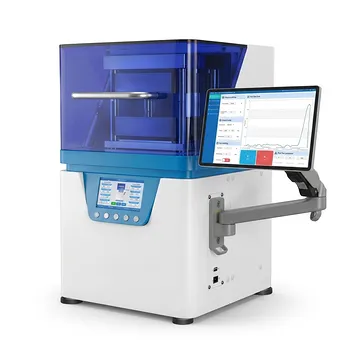
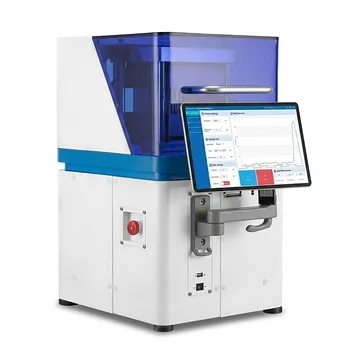
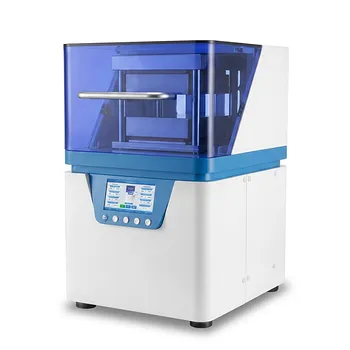
High-precision laboratory hydraulic hot presses are defined by their ability to provide synchronized, precisely controlled thermal and mechanical fields. These machines supply the constant high temperature and continuous hydraulic pressure required to simultaneously trigger chemical resin curing and enforce physical veneer consolidation. This dual action ensures a unified structural bond, eliminates internal density gaps, and establishes the final geometric dimensions of the plywood composite.
The core function of a laboratory hot press is to create a stabilized environment where thermal energy triggers chemical cross-linking while mechanical pressure ensures physical interlocking. This synchronization is critical for transforming loose veneer layers into a high-strength, dimensionally stable composite.
Thermal Management: Driving Chemical Transformation
Catalyzing Resin Cross-linking
The primary role of heat (typically ranging from 120°C to 160°C) is to facilitate the rapid curing reaction of adhesives such as urea-formaldehyde, phenolic, or bio-polyurethane resins. High temperatures drive the chemical cross-linking process, which creates the essential bonds between the isocyanate groups of the adhesive and the hydroxyl groups of the wood.
Facilitating Deep Heat Penetration
Precise temperature control allows the heat to penetrate the core of the plywood assembly, ensuring that the internal layers reach a sufficient state for bonding. In advanced applications, researchers use additives like graphene oxide within the resin to leverage high thermal conductivity, effectively shortening the pressing cycle and strengthening inter-fiber bonds.
Wetting and Interface Quality
Maintaining a constant temperature field ensures that the resin reaches a molten or fluid state, allowing it to thoroughly wet the wood fibers. This wetting is vital for the adhesive to penetrate the veneer’s cellular structure, creating a high-strength mechanical "anchor" that prevents peeling.
Mechanical Stability: Achieving Physical Consolidation
Eliminating Surface Irregularities
Continuous hydraulic pressure (often between 0.7 MPa and 3.0 MPa) is required to force the veneer layers into tight contact. This compression eliminates bonding gaps caused by the natural surface irregularities of wood, ensuring that the adhesive interface is continuous across the entire surface area.
Controlled Density and Compaction
Precision hot presses allow researchers to compress loose material to a predetermined density, which dictates the finished product's hardness and structural integrity. By regulating the pressure output (e.g., 1.5 N/mm²), the machine ensures that the plywood reaches its final geometric dimensions without over-compressing the wood fibers.
Preventing Interlayer Cracking
A stable pressure field prevents the formation of internal voids or density inconsistencies that lead to structural failure. By maintaining high pressure during the entire curing phase, the press ensures that the mechanical interlocking between layers remains intact as the resin transitions from a liquid to a solid state.
Understanding the Trade-offs
Temperature vs. Material Degradation
While higher temperatures accelerate the curing process and shorten production cycles, excessive heat can lead to the thermal degradation of wood fibers. Identifying the "sweet spot" is critical; for instance, bio-resins may require lower temperatures (120°C) compared to phenolic resins (150°C+) to maintain the natural strength of the veneer.
Pressure vs. Fiber Damage
Higher pressure ensures superior contact and density, but exceeding the proportional limit of the wood can cause permanent cell wall collapse. This reduces the elasticity of the plywood and can lead to a brittle finished product that is more prone to impact failure.
Cycle Time vs. Internal Stress
Shortening the pressing cycle too aggressively can result in a "wet core" where the resin hasn't fully cured, leading to delamination once the pressure is released. Conversely, excessively long cycles are energy-inefficient and may cause the adhesive to become over-cured and brittle.
Making the Right Choice for Your Goal
To achieve the best results in plywood molding, your press settings must align with your specific research or production objectives.
- If your primary focus is Maximum Structural Strength: Prioritize precise pressure regulation (roughly 1.0–1.5 MPa) to ensure deep mechanical anchoring of the resin into the wood fibers.
- If your primary focus is Rapid Prototyping/Cycle Efficiency: Utilize high-conductivity additives like graphene oxide and higher temperatures (near 160°C) to accelerate the thermal transfer to the core.
- If your primary focus is Using Bio-Based Adhesives: Opt for lower, more stable temperature profiles (around 120°C) to facilitate the specific chemical cross-linking required by isocyanate groups without damaging sensitive bio-polymers.
- If your primary focus is Dimensional Precision: Focus on the hydraulic press’s ability to maintain a "predetermined thickness" stop, ensuring the final board density remains uniform across the entire surface.
The success of the plywood curing process ultimately depends on the harmonious balance between the chemical kinetics of the resin and the physical compaction of the wood veneers.
Summary Table:
| Core Condition | Typical Parameter Range | Primary Function in Plywood Molding |
|---|---|---|
| Thermal Field | 120°C – 160°C | Catalyzes resin cross-linking & ensures deep heat penetration. |
| Mechanical Field | 0.7 MPa – 3.0 MPa | Eliminates surface irregularities & stabilizes product density. |
| Interface Quality | Constant Fluid State | Facilitates resin wetting for high-strength mechanical anchoring. |
| Process Sync | Synchronized Control | Prevents interlayer cracking & ensures dimensional precision. |
Elevate Your Lab’s Precision with KINTEK Pressing Solutions
Achieving the perfect balance of temperature and pressure is critical for high-performance material composites. KINTEK specializes in comprehensive laboratory pressing solutions tailored for demanding research environments. Whether you are perfecting plywood molding or advancing battery research, our equipment delivers the synchronized control you need.
Our extensive range includes:
- Manual & Automatic Hot Presses for versatile lab applications.
- Heated & Multifunctional Models for precise thermal management.
- Glovebox-Compatible Presses for air-sensitive material processing.
- Cold & Warm Isostatic Presses for uniform density distribution.
Ready to enhance your structural bonding and dimensional accuracy? Contact KINTEK today to find the ideal pressing solution for your lab!
References
- Anita Wronka, Grzegorz Kowaluk. Upcycling of Wood Dust from Particleboard Recycling as a Filler in Lignocellulosic Layered Composite Technology. DOI: 10.3390/ma16237352
This article is also based on technical information from Kintek Solution Knowledge Base .
Related Products
- 24T 30T 60T Heated Hydraulic Lab Press Machine with Hot Plates for Laboratory
- Automatic Large Format Laboratory Heated Hydraulic Press 400x400mm Plate Capacity
- Automatic Heated Hydraulic Press Machine with Hot Plates for Laboratory
- Automatic Heated Hydraulic Lab Press 120x120mm Plate Fully Automated Material Research Press
- Automatic Hydraulic Hot Press with Large Plate and Precision Temperature Control for Advanced Material Sample Preparation and Industrial Research
People Also Ask
- Function of a Laboratory Hydraulic Press with Heated Platens in SSE? Enhance Battery Density & Conductivity
- Why is a laboratory hydraulic press with heating plates required for PLA/TEC films? Achieve Precise Sample Integrity
- What role does a laboratory heated hydraulic press play in LTCC? Essential for High-Density Ceramic Lamination
- Why reduce load when applying composite strengthening tabs? Protect Specimen Integrity and Data Accuracy
- Why is a laboratory heated hydraulic press utilized during the lamination stage of NASICON green tapes?