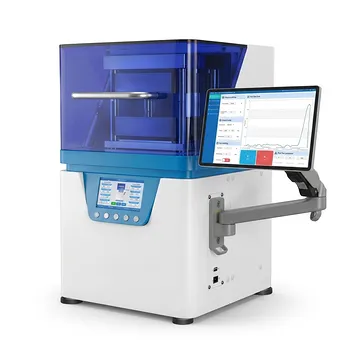
The laboratory precision hydraulic press is the critical bridge between raw composite material and scientifically valid data. It provides the controlled high-temperature and high-pressure environment required to transform loose granules, fibers, or powders into dense, defect-free standardized plates. By strictly regulating the preheating, pressure holding, and cooling cycles, the machine ensures that the resulting specimens are a true representation of the material's inherent properties rather than a reflection of manufacturing flaws.
Core Takeaway: A precision hydraulic press eliminates internal voids and residual stresses through synchronized thermal and mechanical control. This standardization is fundamental to achieving reproducible results in tensile, flexural, and thermal deformation testing.
Ensuring Structural Integrity and Density
Eliminating Internal Voids and Air Bubbles
High-precision pressing applies substantial closing pressure, often ranging from 150 kN to 300 kN, to force out entrapped air between material layers. This process eliminates internal voids that would otherwise act as stress concentrators, prematurely weakening the specimen during mechanical testing.
Achieving Uniform Resin Infiltration
In fiber-reinforced composites, the hydraulic press ensures that the resin matrix fully infiltrates the fiber fabric. This uniform wetting is essential for achieving a stable fiber volume content, which is the primary factor determining the strength of aerospace and automotive components.
Maximizing Material Density
The application of constant, high-level pressure (such as 2000 psi) ensures that particles are fully rearranged and tightly bonded. This compaction creates a dense internal structure that is necessary for reliable uniaxial compression and physical property characterization.
Thermal Control and Molecular Stability
Regulating Crystallization and Solidification
Precise cooling phases allow researchers to regulate the crystallization behavior of polymers like Poly(lactic acid). Programmed cooling ensures that the molecular structure is consistent across all samples, reducing variations in thermal and mechanical performance.
Minimizing Residual Internal Stresses
By accurately controlling the preheating and pressure-holding phases, the hydraulic press prevents the formation of internal stresses. Without this control, specimens may warp or contain "frozen-in" stresses that skew tensile and flexural strength data.
Facilitating Uniform Cross-linking
For thermoset composites, the heated plates provide a stable environment (often up to 220°C) for uniform chemical reactions. This ensures that the matrix reaches a consistent state of solidification throughout the entire thickness of the plate.
Standardization for Reliable Characterization
Achieving Dimensional Uniformity
The hydraulic press produces sheets with consistent thickness (e.g., 1 mm) and smooth surfaces across the entire batch. This geometric precision is vital for tests where dimensions directly impact the calculation of stress, such as UL94 flammability or cone calorimetry.
Enhancing Data Reproducibility
By removing random defects and human error from the molding process, the press significantly reduces data scatter. This allows researchers to attribute changes in performance to material composition rather than inconsistent specimen preparation.
Understanding the Trade-offs
The Complexity of Parameter Optimization
Achieving the perfect specimen requires a delicate balance of temperature, pressure, and time; incorrect settings can lead to thermal degradation of the polymer or "flash" (excess material leaking from the mold). If the pressure is applied too rapidly, it can also cause fiber misalignment in reinforced composites.
Equipment Limitations and Maintenance
While high-precision presses offer superior control, they require regular calibration to ensure that the heating plates remain perfectly parallel and uniformly heated. Any deviation in plate flatness can result in uneven specimen thickness, which invalidates mechanical test results.
How to Apply This to Your Research
Implementing the Right Pressing Strategy
To ensure your composite specimens meet industry standards for aerospace, automotive, or material science, tailor your pressing parameters to your specific goals:
- If your primary focus is mechanical strength (tensile/flexural): Prioritize high closing pressure (150-300 kN) and long pressure-holding times to ensure maximum density and zero void content.
- If your primary focus is thermal or chemical behavior: Focus on the precision of the heating plates and the cooling rate to manage crystallization and cross-linking density.
- If your primary focus is fiber-reinforced structures: Ensure the mold-closing speed is controlled to allow the resin matrix to infiltrate the fibers without displacing them.
By mastering the precision of the hydraulic press, you ensure that every test specimen serves as a reliable foundation for scientific discovery.
Summary Table:
| Key Feature | Functional Impact | Research Benefit |
|---|---|---|
| High Closing Pressure | Forces out entrapped air and voids | Increases structural integrity and tensile strength |
| Thermal Regulation | Controls crystallization and cross-linking | Ensures molecular stability and reduces warping |
| Uniform Infiltration | Ensures resin fully coats fiber matrix | Consistent fiber volume content for valid data |
| Precision Molding | Maintains exact specimen thickness | Enables reproducible mechanical and thermal results |
Elevate Your Composite Research with KINTEK Precision
Achieving scientifically valid data starts with the perfect specimen. KINTEK specializes in comprehensive laboratory pressing solutions designed to eliminate manufacturing flaws and deliver reproducible results. From manual and automatic heated models to multifunctional and glovebox-compatible presses, we provide the thermal and mechanical control your research demands.
Our advanced range also includes cold and warm isostatic presses, widely applied in cutting-edge battery research and aerospace material development. Don't let specimen defects compromise your findings—leverage our expertise to optimize your pressing parameters today.
Contact KINTEK Experts for a Custom Solution
References
- Maria Sönmez, Roxana Truşcă. The Effect of the Functionalizing Agent Type on Processability, Mechanical and Thermal Properties of Polypropylene-Based Composites. DOI: 10.24264/icams-2016.i.23
This article is also based on technical information from Kintek Solution Knowledge Base .
Related Products
- 24T 30T 60T Heated Hydraulic Lab Press Machine with Hot Plates for Laboratory
- Laboratory Hydraulic Press Lab Pellet Press Machine for Glove Box
- Automatic Hydraulic Hot Press with Large Plate and Precision Temperature Control for Advanced Material Sample Preparation and Industrial Research
- Automatic Heated Hydraulic Lab Press with Programmable Touch Screen Controls and Precision Temperature Regulation
- Automatic Laboratory Hydraulic Press Lab Pellet Press Machine
People Also Ask
- Function of a Laboratory Hydraulic Press with Heated Platens in SSE? Enhance Battery Density & Conductivity
- Why is a laboratory hydraulic press with heating plates required for PLA/TEC films? Achieve Precise Sample Integrity
- What role does a laboratory heated hydraulic press play in LTCC? Essential for High-Density Ceramic Lamination
- Why reduce load when applying composite strengthening tabs? Protect Specimen Integrity and Data Accuracy
- Why is a laboratory heated hydraulic press utilized during the lamination stage of NASICON green tapes?