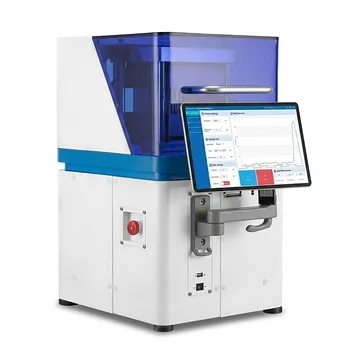
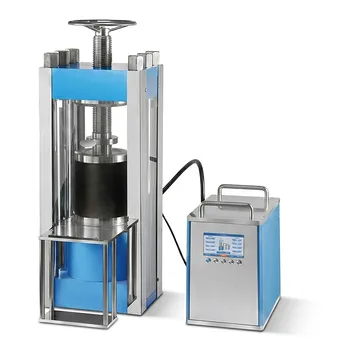
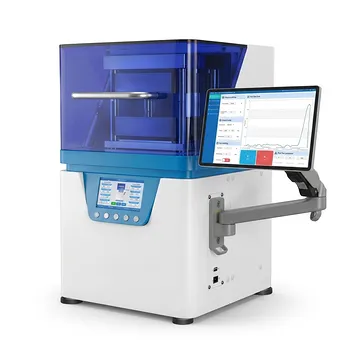
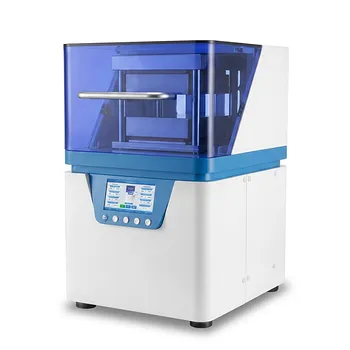
The high-pressure heated flat vulcanizing press is the essential catalyst for transforming raw fluoroelastomer compounds into high-performance nanocomposites. By providing a synchronized environment of intense thermal energy (e.g., 177°C) and significant mechanical pressure (e.g., 10 MPa), the press triggers peroxide-initiated crosslinking reactions. This process ensures that the polymer chains form a dense, three-dimensional network while simultaneously eliminating air bubbles and defects to achieve uniform geometric dimensions.
The primary function of the vulcanizing press is to provide the simultaneous heat and pressure required to drive chemical crosslinking and ensure material density. This dual action is what transforms a plasticized mixture into a stable, high-performance elastomer with a precisely defined molecular structure.
Driving Chemical Crosslinking and Network Formation
Inducing Peroxide-Initiated Reactions
The press provides a stable, high-temperature environment that is critical for breaking down chemical initiators. In fluoroelastomer nanocomposites, this thermal energy triggers peroxide-initiated crosslinking, which allows individual polymer chains to bond chemically.
Building the 3D Molecular Network
Under the heat of the press, linear macromolecules are converted into a stable three-dimensional spatial network. This transformation is what changes the material from a soft, plastic state into a finished elastomer with high elasticity and structural integrity.
Defining Material Properties
The precision of the thermal field within the press determines the ideal vulcanization time. Accurate timing and temperature control are necessary to ensure the crosslinking is uniform, which directly impacts the mechanical strength and flame retardancy of the final composite.
Ensuring Physical Integrity and Precision
Eliminating Internal Defects and Voids
High mechanical pressure is applied to force the elastomer compound to fully fill every cavity of the steel mold. This action eliminates air bubbles and internal voids, which are common failure points in high-pressure or high-temperature applications.
Achieving High Structural Density
By tightly arranging the powder components and polymer chains, the press produces specimens with high internal density. This density is essential for achieving the desired dielectric response and mechanical durability required in industrial specifications.
Ensuring Dimensional Accuracy
The combination of rigid steel molds and continuous pressure results in test specimens with uniform geometric dimensions and low surface roughness. This standardization is vital for accurate laboratory testing and predictable performance in real-world engineering environments.
Understanding the Process Trade-offs
The Risk of Thermal Gradient Imbalance
If the heating plates do not provide a perfectly uniform thermal field, different areas of the nanocomposite may cure at different rates. This can lead to internal stresses or localized "soft spots" where the 3D network is incomplete.
Pressure Sensitivity in Nanocomposites
While high pressure is necessary to lock the nanoparticle network into the polymer matrix, excessive pressure can occasionally lead to flash or mold overflow. Finding the specific balance (such as the 10 MPa cited for certain fluoroelastomers) is critical for maintaining material yield and surface quality.
Balancing Cure Time and Material Degradation
Leaving a specimen in the press for too long to ensure "full" crosslinking can backfire by causing thermal degradation of the polymer chains. Operators must precisely calibrate the press based on the specific thickness and formulation of the compound.
How to Apply This to Your Project
When utilizing a high-pressure heated flat vulcanizing press, your primary goal determines how you should calibrate your process parameters.
- If your primary focus is Maximum Mechanical Strength: Prioritize the stability of the high-pressure environment (e.g., 10 MPa) to ensure the highest possible structural density and the elimination of all internal voids.
- If your primary focus is Chemical and Thermal Stability: Focus on the precision of the thermal field (e.g., 177°C) to ensure a complete and uniform 3D crosslinking network across the entire specimen.
- If your primary focus is Nanoparticle Integration: Use synchronized thermopressure to "lock" the nanoparticle network within the matrix, preventing agglomeration and ensuring a consistent dielectric response.
By mastering the balance of synchronized heat and pressure, you ensure the production of fluoroelastomer nanocomposites that meet the most rigorous technical standards.
Summary Table:
| Function | Key Mechanism | Operational Benefit |
|---|---|---|
| Crosslinking | Thermal energy (e.g., 177°C) triggers peroxide reactions | Transforms plastic mixture into a stable 3D network |
| Void Removal | High mechanical pressure (e.g., 10 MPa) forces mold filling | Eliminates air bubbles and internal structural defects |
| Densification | Simultaneous heat and pressure application | Achieves high structural density and dielectric response |
| Precision Molding | Rigid steel mold containment | Ensures uniform geometric dimensions and low roughness |
Elevate Your Material Research with KINTEK Precision Pressing
Unlock the full potential of your fluoroelastomer and battery research with KINTEK’s industry-leading laboratory pressing solutions. Whether you are inducing precise chemical crosslinking or developing high-density nanocomposites, our equipment delivers the synchronized heat and pressure your project demands.
Our Comprehensive Product Range Includes:
- Manual & Automatic Heated Presses: For reliable, repeatable molding results.
- Multifunctional & Glovebox-Compatible Models: Optimized for sensitive research environments.
- Cold & Warm Isostatic Presses (CIP/WIP): Perfect for achieving maximum structural density in advanced ceramics and battery materials.
Don't let thermal gradients or pressure imbalances compromise your specimens. Partner with KINTEK for unparalleled control and expertise.
Contact us today to find the perfect press for your lab!
References
- Javad Heidarian, Nor Mas Mira Abd Rahman. Improving the thermal properties of fluoroelastomer (Viton GF-600S) using acidic surface modified carbon nanotube. DOI: 10.1590/0104-1428.2044
This article is also based on technical information from Kintek Solution Knowledge Base .
Related Products
- Automatic High Temperature Heated Hydraulic Press Machine with Heated Plates for Lab
- Heated Hydraulic Press Machine With Heated Plates For Vacuum Box Laboratory Hot Press
- 24T 30T 60T Heated Hydraulic Lab Press Machine with Hot Plates for Laboratory
- Automatic Hydraulic Hot Press with Large Plate and Precision Temperature Control for Advanced Material Sample Preparation and Industrial Research
- Automatic Heated Hydraulic Lab Press Machine 200x200 Plate Size for Battery Research and Materials Science
People Also Ask
- Function of a Laboratory Hydraulic Press with Heated Platens in SSE? Enhance Battery Density & Conductivity
- How does a laboratory heated hydraulic press facilitate PBN sample prep for WAXS? Achieve Precise X-Ray Scattering
- What are the requirements for electrode pressing with high-viscosity ionic liquids like EMIM TFSI? Optimize Performance
- What are the industrial applications of heated hydraulic presses? Master Heat & Force for Precision Manufacturing
- Why is a laboratory hydraulic press with heating plates required for PLA/TEC films? Achieve Precise Sample Integrity