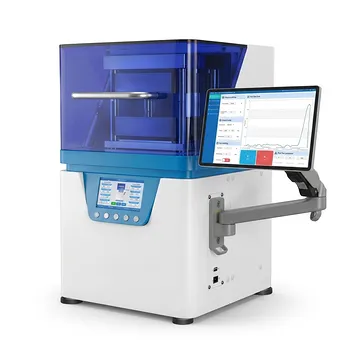
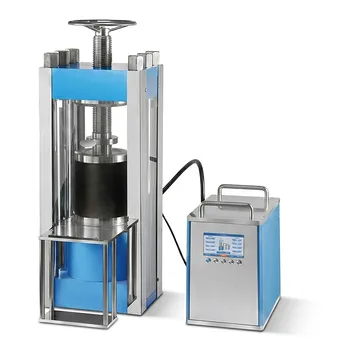
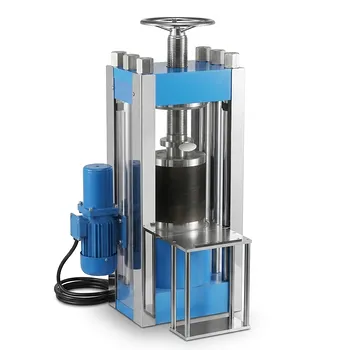
The heated laboratory press is the fundamental instrument used to bond the multi-layered components of a Membrane Electrode Assembly (MEA). By applying simultaneous high temperature (e.g., 257°F) and high pressure (e.g., 500 psi), it transfers the catalyst layer from a substrate onto the proton exchange membrane. This process creates the critical physical and electrical connection required for the Direct Methanol Fuel Cell (DMFC) to generate power efficiently.
Core Takeaway: The heated laboratory press facilitates the "hot-pressing" process, which is essential for reducing interfacial contact resistance and establishing a robust three-phase reaction interface between the membrane, catalyst, and gas diffusion layers.
The Mechanism of Catalyst Transfer
Enabling the Decal Method
In DMFC fabrication, the press is used to transfer a catalyst layer (typically platinum or platinum-ruthenium) from a transfer sheet onto a perfluorosulfonic acid membrane. The combination of heat and force causes the catalyst to adhere more strongly to the membrane than to its original carrier.
Establishing Molecular-Level Bonding
The press ensures that the catalyst layer is not merely sitting on the surface but is physically embedded into the membrane. This creates a "molecular-level bond" that is vital for the movement of protons across the interface.
Ensuring Component Uniformity
High-precision presses maintain a consistent thickness across the entire MEA. This uniformity is critical for preventing "hot spots" and ensuring that the fuel cell stack can be assembled without internal gas leakage.
Optimization of the Three-Phase Interface
Reducing Interfacial Contact Resistance
One of the primary deep needs in fuel cell design is minimizing ohmic polarization. The heated press reduces the resistance between layers, allowing electrons and ions to flow with minimal energy loss.
Creating Transport Channels
The pressing process optimizes the micro-structure of the catalyst layer. By carefully controlling the collapse of pores, the press helps create efficient channels for the transport of methanol (fuel), protons, and reaction gases.
Enhancing Charge Transport Efficiency
By establishing tight physical contact, the press improves the charge transfer efficiency. This ensures that the electrochemical reactions occur rapidly and that the resulting current is collected effectively.
Ensuring Mechanical Durability
Preventing Delamination
DMFCs operate in high-humidity and high-temperature environments, which can cause materials to swell and separate. The thermal bonding provided by the press creates a robust assembly that resists delamination during long-term operation.
Integrating the Gas Diffusion Layer (GDL)
The press is often used to integrate the gas diffusion layer and titanium felt with the catalyst-coated membrane (CCM). This "physical packaging" step ensures the MEA can withstand the mechanical stresses of the fuel cell stack.
Understanding the Trade-offs and Pitfalls
The Risk of Over-Compression
Applying excessive pressure can crush the porous structure of the gas diffusion layer or the catalyst layer. If the pores are closed, the methanol fuel and oxygen cannot reach the reaction sites, leading to a "mass transport" failure.
Temperature Sensitivity of the Membrane
While heat is necessary for bonding (often around 130°C), exceeding the glass transition temperature of the membrane can cause structural degradation. Precise temperature control is mandatory to avoid damaging the proton exchange membrane.
Non-Uniform Pressure Distribution
If the press platens are not perfectly parallel, the pressure distribution will be uneven. This results in some areas of the MEA having high contact resistance while other areas are over-compressed, leading to inconsistent performance.
How to Apply This to Your Project
Recommendations for MEA Preparation
- If your primary focus is maximizing power output: Prioritize a press with high-precision temperature control to optimize the three-phase interface and minimize ohmic losses.
- If your primary focus is long-term durability: Focus on the bonding duration and pressure consistency to ensure the layers do not delaminate under thermal cycling.
- If your primary focus is prototyping new catalysts: Use a press that allows for rapid adjustment of pressure (e.g., between 500 psi and 4 kN) to find the ideal embedding depth for different material densities.
The heated laboratory press is the bridge between individual chemical components and a functional, high-performance electrochemical system.
Summary Table:
| Core Process | Role in MEA Fabrication | Critical Benefit |
|---|---|---|
| Hot-Pressing | Transfers catalyst from substrate to membrane | Enables robust molecular-level bonding |
| Pressure Control | Compresses GDL, catalyst, and membrane | Minimizes interfacial contact resistance |
| Thermal Bonding | Applies consistent heat (e.g., 130°C) | Prevents delamination and layer separation |
| Precision Levelling | Ensures uniform thickness across the assembly | Eliminates hot spots and prevents leakage |
Elevate Your Fuel Cell Research with KINTEK Precision
Achieving the perfect three-phase reaction interface requires uncompromising control over temperature and pressure. KINTEK specializes in comprehensive laboratory pressing solutions tailored for battery and fuel cell research.
Our extensive range includes manual, automatic, heated, multifunctional, and glovebox-compatible models, as well as cold and warm isostatic presses. Whether you are prototyping new catalysts or optimizing MEA durability, KINTEK provides the high-precision tools necessary to reduce ohmic polarization and enhance charge transport.
Ready to optimize your DMFC fabrication? Contact KINTEK today to find your ideal pressing solution!
References
- Dawson Plummer, Sheldon Jeter. Multiple Fuel And Current Collector Testing In Direct Water Methanol Fuel Cells. DOI: 10.18260/1-2--15310
This article is also based on technical information from Kintek Solution Knowledge Base .
Related Products
- 24T 30T 60T Heated Hydraulic Lab Press Machine with Hot Plates for Laboratory
- Automatic Large Format Laboratory Heated Hydraulic Press 400x400mm Plate Capacity
- Automatic Heated Hydraulic Lab Press Machine 200x200 Plate Size for Battery Research and Materials Science
- Automatic Heated Hydraulic Lab Press with Programmable Touch Screen Controls and Precision Temperature Regulation
- Heated Hydraulic Press Machine with Heated Plates for Vacuum Box Laboratory Hot Press
People Also Ask
- Function of a Laboratory Hydraulic Press with Heated Platens in SSE? Enhance Battery Density & Conductivity
- Why is a laboratory hydraulic press with heating plates required for PLA/TEC films? Achieve Precise Sample Integrity
- What role does a laboratory heated hydraulic press play in LTCC? Essential for High-Density Ceramic Lamination
- What is the primary function of a laboratory heated hydraulic press? Mastering Thermoplastic Carbon Fiber Composites
- Why reduce load when applying composite strengthening tabs? Protect Specimen Integrity and Data Accuracy