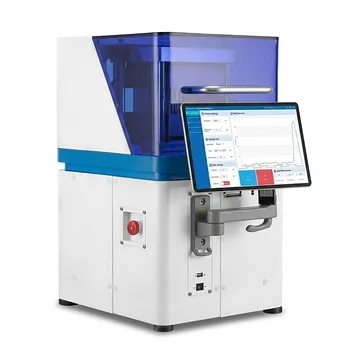
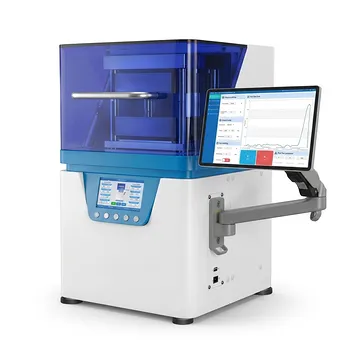
The laboratory plate vulcanizing press is the essential catalyst for transforming raw, plasticized rubber compounds and carbon nanotubes (CNTs) into a high-performance, reinforced elastomer. By applying precise high temperatures—typically 160°C—and high pressures of approximately 20 MPa, the press facilitates a chemical cross-linking reaction known as vulcanization. This process binds the rubber molecular chains and CNTs into a stable, three-dimensional network, granting the final composite its required mechanical strength, elasticity, and dimensional stability.
The core function of the vulcanizing press is to provide a strictly controlled thermal and mechanical environment that triggers chemical bonding while simultaneously densifying the material. This dual action eliminates internal voids and ensures the carbon nanotubes are properly integrated into the rubber matrix for optimal performance.
Driving the Vulcanization Reaction
Catalyzing Molecular Cross-Linking
The primary role of the press is to provide the thermal energy necessary to activate vulcanizing agents within the rubber compound. At temperatures like 160°C, chemical bridges form between polymer chains, transitioning the material from a moldable "green" state to a resilient elastomer.
Forming a Stable 3D Network
Under continuous pressure, these cross-links develop into a permanent three-dimensional structure. This network locks the Carbon Nanotubes in place, ensuring that the reinforcement provided by the nanotubes is consistent throughout the entire volume of the sample.
Ensuring Chemical Uniformity
Precise temperature control across the heating plates ensures that the vulcanization rate is identical at the core and the surface. This uniformity is critical for producing standardized test samples that exhibit predictable physical and chemical properties.
Achieving Structural Density and Homogeneity
Eliminating Internal Porosity
High axial pressure is utilized to exhaust trapped air and volatile gases from the mixed composite powders or compounds. By removing these microscopic voids, the press prevents internal defects that could lead to structural failure or cracking during use.
Optimizing Particle Contact
The application of pressure increases the contact area between the rubber matrix and the CNT particles. This proximity enhances atomic diffusion efficiency, which is vital for creating a cohesive material rather than a loose mixture of components.
Infiltration of the Nanotube Network
In thermoplastic or thermosetting matrices, the heated press promotes polymer melting to ensure complete infiltration of the CNT network. This ensures that the nanotubes are fully "wetted" by the matrix, which is a prerequisite for effective stress transfer and mechanical reinforcement.
Enhancing Electrical and Mechanical Properties
Reducing Contact Resistance
For applications requiring electrical conductivity, the press optimizes the contact density between the active materials. By flattening and densifying the CNT/rubber sheets, the press reduces internal resistance and helps establish a continuous conductive path.
Improving Stress Transfer
The high-pressure environment ensures a tight interface between the rubber chains and the high-surface-area nanotubes. This intimacy allows the composite to effectively distribute mechanical loads, significantly increasing the tensile strength and toughness of the final product.
Locking in Dimensional Stability
Some processes utilize a "cold pressing" stage following the hot press, using circulating water to rapidly lower the temperature. This "freezes" the molecular orientation and dimensions, ensuring the final part matches the mold's precision with minimal shrinkage.
Understanding the Trade-offs
The Risk of Over-Vulcanization
Maintaining high temperatures for too long can lead to over-vulcanization, which causes the rubber to become brittle and lose its elastic properties. This degradation can also negatively impact the interface with the CNTs, reducing the overall durability of the composite.
Pressure-Induced Material Stress
While high pressure is necessary for densification, excessive force can sometimes damage the delicate structure of certain nanotubes or cause non-uniform density gradients. Finding the balance between "green strength" and material integrity is a common challenge for technicians.
Thermal Gradients in Large Samples
In thicker samples, the outer layers may vulcanize faster than the core, leading to internal stresses or "uncured" centers. This requires careful calibration of the press's heating rate and dwell time to ensure a fully cured, homogeneous specimen.
How to Apply This to Your Project
- If your primary focus is mechanical durability: Prioritize precise pressure control to ensure maximum densification and the elimination of all internal voids.
- If your primary focus is electrical conductivity: Focus on the dwell time at peak temperature to allow the polymer to fully infiltrate the CNT network without degrading the nanotubes.
- If your primary focus is sample repeatability: Utilize a press with high-precision digital temperature monitoring to ensure every batch undergoes an identical thermal history.
By mastering the balance of heat and pressure, you turn a simple mixture of carbon and rubber into a sophisticated engineering material capable of meeting the most demanding technical specifications.
Summary Table:
| Key Function | Mechanism | Impact on Composite |
|---|---|---|
| Vulcanization | Controlled Heat (e.g., 160°C) | Triggers molecular cross-linking and chemical bonding |
| Densification | Axial Pressure (e.g., 20 MPa) | Eliminates internal porosity and prevents structural defects |
| Infiltration | Polymer Melting/Flow | Ensures full wetting of the CNT network for stress transfer |
| Conductivity Enhancement | High-Pressure Contact | Reduces internal resistance and creates conductive paths |
| Dimensional Control | Mold Precision & Cooling | Locks molecular orientation and ensures part accuracy |
Elevate Your Composite Materials with KINTEK
Achieving the perfect balance of heat and pressure is critical for high-performance CNT/rubber composites and advanced battery research. KINTEK specializes in comprehensive laboratory pressing solutions designed for precision and repeatability.
Our extensive range includes:
- Manual and Automatic Presses for versatile lab requirements.
- Heated & Multifunctional Models for complex vulcanization processes.
- Glovebox-Compatible & Isostatic (Cold/Warm) Presses for specialized research environments.
Ensure chemical uniformity and structural integrity in every sample with our industry-leading equipment. Contact KINTEK today to find the ideal pressing solution for your research and development needs!
References
- Young-Soo Park, Kay-Hyeok Ahn. Effect of CNT Diameter on Physical Properties of Styrene-Butadiene Rubber Nanocomposites. DOI: 10.5714/cl.2009.10.4.320
This article is also based on technical information from Kintek Solution Knowledge Base .
Related Products
- 24T 30T 60T Heated Hydraulic Lab Press Machine with Hot Plates for Laboratory
- Automatic High Temperature Heated Hydraulic Press Machine with Heated Plates for Lab
- Automatic Heated Hydraulic Press Machine with Heated Plates for Laboratory
- Automatic Heated Hydraulic Press Machine with Hot Plates for Laboratory
- Automatic Heated Hydraulic Lab Press Machine 200x200 Plate Size for Battery Research and Materials Science
People Also Ask
- Function of a Laboratory Hydraulic Press with Heated Platens in SSE? Enhance Battery Density & Conductivity
- Why is a laboratory hydraulic press with heating plates required for PLA/TEC films? Achieve Precise Sample Integrity
- What role does a laboratory heated hydraulic press play in LTCC? Essential for High-Density Ceramic Lamination
- What is the primary function of a laboratory heated hydraulic press? Mastering Thermoplastic Carbon Fiber Composites
- Why is a laboratory heated hydraulic press utilized during the lamination stage of NASICON green tapes?