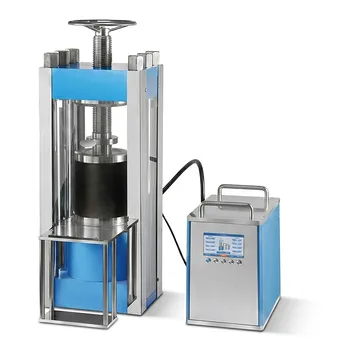
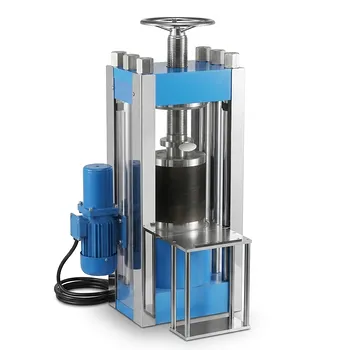
A laboratory press with heating capabilities is the primary tool for densifying composite solid-state electrolytes by simultaneously applying mechanical force and controlled thermal energy. It functions by softening or melting thermoplastic binders so they can fully encapsulate inorganic electrolyte particles. This process, known as hot-pressing, eliminates internal voids and constructs the continuous ion transport channels necessary for efficient battery operation.
The heated laboratory press transforms a loose mixture of polymers and ceramics into a dense, unified film by utilizing heat to facilitate polymer flow. This synchronization of heat and pressure is critical for eliminating internal defects, enhancing mechanical strength, and ensuring low interfacial resistance.
Facilitating Thermal Rheology and Material Flow
Softening the Polymer Matrix
The press applies heat to reach the glass transition temperature ($T_g$) or the melting point ($T_m$) of the polymer binder. In this state, the polymer exhibits thermal rheology, transitioning from a rigid solid to a flowable state.
Encapsulation of Inorganic Fillers
Once the binder is softened or molten, the applied pressure forces it to infiltrate the inorganic filler framework. This ensures that the electrolyte particles are fully encapsulated, creating a cohesive composite structure rather than a loose mixture.
Optimizing Atomic-Level Contact
By combining heat and pressure, the press facilitates interfacial fusion between the polymer and the active materials. This optimizes contact at the atomic level, which is essential for reducing the impedance that often hinders ion movement in solid-state systems.
Achieving Structural Densification
Elimination of Internal Voids
The primary mechanical function of the press is to eliminate macroscopic defects and micropores. By applying high pressure while the binder is fluid, air bubbles are expelled and gaps between ceramic particles are filled.
Construction of Ion Transport Channels
A dense, pore-free membrane is necessary to build continuous ion transport channels. Hot-pressing ensures that the ceramic fillers and the polymer matrix form a seamless network, allowing lithium ions to move through the material without interruption.
High-Pressure Densification Control
Some laboratory presses can apply pressures up to 240 MPa, which is critical for forming a "green body" or a dense pellet. This extreme compaction creates the necessary contact conditions for mass transport and bonding during subsequent processing phases.
Enhancing Battery Longevity and Safety
Mechanical Strength and Flexibility
The hot-pressing process produces a membrane that is both mechanically robust and flexible. This structural integrity is vital for handling the stresses of battery assembly and the volume changes that occur during charge/discharge cycles.
Suppression of Lithium Dendrites
A high-density electrolyte with no internal voids acts as a physical barrier against lithium dendrites. By creating a uniform and void-free film, the heated press helps prevent these needle-like structures from penetrating the electrolyte and causing short circuits.
Reducing Interfacial Impedance
The uniform thermal and pressure environment ensures that the electrolyte bonds tightly to the electrodes or substrates. This tight bonding reduces interfacial impedance, allowing for faster charging and more efficient energy delivery.
Understanding the Trade-offs
Thermal Degradation Risks
While heat is necessary for flow, exceeding the thermal stability limit of the polymer or organic additives can lead to material degradation. Precision temperature control is required to prevent the breakdown of the polymer chains, which would weaken the electrolyte.
Pressure-Induced Particle Fracture
Applying excessive mechanical pressure can crush or fracture brittle ceramic fillers. If the inorganic particles break, it can disrupt the intended ion transport pathways and diminish the overall conductivity of the composite.
Processing Window Complexity
Each composite material has a specific processing window—a narrow range of temperature and pressure where optimal density is achieved. Operating outside this window can result in either insufficient densification (too cold/low pressure) or material squeeze-out and damage (too hot/high pressure).
How to Apply This to Your Research
When using a laboratory press for composite electrolytes, your settings must align with your specific material objectives.
- If your primary focus is Maximum Ionic Conductivity: Prioritize the "melting state" of your binder to ensure the filler particles are perfectly wetted and the ion channels are continuous.
- If your primary focus is Dendrite Suppression: Use higher pressure settings to achieve maximum densification and eliminate all internal micropores that could host dendrite growth.
- If your primary focus is Structural Flexibility: Focus on the glass transition point rather than full melting to maintain the polymer's long-chain integrity while ensuring a strong bond with the ceramic phase.
The controlled application of thermal and mechanical energy remains the most effective method for producing high-performance, solid-state battery components.
Summary Table:
| Process Element | Mechanical/Thermal Mechanism | Research Benefit |
|---|---|---|
| Thermal Rheology | Softens polymer matrix at $T_g$ or $T_m$ | Ensures full encapsulation of inorganic fillers |
| Densification | Applies up to 240 MPa of pressure | Eliminates internal voids and gas bubbles |
| Interfacial Fusion | Atomic-level material contact | Minimizes resistance for faster ion flow |
| Structural Integrity | Simultaneous heat and force application | Enhances flexibility and suppresses dendrites |
Optimize Your Battery Research with KINTEK Precision
Fabricating high-performance solid-state electrolytes requires the perfect balance of heat and pressure. KINTEK specializes in comprehensive laboratory pressing solutions designed for the rigors of battery research. From manual and automatic heated models to multifunctional, glovebox-compatible, and cold/warm isostatic presses, our equipment delivers the density and uniformity your materials demand.
Ready to enhance your lab's efficiency and electrolyte quality? Contact us today to find the perfect pressing solution for your research!
References
- Nan Wang, Xiangxin Guo. Research progress on the application of ultra-thin solid electrolytes in high-energy-density solid-state lithium batteries. DOI: 10.1360/tb-2025-0198
This article is also based on technical information from Kintek Solution Knowledge Base .
Related Products
- Warm Isostatic Press for Solid State Battery Research Warm Isostatic Press
- Lab Heat Press Special Mold
- Automatic High Temperature Heated Hydraulic Press Machine with Heated Plates for Lab
- Split Hot Isostatic Pressing Machine 150 Ton Laboratory Heated Isostatic Press
- Cylindrical Lab Electric Heating Press Mold for Laboratory Use
People Also Ask
- Why must composite cathodes be sealed in vacuum lamination bags for WIP? Ensure Battery Stability and Density
- How do sacrificial volume materials (SVM) maintain microchannels in isostatic pressing? Ensure Structural Integrity
- What is the function of elastic molds in warm isostatic pressing? Achieve Uniform Density in Composite Particles
- How does Warm Isostatic Pressing differ from traditional pressing methods? Unlock Uniform Density for Complex Parts
- What are the advantages of using a Warm Isostatic Press (WIP) for batteries? Achieve Superior Interface Contact