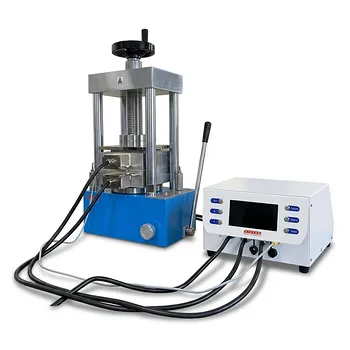
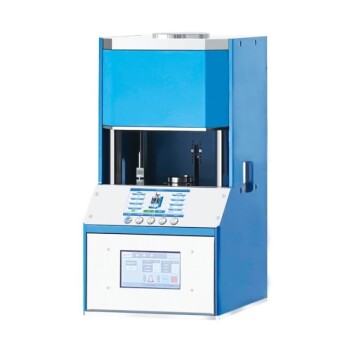
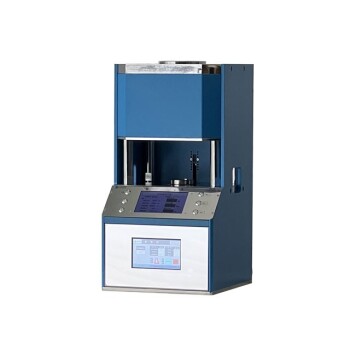
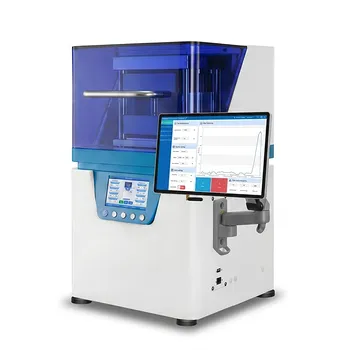
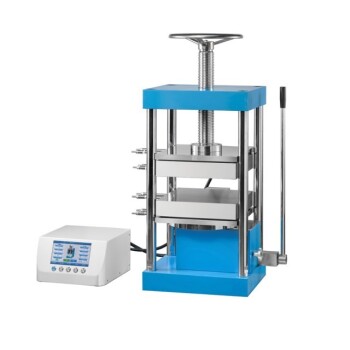
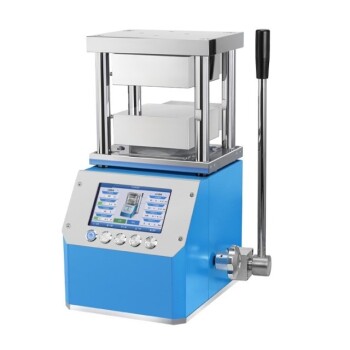
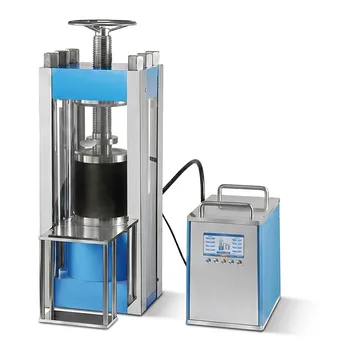
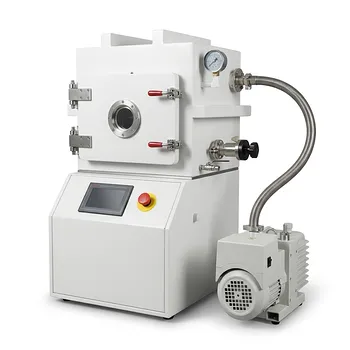
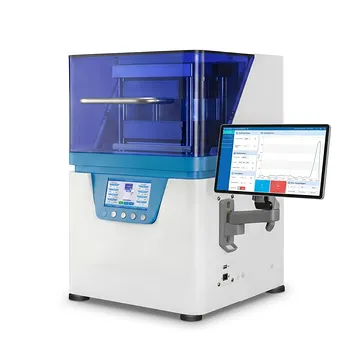
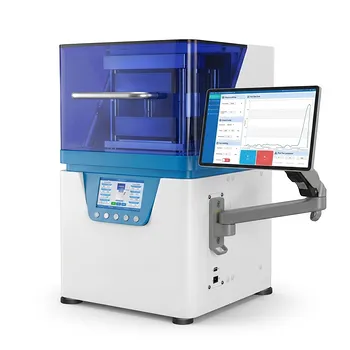
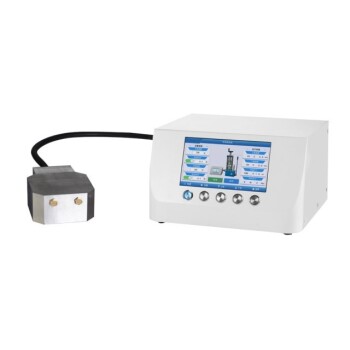
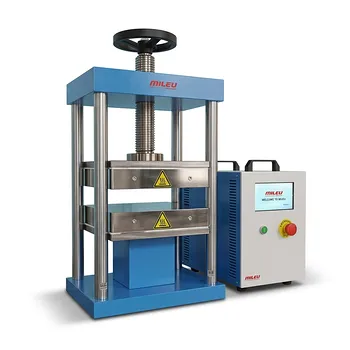
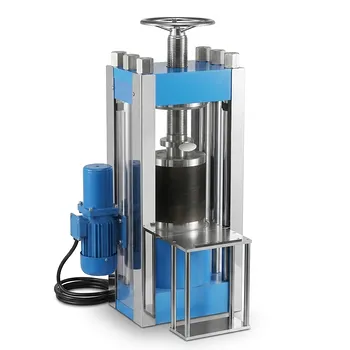
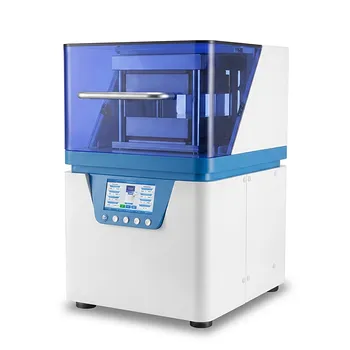
The primary function of a dual-side heated laboratory press in beech wood densification is to create a controlled thermal environment that softens the wood’s internal chemical components. By maintaining temperatures typically around 140°C, the press plasticizes the lignin and hemicellulose within the cell walls, enabling the wood to undergo permanent compressive deformation. This process fundamentally increases the material's density and enhances its overall mechanical properties.
The dual-side heated press serves as a dual-action catalyst, using synchronized heat and pressure to transition wood from a rigid state to a plasticized one. This allows for the structural collapse of cell lumens, effectively "locking" the wood into a higher-density configuration with superior strength.
The Role of Thermal Conditioning
Softening Lignin and Hemicellulose
Beech wood contains natural polymers—lignin and hemicellulose—that act as a rigid matrix. The heated press raises the internal temperature to a specific glass transition point, where these polymers soften and become pliable.
Reducing Viscoelastic Resistance
At room temperature, wood is resistant to permanent compression and tends to "spring back" if pressed. By applying heat (often between 120°C and 160°C), the press reduces this viscoelastic resistance, making the wood fibers easier to rearrange without fracturing the cell wall structure.
Mechanical Structural Rearrangement
Collapsing the Cell Lumens
Once the wood is softened, the press applies uniaxial compressive force to collapse the internal pore volume, or lumens. This reduces the internal porosity of the wood, significantly increasing the proportion of cell wall substance per unit of volume.
Achieving Permanent Deformation
The combination of heat and pressure ensures that the deformation is "set." In specific workflows, this process can achieve a compression rate of 50%, doubling the density of the wood and providing the physical foundation for high-performance applications like Cross-Laminated Timber (CLT).
The Importance of Precision and Uniformity
Uniform Thermal Distribution
Dual-side heating ensures that the thermal energy penetrates the wood sample evenly from both the top and bottom. This uniformity is critical for preventing internal stresses and ensuring the densified layer is consistent throughout the entire thickness of the material.
Precise Pressure Control
Modern laboratory presses provide closed-loop control over both temperature and pressure. This precision determines the final surface hardness and the depth of the densified layer, allowing researchers to repeatably achieve specific material characteristics.
Understanding the Trade-offs and Pitfalls
The Risk of Thermal Degradation
Exceeding the required temperature (typically above 160°C for extended periods) can lead to the thermal degradation of cellulose. This weakens the wood fibers and can result in a brittle final product rather than a toughened one.
The Challenge of "Set-Recovery"
If the wood is not held under pressure until it has sufficiently cooled or "set," it may experience set-recovery (springback). This occurs when the internal stresses are not fully relaxed, causing the wood to partially return to its original thickness when moisture is introduced.
How to Apply This to Your Project
Making the Right Choice for Your Goal
To achieve the best results with a laboratory press, align your parameters with your specific material objectives:
- If your primary focus is Maximum Hardness: Prioritize precise pressure control and higher temperatures (near 150°C) to ensure deep plasticization and total lumen collapse.
- If your primary focus is Dimensional Stability: Focus on the cooling cycle under pressure to ensure the chemical bonds "lock" in place, minimizing the risk of future springback.
- If your primary focus is Surface Aesthetics: Use dual-side heating with highly polished plates to ensure a uniform finish and consistent color across the wood surface.
By mastering the synchronization of heat and pressure, the dual-side laboratory press transforms beech wood from a standard timber into a high-performance, high-density engineered material.
Summary Table:
| Key Feature | Role in Beech Wood Densification | Benefit to Material Performance |
|---|---|---|
| Dual-Side Heating | Uniform thermal penetration (120°C - 160°C) | Prevents internal stress and ensures consistent densification |
| Controlled Temperature | Softens lignin and hemicellulose | Transitions wood from rigid to plastic state for easy deformation |
| Uniaxial Pressure | Collapses internal cell lumens | Increases material density and mechanical strength (up to 50%) |
| Precision Cooling | Sets the structural rearrangement | Minimizes "springback" and ensures long-term dimensional stability |
Optimize Your Material Research with KINTEK
Unlock the full potential of your wood densification projects with KINTEK’s industry-leading laboratory pressing solutions. We specialize in providing the precision and control necessary to achieve superior material properties without the risk of thermal degradation or set-recovery. Our comprehensive range includes:
- Heated Presses (Manual & Automatic): Perfect for precise thermal conditioning and polymer softening.
- Isostatic Presses (Cold & Warm): Widely applied in high-pressure material science and battery research.
- Specialized Models: Multifunctional and glovebox-compatible designs for sensitive research environments.
Whether your primary focus is maximum hardness or dimensional stability, KINTEK offers the technical expertise and equipment to drive your research forward. Contact us today to find your ideal pressing solution!
References
- Adam Síkora, Róbert Németh. Properties of wood-based composites manufactured from densified beech wood in viscoelastic and plastic region of the force-deflection diagram (FDD). DOI: 10.1515/rams-2021-0053
This article is also based on technical information from Kintek Solution Knowledge Base .
Related Products
- 24T 30T 60T Heated Hydraulic Lab Press Machine with Hot Plates for Laboratory
- Automatic Heated Hydraulic Press Machine with Heated Plates for Laboratory
- Automatic High Temperature Heated Hydraulic Press Machine with Heated Plates for Lab
- Automatic Heated Hydraulic Press Machine with Hot Plates for Laboratory
- Automatic Heated Hydraulic Lab Press 120x120mm Plate Fully Automated Material Research Press
People Also Ask
- Function of a Laboratory Hydraulic Press with Heated Platens in SSE? Enhance Battery Density & Conductivity
- Why is a laboratory hydraulic press with heating plates required for PLA/TEC films? Achieve Precise Sample Integrity
- What role does a laboratory heated hydraulic press play in LTCC? Essential for High-Density Ceramic Lamination
- Why reduce load when applying composite strengthening tabs? Protect Specimen Integrity and Data Accuracy
- What role does a laboratory heated hydraulic press play in PI/PA based SPE membranes? Optimize Solid Battery Performance