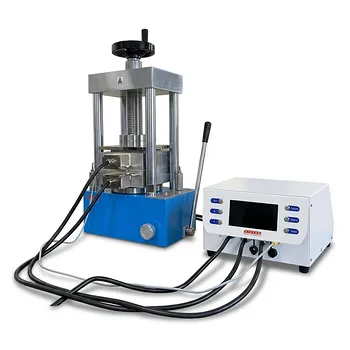
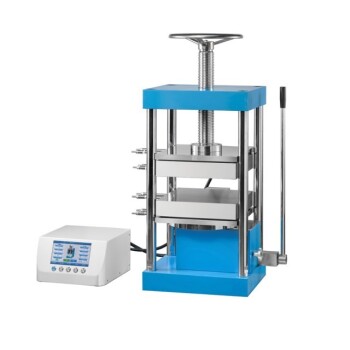
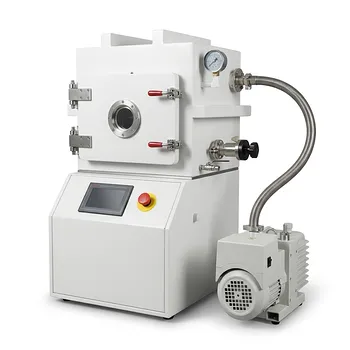
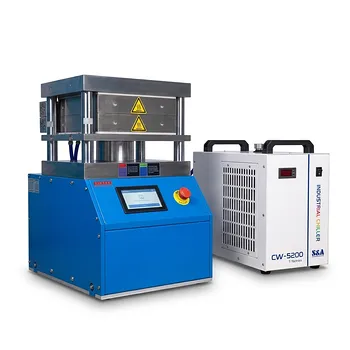
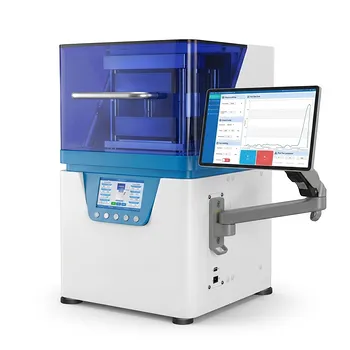
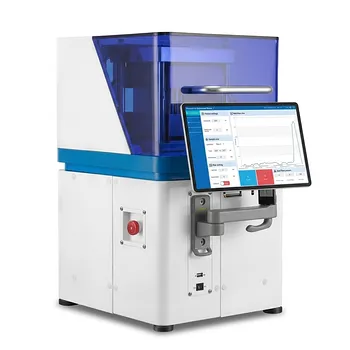
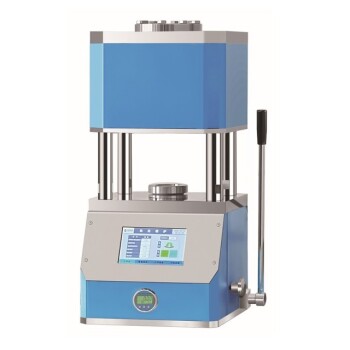
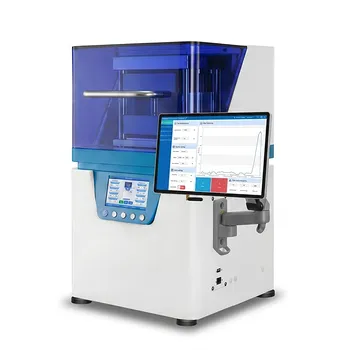
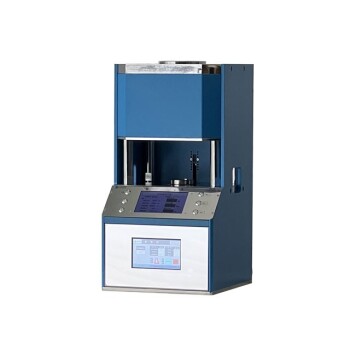
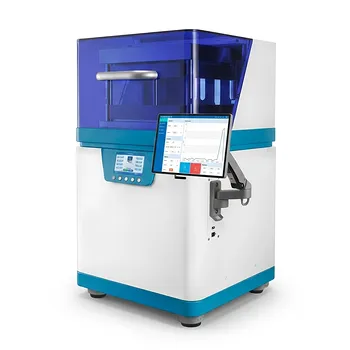
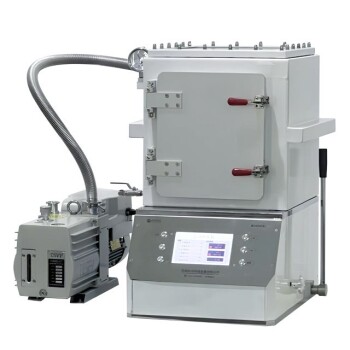
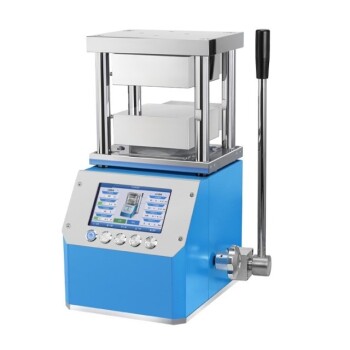
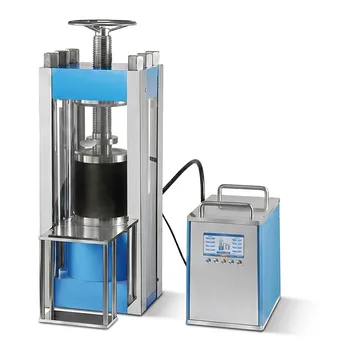
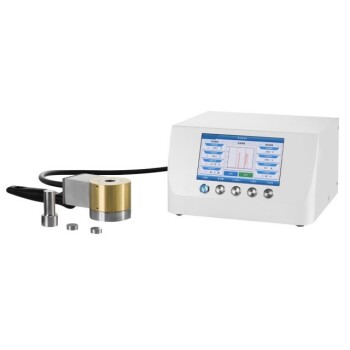
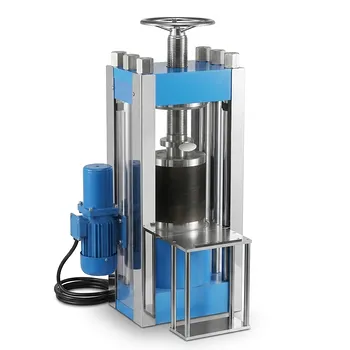
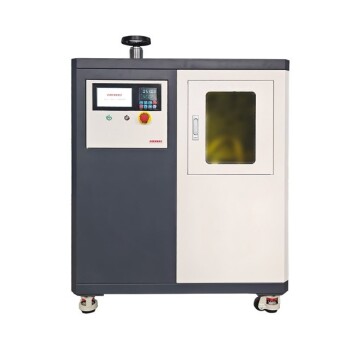
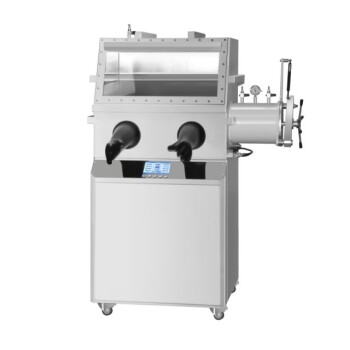
The laboratory hot press serves as the critical tool for the secondary densification and precision molding of solid polymer electrolyte (SPE) films. By applying simultaneous heat and uniform pressure, it transforms pre-formed polymer membranes into dense, homogenous structures while eliminating internal defects like micro-bubbles that can compromise battery safety.
Core Takeaway: The hot-pressing stage is essential for achieving the density, thickness uniformity, and interfacial contact required for high-performance solid-state batteries. It bridges the gap between a raw solvent-casted film and a high-integrity electrolyte capable of resisting dendrite penetration.
Enhancing Microstructural Integrity
Elimination of Internal Porosity
During the initial solvent-casting phase, micro-bubbles and internal pores often remain trapped within the polymer matrix. A hot press applies controlled pressure to collapse these voids, ensuring the electrolyte membrane reaches a state of high density.
Achieving Secondary Densification
Even after drying, polymer films may exhibit a loose molecular structure. The combined action of heat and pressure facilitates molecular chain rearrangement, which significantly increases the compactness of the material compared to simple casting.
Facilitating Homogenous Mixing
At elevated temperatures, the polymer matrix enters a molten or softened state, typically near its glass transition temperature ($T_g$). This allows the polymer chains and lithium salts to mix more thoroughly, optimizing the ion transport pathways throughout the film.
Precision Dimensional Control
Precise Thickness Adjustment
Standard laboratory hot presses allow researchers to compress films to a specific target thickness, such as 120 or 180 micrometers. This precision is vital for maintaining high energy density within the battery cell.
Ensuring Thickness Uniformity
Variation in film thickness leads to uneven current distribution and localized "hotspots" during battery operation. The parallel platens of a hot press ensure uniform thickness across the entire surface area, which is critical for reducing internal resistance.
Impact on Dendrite Resistance
A dense, uniform film acts as a robust physical barrier. By eliminating structural weak points, the hot-pressed electrolyte can effectively prevent the penetration of sodium or lithium dendrites, thereby preventing internal short circuits and extending cycle life.
Interfacial and Mechanical Optimization
Improving Interfacial Wetting
Heat reduces the viscosity of the polymer, allowing it to "wet" the surface of the electrode more effectively. This creates superior contact between the electrolyte and the metal anode, significantly reducing interfacial contact resistance.
Strengthening Mechanical Adhesion
In many fabrication workflows, the hot press is used to bond the electrolyte layer directly to the electrodes. This lamination process strengthens the mechanical adhesion of the interface, ensuring the battery structure remains compact and stable under thermal or mechanical stress.
Enhancing Mechanical Stability
The hot-pressing process optimizes the physical properties of the film, such as its tensile strength. This results in a free-standing electrolyte membrane that is durable enough to be handled during assembly without tearing or deforming.
Understanding the Trade-offs
Thermal Degradation Risks
While heat is necessary to soften the polymer, excessive temperatures can lead to the thermal degradation of the polymer matrix or the lithium salt. It is critical to operate within the specific thermal window of materials like PEO or PVDF.
Pressure-Induced Shorting
Applying excessive pressure (beyond typical ranges like 20 MPa) can result in a film that is too thin, potentially leading to dielectric breakdown or mechanical failure. Finding the "sweet spot" between density and structural integrity is a primary challenge in process optimization.
Viscosity Management
If the temperature is too high, the polymer viscosity may drop too low, causing the material to leak out from the pressing plates. This results in a loss of material and an inability to maintain the target thickness.
How to Apply This to Your Project
When utilizing a laboratory hot press for solid polymer electrolyte fabrication, your parameters should be dictated by your specific performance goals.
- If your primary focus is reducing internal resistance: Prioritize thickness uniformity and interfacial wetting by pressing at temperatures slightly above the polymer's melting point.
- If your primary focus is preventing battery short circuits: Focus on maximum densification and the elimination of micro-bubbles by applying higher pressure (up to 20 MPa) during the molding stage.
- If your primary focus is mechanical handling: Ensure the cooling phase occurs under slight pressure to maintain the flatness and "free-standing" integrity of the membrane.
The laboratory hot press is the definitive tool for refining the raw material into a technically viable, high-performance electrolyte membrane.
Summary Table:
| Key Function | Impact on Solid Polymer Electrolyte (SPE) Films |
|---|---|
| Secondary Densification | Eliminates micro-bubbles and collapses internal voids for a homogenous structure. |
| Dimensional Control | Ensures precise thickness (e.g., 120-180μm) and surface uniformity across the film. |
| Interfacial Wetting | Reduces polymer viscosity to create superior contact with metal anodes. |
| Dendrite Resistance | Increases structural integrity to prevent lithium/sodium dendrite penetration. |
| Mechanical Bonding | Facilitates lamination of the electrolyte layer directly to electrodes. |
Elevate your solid-state battery research with KINTEK’s comprehensive laboratory pressing solutions. We specialize in high-precision equipment including manual, automatic, heated, and multifunctional presses, as well as glovebox-compatible models and cold/warm isostatic presses. Our tools are engineered to help you achieve the perfect densification and interfacial contact required for high-performance materials. Contact KINTEK today to find the ideal pressing solution for your laboratory!
References
- Itziar Aldalur, María Martínez‐Ibáñez. Asymmetric Benzene Sulfonamide Sodium Salt Enabling Stable Cycling in Solid‐State Sodium Metal Batteries. DOI: 10.1002/cssc.202500245
This article is also based on technical information from Kintek Solution Knowledge Base .
Related Products
- 24T 30T 60T Heated Hydraulic Lab Press Machine with Hot Plates for Laboratory
- Laboratory Split Manual Heated Hydraulic Press Machine with Hot Plates
- Heated Hydraulic Press Machine with Heated Plates for Vacuum Box Laboratory Hot Press
- Automatic Heated Hydraulic Press Machine with Hot Plates for Laboratory
- Automatic Large Format Laboratory Heated Hydraulic Press 400x400mm Plate Capacity
People Also Ask
- Function of a Laboratory Hydraulic Press with Heated Platens in SSE? Enhance Battery Density & Conductivity
- Why is a laboratory hydraulic press with heating plates required for PLA/TEC films? Achieve Precise Sample Integrity
- What role does a laboratory heated hydraulic press play in LTCC? Essential for High-Density Ceramic Lamination
- Why reduce load when applying composite strengthening tabs? Protect Specimen Integrity and Data Accuracy
- What role does a laboratory heated hydraulic press play in PI/PA based SPE membranes? Optimize Solid Battery Performance