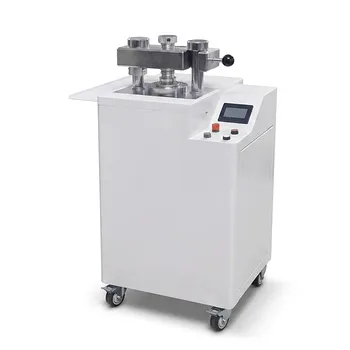
The laboratory precision press is the fundamental instrument used to establish electrochemical pathways and mechanical integrity within a coin cell. It provides the controlled, uniform pressure necessary to ensure tight interfacial contact between electrodes and electrolytes while creating a hermetic seal to protect the battery’s internal chemistry. This precision is the prerequisite for obtaining repeatable, high-quality research data in lithium metal battery development.
The laboratory precision press serves a dual role: it optimizes the internal physical contact required for efficient charge transfer and provides the mechanical sealing necessary to isolate sensitive lithium components from environmental degradation.
Optimizing Electrochemical Interfaces
Minimizing Interfacial Contact Resistance
In lithium metal batteries, such as the Li||NCM811 system, a press provides constant and uniform pressure to bridge gaps between internal layers. This tight contact reduces ohmic internal resistance, allowing for more efficient ion transport across the interfaces.
Ensuring Uniform Electrolyte Wetting
Properly applied pressure forces the electrolyte into the microscopic pores of the separator and across the surface of the lithium metal foil. This process ensures thorough wetting, which is essential for maintaining a stable and uniform current density distribution during cycling.
Enhancing Lithium Metal Consistency
Beyond sealing, high-precision presses are used to compress raw lithium metal into thin-film electrodes with uniform density and thickness. By eliminating internal voids and surface defects in the lithium’s body-centered cubic (bcc) lattice, the press helps prevent the non-uniform current distribution that accelerates dendrite nucleation.
Ensuring Mechanical and Environmental Integrity
Achieving Hermetic Encapsulation
The press applies precise radial pressure to join the battery case, spring, gasket, and electrodes into a single unit. This mechanical sealing is vital for preventing the volatilization of the electrolyte and ensuring the cell remains functional throughout long-term cycle life tests.
Preventing Environmental Contamination
Lithium metal is highly reactive to moisture and oxygen. A laboratory press provides a rigorous seal that prevents the ingress of air and moisture, which would otherwise lead to parasitic reactions and the premature failure of the cell.
Simulating Operational Stack Pressure
In commercial battery packs, cells are often held under specific mechanical loads. A precision press allows researchers to simulate the stack pressure found in real-world operating environments, making laboratory results more representative of actual performance.
Understanding the Trade-offs and Critical Risks
The Danger of Over-Compression
Applying excessive force during the assembly process can damage the microporous structure of the separator. If the separator is crushed, it may lead to internal short circuits or restricted ion flow, effectively ruining the test cell.
The Consequences of Insufficient Pressure
If the pressure is too low, the battery will suffer from high interfacial impedance. This lack of contact results in poor electrochemical performance, inaccurate stripping and plating test results, and a lack of repeatability across different test batches.
Managing Mechanical Variations
Even slight variations in sealing pressure can lead to inconsistent results in critical current density measurements. Maintaining a highly reproducible pressing process is the only way to ensure that differences in battery performance are due to material chemistry rather than assembly flaws.
How to Apply This to Your Research
Selecting the Right Approach for Your Goal
- If your primary focus is high-current density testing: Prioritize a press with micron-level control to ensure the lithium foil surface is perfectly flat, minimizing the risk of early dendrite growth.
- If your primary focus is solid-state or polymer electrolytes: Use a press capable of maintaining high, constant pressure to ensure a seamless interface between the solid electrolyte membrane and the metal anode.
- If your primary focus is long-term cycling stability: Invest in a press that emphasizes radial sealing precision to prevent electrolyte "dry-out" or moisture infiltration over months of testing.
By mastering the application of mechanical pressure, researchers can transform sensitive raw materials into a reliable, hermetically sealed environment for accurate electrochemical analysis.
Summary Table:
| Key Role | Primary Benefit | Research Impact |
|---|---|---|
| Interfacial Contact | Reduces ohmic resistance | Faster ion transport & higher efficiency |
| Hermetic Sealing | Prevents air/moisture ingress | Prevents parasitic reactions & cell failure |
| Pressure Uniformity | Minimizes surface defects | Prevents dendrite nucleation & short circuits |
| Stack Simulation | Replicates real-world loads | Produces representative performance data |
Elevate Your Battery Research with KINTEK Precision Solutions
Achieving repeatable, high-quality data requires the right mechanical load. KINTEK specializes in comprehensive laboratory pressing solutions tailored for battery research, including:
- Manual & Automatic Presses for consistent sealing pressure.
- Heated & Multifunctional Models for advanced material synthesis.
- Glovebox-Compatible Designs to protect sensitive lithium chemistry.
- Cold & Warm Isostatic Presses for high-density electrode development.
Ensure the integrity of your coin cells and optimize electrochemical performance with our industry-leading equipment. Contact KINTEK today to find the perfect press for your lab!
References
- Lanlan Zuo, Yufang Chen. Anion-tethered interface engineering enabling dendrite-free lithium metal anodes. DOI: 10.1039/d5cc03176a
This article is also based on technical information from Kintek Solution Knowledge Base .
Related Products
- Assemble Square Lab Press Mold for Laboratory Use
- Lab Button Battery Tablet Press Sealing Mold
- Assemble Lab Cylindrical Press Mold for Laboratory Use
- Lab Polygon Press Mold
- Button Battery Sealing Press Machine for Lab
People Also Ask
- What is the purpose of incorporating cartridge heaters into a lab press mold for MLCC block compression? Optimize Results
- Why is a high-performance laboratory molding press critical for in-situ electrolyte formation? Unlock Battery Success
- How does the geometry of laboratory molds influence mycelium-based composites? Optimize Density and Strength
- What challenges are associated with recycling textiles, and how do laboratory presses help? Overcome Recycling Hurdles with Precision Tools
- What are the common applications for laboratory presses? Expert Guide to Sample Prep, R&D, and Quality Control