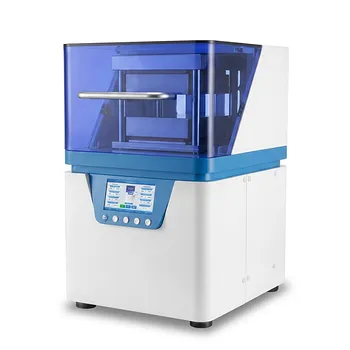
The integration of a hydraulic press within a vacuum glovebox is a non-negotiable requirement for ternary III-C-N semiconductor synthesis due to the material's extreme sensitivity to environmental contaminants. This configuration allows for the mold loading and high-pressure forming stages to occur within a high-purity inert gas atmosphere, effectively shielding the raw powders from oxygen and moisture. By isolating these reactive materials, researchers can prevent premature oxidation or hydrolysis, which is critical for maintaining the precise stoichiometry necessary for functional semiconductor devices.
Core Takeaway: To achieve the high-purity electrical characteristics required for III-C-N compounds, the entire powder metallurgy workflow—from measurement to pressing—must be conducted in a hermetically sealed, inert environment to prevent irreparable material degradation.
Maintaining Chemical and Structural Integrity
Prevention of Oxidation and Hydrolysis
Ternary III-C-N semiconductor compounds are exceptionally prone to reacting with ambient moisture and oxygen. Even brief exposure during the molding process can trigger oxidation or hydrolysis, chemically altering the raw materials before they are even pressed.
Preservation of Stoichiometric Precision
Semiconductor performance depends entirely on the exact ratio of elements within the crystal lattice. By conducting the pressing process in a vacuum glovebox, the stoichiometric balance of the ternary compound is preserved, ensuring that the final material exhibits the intended bandgap and electron mobility.
Protection of Electrical Characteristics
Any introduction of oxygen or water vapor acts as a dopant or impurity within the semiconductor structure. Utilizing a glovebox-integrated press ensures the high-purity environment required to produce samples with consistent and predictable electrical properties.
Achieving Material Density and Strength
The Role of Hydraulic Force in Densification
Beyond atmospheric control, the hydraulic press is essential for the densification of the ceramic powders. High-pressure application reduces the porosity of the green body, which is a prerequisite for successful solid-phase reactions during subsequent sintering.
Enhancement of Mechanical Properties
The uniform application of force within the inert environment results in a more homogeneous compact. This leads to enhanced mechanical properties, such as fracture toughness and structural stability, which are vital for the durability of the semiconductor component.
Facilitating Solid-Phase Reactions
When using a hydraulic hot press, the combination of high temperature and pressure in a vacuum allows for solid-phase reactions that would be impossible at atmospheric pressure. This method produces materials with superior grain structures and minimal internal defects.
Understanding the Trade-offs and Challenges
Complexity of Maintenance and Calibration
Operating a hydraulic press inside a sealed vacuum glovebox significantly increases maintenance complexity. Accessing the press for repairs or routine calibration requires breaching the inert seal or using restrictive glove ports, which can lead to downtime.
Thermal Management Constraints
Hydraulic systems and hot-press components generate significant heat, which can be difficult to dissipate within a closed glovebox environment. Effective cooling systems must be integrated to prevent the inert gas temperature from rising, which could otherwise damage the glovebox seals or affect the powder properties.
Spatial and Ergonomic Limitations
Integrating heavy machinery into a vacuum chamber creates spatial constraints that make mold handling more difficult for the operator. The limited range of motion provided by the gloves can lead to slower processing times and a higher risk of accidental spills or tool damage.
How to Apply This to Your Project
Selecting the Right Integration Strategy
- If your primary focus is maximized purity: Choose a fully automated internal press system to minimize human intervention and potential glove breaches.
- If your primary focus is high-volume densification: Prioritize a hydraulic press with integrated heating elements (hot pressing) to facilitate faster solid-phase reactions.
- If your primary focus is cost-sensitive R&D: Utilize a modular glovebox design that allows for the removal of the press for maintenance without compromising the entire vacuum system.
By strictly isolating the pressing stage from the external atmosphere, you ensure that the fundamental physics of your III-C-N compounds remain uncompromised.
Summary Table:
| Key Feature | Benefit | Impact on III-C-N Materials |
|---|---|---|
| Inert Atmosphere | Prevents Oxidation & Hydrolysis | Protects electrical properties & material purity. |
| Hydraulic Force | Increases Material Densification | Enhances mechanical strength and fracture toughness. |
| Vacuum Integration | Preserves Stoichiometric Balance | Ensures consistent bandgap and electron mobility. |
| Thermal Control | Enables Solid-Phase Reactions | Produces superior grain structures with minimal defects. |
Optimize Your Advanced Material Synthesis with KINTEK
Maintaining the integrity of sensitive ternary III-C-N compounds requires precision equipment designed for extreme environments. KINTEK specializes in comprehensive laboratory pressing solutions, offering manual, automatic, heated, multifunctional, and glovebox-compatible models, as well as cold and warm isostatic presses.
Whether you are leading breakthrough battery research or developing next-generation semiconductors, our experts are here to help you integrate the perfect hydraulic system into your workflow. Ensure maximum material purity and structural excellence—contact KINTEK today to discuss your project requirements!
References
- D. M. Hoyle, Tom McLeish. Large amplitude oscillatory shear and Fourier transform rheology analysis of branched polymer melts. DOI: 10.1122/1.4881467
This article is also based on technical information from Kintek Solution Knowledge Base .
Related Products
- Laboratory Hydraulic Press Lab Pellet Press Machine for Glove Box
- Automatic Hydraulic Heat Press Machine with Multi Stage Programmable Control and Integrated Water Cooling Plate Size 180x180mm
- Manual Heated Hydraulic Lab Press with Integrated Hot Plates Hydraulic Press Machine
- Heated Hydraulic Press Machine with Heated Plates for Vacuum Box Laboratory Hot Press
- Heated Hydraulic Press Machine With Heated Plates For Vacuum Box Laboratory Hot Press
People Also Ask
- How does a laboratory hydraulic press contribute to the preparation of Li3-3xScxSb samples? Optimize Ionic Conductivity
- What is the function of a laboratory hydraulic press in FT-IR of curcumin-coated MWCNTs? Achieve Optical Clarity.
- Why is a laboratory hydraulic press required for compression molding boron-siloxane? Solve High-Loading Density Challenges
- What role does a laboratory hydraulic press play in reaction pellets? Optimizing Lunar Soil and Metal Fuel Density
- What role does a laboratory hydraulic press play in the preparation of piezoelectric ceramic discs for DC-PG? | KINTEK