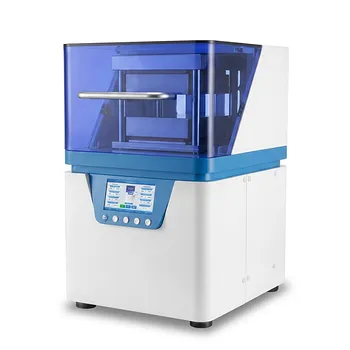
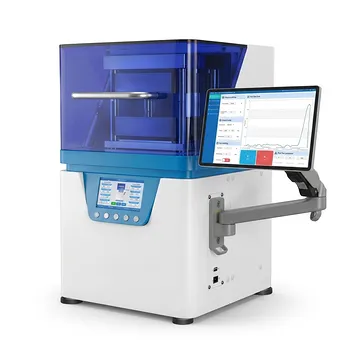
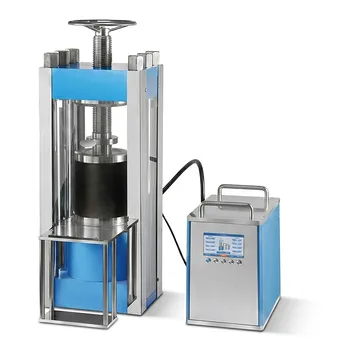
The heated platen press is the central engine of the thermoforming process, acting as the mechanism that transforms raw hemp fibers and polypropylene (PP) into a unified, high-performance composite. By providing a precisely controlled environment of simultaneous heat and pressure, the press melts the thermoplastic matrix and forces it to encapsulate the reinforcement fibers, ensuring structural integrity and geometric precision.
Core Takeaway: The heated platen press serves as the critical interface where thermal energy and mechanical force converge to eliminate internal voids, facilitate molecular bonding between the polypropylene and hemp, and dictate the final physical properties of the composite material.
The Fundamental Role: Thermal Transformation and Wetting
Achieving the Melting Point of Polypropylene
The primary function of the press is to provide the thermal energy required to reach the melting point of the polypropylene component, typically between 160°C and 180°C. Once the PP fibers or pellets transition into a molten state, they gain the fluidity necessary to act as a matrix.
Facilitating Fiber Encapsulation
Uniform heating across the platens ensures that the molten polypropylene can thoroughly wet and encapsulate the hemp fibers. This "wetting" is essential because any fiber not fully coated by the plastic matrix will act as a point of structural failure in the finished part.
Inducing the Glass Transition of Natural Components
Beyond melting the plastic, the heat allows natural resins like lignin on the surface of the hemp fibers to reach their glass transition temperature. This softening allows the natural fibers to become more pliable, assisting in the creation of a more compact and integrated fiber network.
The Synergy of Heat and Pressure
Eliminating Internal Voids and Micro-bubbles
Pressure is applied simultaneously with heat to compact the fiber network and eliminate internal air pockets or micro-bubbles. These voids are detrimental to the material's performance, as they create internal stress concentrations and paths for moisture ingress.
Ensuring Uniformity and Geometric Precision
The mechanical force of the press ensures the composite attains a uniform thickness and consistent microstructure across the entire surface area. By using metal molds within the platens, the press forces the material to conform to specific geometric dimensions required for standardized testing or industrial application.
Consolidation and Density Optimization
The coupling of high temperature and pressure—often reaching tens of kilonewtons—significantly increases the material's density. This consolidation is directly responsible for enhancing the tensic strength, ring crush strength, and overall barrier properties of the hemp-PP composite.
Structural and Mechanical Optimization
Controlling Interfacial Bonding
The press creates the thermophysical conditions necessary for effective bonding between the reinforcement (hemp) and the matrix (PP). A strong interfacial bond is the most critical factor in determining how well the composite will transfer loads under stress.
Managing Crystallization and Morphology
By accurately adjusting the cooling rate and the temperature distribution of the platens, the press allows for the fine control of the polymer’s crystallization behavior. This microscopic morphology dictates the final material's stiffness, impact resistance, and long-term durability.
Simulating Industrial Production
In a laboratory setting, the heated press serves as a high-precision simulator for industrial-scale thermoforming. It allows researchers to establish the ideal "dwell time" (how long the material stays under heat) and pressure profiles needed for mass manufacturing.
Understanding the Trade-offs
Risk of Thermal Degradation
A common pitfall is the over-application of heat; while PP requires high temperatures to melt, hemp fibers are organic and will begin to degrade if exposed to excessive heat for too long. This degradation weakens the fibers and can lead to discoloration and a loss of mechanical strength.
Balancing Pressure and Fiber Integrity
Excessive pressure can crush the hemp fibers or cause "fiber wash," where the reinforcement is pushed to the edges of the mold, resulting in uneven fiber distribution. Conversely, insufficient pressure leaves the material porous and structurally weak.
The Impact of Dwell Time
The duration the material remains in the press (dwell time) is a delicate balance. If the time is too short, the PP will not fully infiltrate the hemp network; if it is too long, the energy cost increases and the risk of polymer chain scission or fiber burning rises.
How to Apply This to Your Project
Recommendations for Optimization
- If your primary focus is Maximum Mechanical Strength: Prioritize the synergy of high pressure and precise temperature control (170°C-180°C) to ensure the lowest possible porosity and the strongest interfacial bond.
- If your primary focus is Dimensional Stability: Focus on the cooling phase of the press cycle, using a controlled cooling rate to manage polymer crystallization and prevent warping.
- If your primary focus is Processing Speed: Optimize the dwell time by finding the minimum duration required for the molten PP to fully wet the hemp fibers without triggering thermal degradation.
By mastering the balance of heat, pressure, and time within the platen press, you can tailor the hemp-polypropylene composite to meet specific industrial requirements while maintaining material efficiency.
Summary Table:
| Function | Impact on Composite Quality | Key Parameter |
|---|---|---|
| Thermal Melting | Liquefies PP matrix to allow for fiber wetting | 160°C - 180°C |
| Pressure Synergy | Eliminates internal voids and air bubbles | Tens of kilonewtons |
| Bonding Control | Establishes the interface for load transfer | Dwell Time |
| Morphology Control | Dictates crystallization, stiffness, and durability | Cooling Rate |
Elevate Your Material Research with KINTEK
Achieve the perfect balance of heat and pressure for your sustainable composite projects. KINTEK specializes in comprehensive laboratory pressing solutions, offering manual, automatic, heated, multifunctional, and glovebox-compatible models. Our high-precision presses, including cold and warm isostatic options, are widely applied in battery research and advanced material science to ensure structural integrity and geometric precision.
Ready to optimize your thermoforming process? Contact us today to find the ideal pressing solution for your lab!
References
- Emilia Ciupan, Emanuela Pop. Characterization of a thermoforming composite material made from hemp fibers and polypropylene. DOI: 10.1051/matecconf/201713708003
This article is also based on technical information from Kintek Solution Knowledge Base .
Related Products
- Automatic High Temperature Heated Hydraulic Press Machine with Heated Plates for Lab
- Heated Hydraulic Press Machine With Heated Plates For Vacuum Box Laboratory Hot Press
- Automatic Hydraulic Heat Press Machine with Multi Stage Programmable Control and Integrated Water Cooling Plate Size 180x180mm
- Automatic Heated Hydraulic Lab Press Machine 200x200 Plate Size for Battery Research and Materials Science
- Manual Heated Hydraulic Lab Press with Integrated Hot Plates Hydraulic Press Machine
People Also Ask
- Function of a Laboratory Hydraulic Press with Heated Platens in SSE? Enhance Battery Density & Conductivity
- How does a laboratory heated hydraulic press facilitate PBN sample prep for WAXS? Achieve Precise X-Ray Scattering
- What are the requirements for electrode pressing with high-viscosity ionic liquids like EMIM TFSI? Optimize Performance
- What are the industrial applications of heated hydraulic presses? Master Heat & Force for Precision Manufacturing
- Why is a laboratory hydraulic press with heating plates required for PLA/TEC films? Achieve Precise Sample Integrity