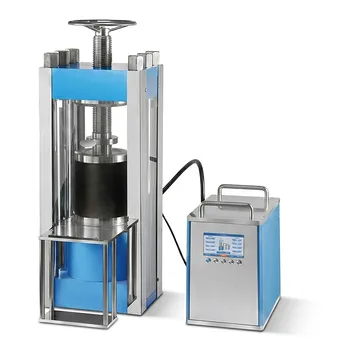
In the production of thermoplastic nanocomposites, a laboratory hot press acts as the critical bridge between raw materials and standardized test specimens. By applying simultaneous high temperature and precise mechanical pressure, the press melts the polymer matrix and consolidates it with nanoparticle fillers. This dual-action process eliminates internal voids and locks the nanoparticle network within the matrix, ensuring the resulting samples possess high density and uniform microstructures suitable for mechanical characterization.
The laboratory hot press is indispensable for transforming loose composite granules into high-performance solids. It ensures material integrity by facilitating polymer flow, eliminating air entrapment, and enabling the precise control of the material's internal morphology.
Facilitating Material Consolidation and Density
Eliminating Internal Voids and Porosity
The primary function of a hot press is to apply uniform pressure (often ranging from 3 MPa to 10 MPa) to the molten polymer. This pressure forces out trapped air and micro-bubbles that naturally occur during the mixing of nanoparticles and resins. By removing these defects, the equipment produces high-density specimens with extremely low porosity, which is vital for obtaining accurate data during subsequent mechanical or thermal testing.
Ensuring Full Polymer Flow and Wetting
At temperatures exceeding the polymer's melting point or glass transition temperature (such as 200°C for common thermoplastics), the matrix reaches a low-viscosity state. The hot press provides the necessary environment for this "melt" to flow completely around and through the nanoparticle clusters. This thorough wetting is essential for creating a strong interface bond between the matrix and the reinforcement.
Engineering the Nanostructure and Morphology
Locking the Nanoparticle Network
Once the nanoparticles are dispersed within the melt, the simultaneous application of heat and pressure helps in the rearrangement of reinforcing fillers. As the press holds the material at a specific dwell time, it "locks" the nanoparticle network into a stable configuration. This prevents the particles from re-agglomerating as the material cools, ensuring a consistent distribution throughout the sample.
Controlling Crystallization and Phase Structure
A laboratory hot press allows researchers to manage the cooling rate and temperature distribution across the heating plates. This level of control is fundamental for studying crystallization behavior and phase separation in nanocomposites. By adjusting these parameters, a technician can influence the microscopic morphology, which ultimately dictates the material's final strength and thermal stability.
Standardizing Samples for Reliable Testing
Achieving Uniform Thickness and Surface Finish
The precision of a hydraulic lab press ensures that bulk materials are compressed into sheets with uniform thickness and smooth, parallel surfaces. This geometric consistency is a prerequisite for standardized testing (such as ASTM or ISO standards). Without this uniformity, test results for interlaminar sliding, friction, or tensile strength would be highly variable and unreliable.
Simulating Industrial Processing Conditions
Laboratory hot presses are designed to simulate industrial-scale hot-pressing and thermoforming processes. This allows researchers to study polymer rheological behavior and multi-layer interface bonding in a controlled environment. By replicating these conditions on a smaller scale, labs can predict how a new nanocomposite will perform during mass production.
Understanding the Trade-offs and Pitfalls
Thermal Degradation from Excessive Dwell Time
While heat is necessary for melting, holding a thermoplastic nanocomposite at high temperatures for too long (excessive dwell time) can lead to polymer degradation. This breaks down molecular chains, weakening the matrix and negating the reinforcing benefits of the nanoparticles. Finding the balance between "full flow" and "thermal stability" is a critical challenge.
Pressure-Induced Particle Agglomeration
In some cases, applying excessive pressure too quickly can actually force nanoparticles together, causing agglomeration rather than maintaining a fine dispersion. Furthermore, if the cooling rate is not strictly controlled, internal stresses can develop within the sample. These stresses may lead to warping or microscopic cracks, compromising the integrity of the test specimen.
How to Apply This to Your Project
Recommendations for Molding Success
Proper utilization of a hot press requires aligning machine parameters with your specific material requirements and research goals.
- If your primary focus is maximizing mechanical strength: Prioritize high pressure (up to 10 MPa) and sufficient dwell time to ensure total void elimination and superior interface bonding.
- If your primary focus is studying crystallization kinetics: Focus on the precision of the cooling rate and plate temperature distribution to capture specific phase transitions.
- If your primary focus is minimizing material degradation: Utilize the minimum effective temperature (just above the melting point) and the shortest possible dwell time required for consolidation.
Mastering the balance of temperature, pressure, and time allows for the creation of nanocomposite samples that truly reflect the potential of the engineered material.
Summary Table:
| Key Role | Mechanical Process | Resulting Material Impact |
|---|---|---|
| Consolidation | High uniform pressure (3-10 MPa) | Eliminates internal voids and air bubbles |
| Interface Wetting | Simultaneous heat & pressure | Ensures polymer flow around nanoparticle clusters |
| Morphology Control | Regulated dwell time & cooling | Locks the nanoparticle network & manages crystallization |
| Standardization | Precision plate alignment | Achieves uniform thickness for ASTM/ISO testing |
| Simulation | Scaled-down thermal processing | Replicates industrial-scale thermoforming conditions |
Elevate Your Materials Research with KINTEK Precision
Achieving the perfect nanostructure requires more than just heat—it requires precise, repeatable control. KINTEK specializes in comprehensive laboratory pressing solutions designed for the most demanding research environments. Whether you are performing advanced battery research or developing next-generation nanocomposites, our range of equipment ensures your samples meet the highest standards of density and uniformity.
Our Solutions Include:
- Manual & Automatic Heated Presses for streamlined specimen production.
- Multifunctional & Glovebox-Compatible Models for sensitive material handling.
- Cold and Warm Isostatic Presses (CIP/WIP) for superior isotropic density.
Ready to eliminate voids and master your material morphology? Contact our technical experts today to find the ideal pressing solution for your laboratory.
References
- Ruben Windey, Martine Wevers. Ultrasonication optimisation and microstructural characterisation for 3D nanoparticle dispersion in thermoplastic and thermosetting polymers. DOI: 10.1016/j.compositesb.2023.110920
This article is also based on technical information from Kintek Solution Knowledge Base .
Related Products
- Lab Heat Press Special Mold
- Cylindrical Lab Electric Heating Press Mold for Laboratory Use
- Special Shape Lab Press Mold for Laboratory Applications
- Lab Round Bidirectional Press Mold
- Lab Double Plate Heating Mold for Laboratory Use
People Also Ask
- How is a laboratory heat press used to evaluate bio-based aliphatic polyesters? Prepare Reliable Samples for Analysis
- How is a laboratory heat press utilized in MEA preparation? Achieve High-Efficiency Iron-Chromium Redox Flow Batteries
- Why is a laboratory heat press necessary for biodegradable films? Unlock Precision Bonding and Barrier Performance
- What is the purpose of incorporating cartridge heaters into a lab press mold for MLCC block compression? Optimize Results
- Why is a laboratory heated press utilized in the preparation of PPC-PCLT copolymer films? Master Uniform Film Production