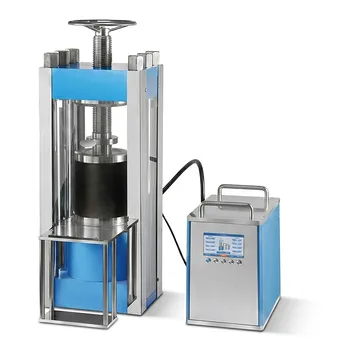
Material transformation requires simultaneous control over thermal energy and mechanical force. A benchtop hydraulic press with heating functions is essential because it transitions plasticized cellulose acetate from a solid or kneaded state into a uniform, molten flow. This dual-action process ensures the material perfectly fills the mold while eliminating internal defects that would otherwise compromise the structural integrity of the sheet.
The heated hydraulic press acts as a precision molding environment that eliminates physical inconsistencies. By maintaining a constant temperature and high pressure, it ensures the production of dense, bubble-free sheets with the exact thickness and uniformity required for rigorous mechanical or spectroscopic analysis.
Facilitating Material Flow and Mold Saturation
Transitioning to a Molten State
Cellulose acetate, when plasticized, requires specific thermal energy to reach a molten state suitable for shaping. The heating elements in the press lower the material's viscosity, allowing it to flow and fill every cavity of the mold.
Ensuring Homogeneous Distribution
Under high pressure, the molten polymer is forced to distribute itself evenly across the mold surface. This prevents the formation of density gradients, ensuring that the physical properties of the sheet are consistent from the center to the edges.
Eliminating Structural Imperfections
Removing Internal Air Entrapment
One of the primary roles of the hydraulic press is the effective removal of internal air bubbles. The application of steady, high pressure forces trapped gases out of the polymer melt before it solidifies, preventing weak points in the final sheet.
Achieving Dimensional Precision
Standardized testing requires sheets with precise thickness requirements, often as thin as 0.3 mm. The hydraulic system provides the stable, repeatable force necessary to compress the material to an exact, uniform gauge across the entire surface area.
Optimizing Molecular Structure for Performance
Facilitating Molecular Rearrangement
The combination of heat and pressure facilitates the secondary rearrangement of molecules within the cellulose acetate. This molecular alignment is critical for achieving the desired mechanical strength and "isotropic" (uniform in all directions) properties.
Preparing Samples for Analytical Accuracy
For techniques like FTIR or XRF spectroscopy, the sample must be thin and homogenous to allow for accurate light or X-ray transmission. The press ensures the sample is sufficiently compacted and dense, which is vital for obtaining reliable, representative analytical data.
Understanding the Trade-offs
Risk of Thermal Degradation
While heat is necessary for flow, excessive temperature or prolonged exposure can lead to the thermal degradation of the polymer chains. This can result in discoloration or a loss of mechanical properties, requiring the operator to balance heat levels and press time carefully.
Pressure Consistency vs. Material Stress
Applying pressure too rapidly can induce internal stresses within the plasticized sheet, leading to warping once the pressure is released. Precise hydraulic control is required to ramp pressure effectively without compromising the material's dimensional stability.
How to Apply This to Your Laboratory Goals
Choosing Your Process Parameters
The specific settings for your benchtop press should be dictated by the final application of the cellulose acetate sheet.
- If your primary focus is mechanical characterization (Tensile/DMTA): Prioritize uniform density and the elimination of air voids to ensure the sample represents the material's true strength.
- If your primary focus is spectroscopic analysis (FTIR/XRF): Focus on achieving the thinnest possible uniform film to ensure optimal signal transparency and representative sampling.
- If your primary focus is lamination or composite assembly: Ensure the sheet has a highly consistent thickness profile to prevent de-lamination or pressure spots during the subsequent bonding stages.
By mastering the balance of heat and pressure, you transform raw cellulose acetate into a high-quality, standardized material ready for definitive scientific evaluation.
Summary Table:
| Feature | Function in Cellulose Acetate Prep | Key Benefit |
|---|---|---|
| Heating Elements | Lowers viscosity to reach a molten state | Ensures complete mold filling and flow |
| Hydraulic Pressure | Forces distribution and air expulsion | Eliminates internal defects and bubbles |
| Precision Control | Maintains constant temperature & pressure | Achieves uniform thickness (down to 0.3mm) |
| Molecular Alignment | Facilitates secondary rearrangement | Enhances mechanical strength and isotropy |
Elevate Your Material Research with KINTEK Precision
Achieve uncompromising sample quality with KINTEK’s comprehensive laboratory pressing solutions. Whether you are preparing plasticized cellulose acetate sheets for spectroscopic analysis or advancing battery research, our range of manual, automatic, heated, and isostatic presses provides the exact thermal and mechanical control your laboratory demands.
Why choose KINTEK?
- Versatility: Solutions ranging from heated benchtop models to glovebox-compatible systems.
- Precision: Maintain stable, repeatable force and temperature for reliable analytical data.
- Expertise: Specialized equipment widely applied in thin-film prep and advanced battery material studies.
Contact KINTEK Today to find the perfect pressing solution for your research goals!
References
- Mariko Yoshioka, N. Shiraishi. Plasticization of cellulose derivatives by reactive plasticizers II: characterization of plasticized cellulose acetates and their biodegradability. DOI: 10.1007/bf00779549
This article is also based on technical information from Kintek Solution Knowledge Base .
Related Products
- Automatic Heated Hydraulic Press Machine with Heated Plates for Laboratory
- Split Automatic Heated Hydraulic Press Machine with Heated Plates
- Automatic Hydraulic Heat Press Machine with Multi Stage Programmable Control and Integrated Water Cooling Plate Size 180x180mm
- Heated Hydraulic Press Machine With Heated Plates For Vacuum Box Laboratory Hot Press
- Automatic Heated Hydraulic Press Machine with Hot Plates for Laboratory
People Also Ask
- Function of a Laboratory Hydraulic Press with Heated Platens in SSE? Enhance Battery Density & Conductivity
- Why is a laboratory hydraulic press with heating plates required for PLA/TEC films? Achieve Precise Sample Integrity
- What is the function of a manual heated press for PLA 2D scaffolds? Achieve Precise Material Densification
- What are the requirements for electrode pressing with high-viscosity ionic liquids like EMIM TFSI? Optimize Performance
- How does a laboratory heated hydraulic press facilitate PBN sample prep for WAXS? Achieve Precise X-Ray Scattering