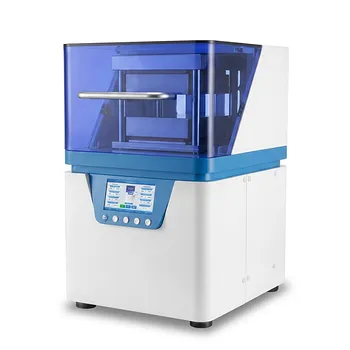
The manual heated laboratory hydraulic press is the primary tool for converting raw PLA granules into high-quality 2D film scaffolds. It functions by applying simultaneous thermal energy and high mechanical pressure to melt, de-gas, and flatten polymer materials into precise, dense sheets that serve as the foundation for further tissue engineering.
The core function of the press is to achieve material densification and dimensional uniformity by eliminating internal voids through controlled thermal cycles. This process creates a standardized substrate with stable mechanical properties, essential for downstream microstructuring and biological testing.
Thermal Transformation and Phase Control
Melting the Polymer Matrix
The press provides controlled thermal energy, typically reaching temperatures around 180°C, to transition Polylactic Acid (PLA) from a solid granular state to a viscous melt. This precise temperature regulation ensures the polymer flows sufficiently to fill the mold while avoiding thermal degradation of the molecular chains.
Achieving Homogeneous Material Distribution
By holding the material at a specific temperature, the press facilitates the microscopic rearrangement of polymer chains. When additives like microcrystalline cellulose (MCC) or hydroxyapatite are present, the heat allows the PLA matrix to encapsulate these particles, ensuring a uniform composite distribution throughout the 2D scaffold.
The Importance of the Pre-heating Phase
Effective fabrication often begins with a pre-heating phase where the material is softened without significant pressure. This step ensures that the heat penetrates the core of the granules or powders, preventing "cold spots" that could lead to structural weaknesses or uneven thickness in the final sheet.
Mechanical Densification and Structural Integrity
Elimination of Voids and Air Bubbles
One of the most critical functions is the use of venting cycles—briefly releasing and reapplying pressure—to expel trapped air and volatile gases. This multi-stage pressure control eliminates internal voids and pores, resulting in a fully dense sample that represents the material's intrinsic properties.
Establishing Uniform Dimensions
The hydraulic system applies constant, high-level pressure (often between 200 to 400 bar) to compact the melt into a specific geometric thickness, typically ranging from 220 to 250 µm. This precision is vital for creating a flat, reproducible surface required for high-resolution post-processing, such as femtosecond laser microstructuring.
Enhancing Mechanical Strength
High-pressure compaction facilitates tight bonding between polymer chains and reinforcing particles. This results in 2D scaffolds with standardized diameters and sufficient mechanical stability to withstand the rigors of surface modification and cell seeding experiments.
The Press as a Research Benchmark
Creating Reference Samples for 3D Printing
In comparative studies, the hydraulic press is used to create "ideal" reference samples that lack the interlaminar boundaries found in 3D-printed parts. By removing these printing-induced defects, researchers can isolate and measure the material's true mechanical parameters and shape memory performance.
Substrate Preparation for Microstructuring
The dense, flat sheets produced by the press serve as the fundamental substrate for advanced fabrication techniques. Without the uniform surface quality provided by the press, subsequent processes like laser etching or chemical surface modification would yield inconsistent results across the scaffold.
Understanding the Trade-offs
Manual vs. Automated Control
While manual presses offer high tactile feedback and lower costs, they require operator consistency to ensure that pressure ramp-up and venting cycles are identical across batches. Inconsistent manual pumping can lead to slight variations in density or thickness compared to automated systems.
Thermal Degradation Risks
Maintaining PLA at high temperatures for extended periods to ensure flow can lead to molecular weight reduction. The operator must balance the need for complete melting and air removal with the risk of overheating, which can embrittle the scaffold and negatively impact its biocompatibility.
Pressure Limits and Mold Wear
Using extremely high pressure (e.g., 400 bar) improves density but increases the wear on specialized molds and spacers. Over time, this can lead to subtle deviations in the "standardized" thickness of the 2D scaffolds, requiring regular calibration of the equipment.
How to Apply This to Your Project
Recommendations Based on Research Goals
- If your primary focus is mechanical characterization: Prioritize the venting cycles and high-pressure phases to ensure a zero-void density that reflects the material's intrinsic strength.
- If your primary focus is surface microstructuring: Focus on the cooling phase and mold precision to ensure the 2D sheet is perfectly flat and within the 220–250 µm thickness range.
- If your primary focus is composite development (e.g., PLA/Hydroxyapatite): Ensure an adequate pre-heating phase to allow the polymer to fully wet the additive particles before applying peak pressure.
By mastering the balance of thermal energy and mechanical force, the laboratory hydraulic press transforms raw polymer into a sophisticated, high-performance foundation for regenerative medicine.
Summary Table:
| Stage | Action | Research Benefit | |ing :--- | :--- | :--- | | Pre-heating | Softening PLA granules | Ensures uniform heat penetration and flow | | Thermal Melting | Heating to ~180°C | Facilitates homogeneous material distribution | | Pressure Control | Applying 200-400 bar | Achieves target thickness (220-250 µm) | | Venting Cycles | Releasing trapped air | Eliminates internal voids for full densification | | Phased Cooling | Controlled temperature reduction | Maintains dimensional stability and flatness |
Elevate Your Materials Research with KINTEK Pressing Solutions
Precision is paramount when fabricating PLA scaffolds or advancing battery research. KINTEK specializes in comprehensive laboratory pressing solutions, offering a versatile range of manual, automatic, heated, multifunctional, and glovebox-compatible models, as well as cold and warm isostatic presses.
Whether you need to eliminate internal voids, ensure uniform thickness for microstructuring, or develop high-performance composites, our equipment provides the consistency and control required for reproducible results.
Ready to optimize your lab's output?
Contact KINTEK Experts Today to find the perfect pressing solution tailored to your research goals.
References
- Liliya Angelova, Ivan Buchvarov. Ultra-fast laser modification of poly-lactic acid (PLA) -towards enhanced biocompatibility. DOI: 10.1088/1742-6596/2240/1/012042
This article is also based on technical information from Kintek Solution Knowledge Base .
Related Products
- Automatic Heated Hydraulic Press Machine with Heated Plates for Laboratory
- Automatic Heated Hydraulic Press Machine with Hot Plates for Laboratory
- Automatic Heated Hydraulic Lab Press with Programmable Touch Screen Controls and Precision Temperature Regulation
- Laboratory Split Manual Heated Hydraulic Press Machine with Hot Plates
- Manual Heated Hydraulic Lab Press with Integrated Hot Plates Hydraulic Press Machine
People Also Ask
- Function of a Laboratory Hydraulic Press with Heated Platens in SSE? Enhance Battery Density & Conductivity
- Why is a laboratory hydraulic press with heating plates required for PLA/TEC films? Achieve Precise Sample Integrity
- How does a laboratory heated hydraulic press facilitate PBN sample prep for WAXS? Achieve Precise X-Ray Scattering
- What are the requirements for electrode pressing with high-viscosity ionic liquids like EMIM TFSI? Optimize Performance
- What are the industrial applications of heated hydraulic presses? Master Heat & Force for Precision Manufacturing