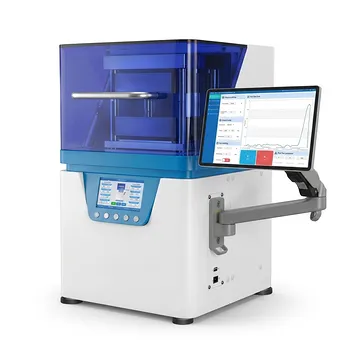
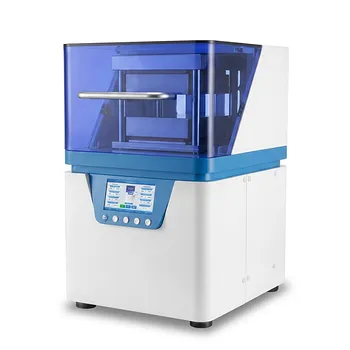
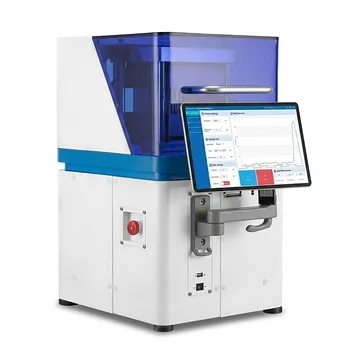
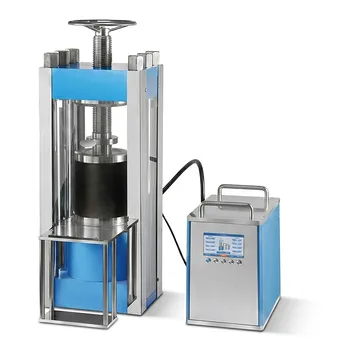
The requirement for a high-pressure heated hydraulic press in PVC composite production is driven by the need for simultaneous thermal fusion and mechanical consolidation. By precisely controlling temperatures (typically around 170°C) and applying significant clamping force (often 250kN or higher), the press transforms raw PVC and fillers into a singular, cohesive structure. This dual action ensures the polymer reaches a flowable state to fill the mold while the pressure eliminates internal defects that would otherwise compromise the board's integrity.
A heated hydraulic press is the only tool capable of creating the high-density, void-free environment necessary for PVC molecules to bond effectively with fillers. This process is fundamental to producing composite boards that meet strict mechanical standards and uniform thickness requirements.
Overcoming Material Resistance Through Thermal Flow
Achieving Optimal Melt Viscosity
PVC and its associated fillers do not naturally bond in a solid state; they require thermal energy to transition into a melt. The heated platens of the hydraulic press provide a controlled environment, often reaching up to 220°C, which reduces the viscosity of the polymer granules.
Ensuring Complete Mold Cavity Infiltration
Once the PVC reaches a molten state, it must be forced into every corner of the mold to ensure a perfect shape. The high pressure from the hydraulic system provides the necessary motive force to ensure the melt flows evenly, preventing "short shots" or incomplete sections in the final board.
Facilitating Molecular Bonding
At the molecular level, sustained heating under pressure promotes tight bonding between polymer chains and the surfaces of the fillers. This creates a reinforced matrix that is significantly stronger and more durable than the individual components would be on their own.
The Role of Pressure in Structural Integrity
Eliminating Internal Air Voids
Air trapped within the composite mixture is the primary cause of structural failure and microscopic defects. The application of high pressure—sometimes exceeding 300kN—physically expels internal air bubbles and excludes residual gases during the molding process.
Achieving High Material Density
A dense structure is critical for the physical-mechanical properties of the board, such as tensile strength and impact resistance. By applying constant, high-level pressure, the press compacts the material to its maximum theoretical density, ensuring the board is solid throughout.
Standardizing Uniform Thickness
Precision hydraulic systems allow for the production of sheets with high dimensional accuracy, such as films as thin as 100 µm or thick structural planks. This uniform thickness is vital for both industrial applications and ensuring that laboratory test data remains repeatable and accurate.
Understanding the Trade-offs and Process Risks
Managing Thermal Degradation
While heat is necessary for flow, PVC is sensitive to prolonged exposure to high temperatures, which can lead to thermal degradation and loss of mechanical properties. Operators must balance the need for melt-flow with precise timing to ensure the material is not "cooked" for too long.
Addressing Density Gradients
Applying pressure too rapidly or unevenly can result in density gradients, where some parts of the board are more compacted than others. Utilizing stepped pressure control—increasing force in stages (e.g., from 5 MT to 15 MT)—is often required to allow air to escape before the material fully sets.
Equipment Maintenance and Calibration
The high forces involved mean that even slight misalignments in the press platens can result in warped boards or uneven thickness. Maintaining a high-precision environment requires regular calibration of both the heating elements and the hydraulic cylinders.
How to Apply This to Your Project
Recommendations for Success
- If your primary focus is Maximum Structural Strength: Prioritize a press with high clamping force (300kN+) to ensure the absolute exclusion of air voids and maximum material compaction.
- If your primary focus is R&D and Material Testing: Select a high-precision laboratory press that offers "stepped" pressure control to produce standardized, defect-free samples for accurate mechanical evaluation.
- If your primary focus is Surface Finish and Clarity: Ensure the press has highly polished, precision-heated platens to achieve a uniform thickness and eliminate surface-level microscopic pores.
The integration of high-pressure and controlled heat is the definitive factor in transforming raw PVC blends into high-performance, industrial-grade composite boards.
Summary Table:
| Key Process Factor | Functional Role | Benefit to PVC Composite |
|---|---|---|
| Thermal Energy (170°C+) | Reduces polymer viscosity | Transitions PVC to a flowable, molten state |
| High Clamping Force | Mechanical consolidation | Eliminates internal air voids and defects |
| Molecular Bonding | Fusion of polymer & fillers | Creates a strong, reinforced structural matrix |
| Hydraulic Precision | Uniform thickness control | Ensures high dimensional accuracy (down to 100 µm) |
| Stepped Pressure | Controlled degassing | Prevents density gradients and material cracking |
Elevate Your Material Research with KINTEK Precision Presses
Achieving the perfect bond in PVC composites requires exact temperature and pressure control. KINTEK specializes in comprehensive laboratory pressing solutions designed for high-performance results. Whether you need manual, automatic, or heated presses for thermal fusion, or cold and warm isostatic presses for battery research, our equipment delivers the density and uniformity your projects demand.
Maximize your lab's efficiency and ensure sample repeatability—Contact us today to explore our full range of solutions!
References
- Navin Chand, Bhajan Das Jhod. Mechanical, electrical, and thermal properties of maleic anhydride modified rice husk filled PVC composites. DOI: 10.15376/biores.3.4.1228-1243
This article is also based on technical information from Kintek Solution Knowledge Base .
Related Products
- Automatic High Temperature Heated Hydraulic Press Machine with Heated Plates for Lab
- Automatic Hydraulic Hot Press with Large Plate and Precision Temperature Control for Advanced Material Sample Preparation and Industrial Research
- Automatic Large Format Laboratory Heated Hydraulic Press 400x400mm Plate Capacity
- Heated Hydraulic Press Machine with Heated Plates for Vacuum Box Laboratory Hot Press
- Heated Hydraulic Press Machine With Heated Plates For Vacuum Box Laboratory Hot Press
People Also Ask
- Function of a Laboratory Hydraulic Press with Heated Platens in SSE? Enhance Battery Density & Conductivity
- What are the requirements for electrode pressing with high-viscosity ionic liquids like EMIM TFSI? Optimize Performance
- How does a laboratory heated hydraulic press facilitate PBN sample prep for WAXS? Achieve Precise X-Ray Scattering
- What are the industrial applications of heated hydraulic presses? Master Heat & Force for Precision Manufacturing
- Why is a laboratory hydraulic press with heating plates required for PLA/TEC films? Achieve Precise Sample Integrity