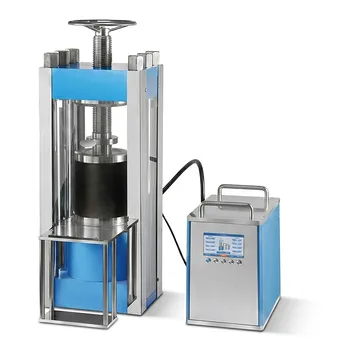
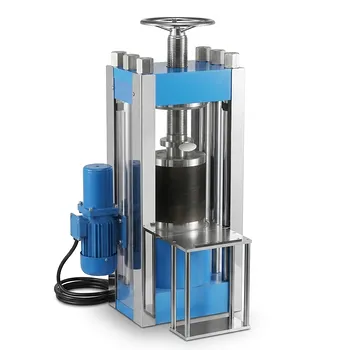
The laboratory hot press is the definitive tool for molding Adaptive Polymer Electrolyte (APE) thin films. It works by providing the simultaneous application of precise thermal energy and mechanical pressure to transform raw polymer mixtures into uniform, high-density membranes. This dual action ensures the material flows perfectly between substrates to reach a specific target thickness—often as precise as 125 micrometers—while removing performance-killing internal defects like air bubbles.
A laboratory hot press is essential because it guarantees the structural integrity and electrochemical performance of electrolyte films through secondary densification and precise geometric control. By integrating heat and pressure, it eliminates voids and ensures a stable interface required for efficient ion transport.
Achieving Precise Geometric and Structural Uniformity
Controlled Flow and Thickness Targeting
The hot press uses a combination of heat (typically around 80 °C) and pressure (approximately 4.4 bar) to force the polymer mixture to flow evenly. This allows researchers to achieve a precise target thickness, which is critical for maintaining consistency across different battery cells. Without this controlled spreading, films often suffer from uneven surfaces that lead to poor contact with electrodes.
Eliminating Internal Voids and Micro-bubbles
During the mixing or solvent-casting stages, microscopic air bubbles can become trapped within the polymer matrix. The high pressure of a hot press performs a secondary densification, squeezing out these residual voids to create a dense, non-porous membrane. This step is vital because internal gaps act as insulators, blocking the path of ions and weakening the overall structure.
Ensuring Mechanical Flatness and Integrity
A hot press provides a uniform thermal field and continuous pressure, resulting in a film with superior mechanical flatness. This flatness is not just aesthetic; it ensures that the electrolyte can withstand the physical stresses of battery assembly and cycling. A perfectly flat membrane prevents "hot spots" where current might concentrate, extending the life of the battery.
Optimizing Electrochemical Performance
Facilitating Ion Transport Efficiency
Many adaptive electrolytes, particularly PEO-based systems, require temperatures above 60 °C to soften the polymer and "activate" ion transport. The hot press provides this activation energy during the molding process, allowing polymer chains to rearrange and lithium salts to dissolve fully. This creates a continuous phase that is highly favorable for the rapid movement of ions.
Reducing Interfacial Contact Resistance
A dense, smooth film produced by a hot press creates a more stable electrode-electrolyte interface. By eliminating surface roughness, the electrolyte can make "intimate contact" with the battery's anode and cathode. This reduction in contact resistance is essential for high-power applications where energy must move quickly across the interface.
Preventing Dendrite Penetration
One of the greatest risks in metal-anode batteries is the growth of needle-like structures called dendrites. The high density achieved through hot pressing significantly improves the mechanical strength of the electrolyte. This creates a robust physical barrier that prevents lithium or sodium dendrites from piercing the membrane and causing a short circuit.
Understanding the Trade-offs
Thermal Degradation Risks
While heat is necessary to soften the polymer, exceeding the material's thermal stability limit can lead to polymer degradation. If the temperature is set too high or applied for too long, the molecular chains may break, significantly reducing the electrolyte's mechanical strength and conductivity.
Pressure-Induced Shorting
Applying excessive pressure during the molding process can cause the polymer to "squeeze out" too thin or even cause structural collapse of inorganic fillers if they are present in the mixture. Finding the balance between enough pressure to densify and too much pressure that compromises film integrity is a common calibration challenge.
Material Compatibility
Not all polymer electrolytes respond well to the hot press method; some may become overly brittle or exhibit phase separation under high pressure. It is critical to match the temperature and pressure settings specifically to the chemical composition of the multinary polymer being used.
How to Apply This to Your Project
Recommendations for Molding Success
Proper use of a laboratory hot press depends on your specific research objectives and the materials involved.
- If your primary focus is Ion Conductivity: Prioritize the thermal settings to ensure the polymer chains and salts are fully fused and rearranged for optimal transport.
- If your primary focus is Battery Safety: Focus on the pressure calibration to maximize the density of the film, creating a harder barrier against dendrite penetration.
- If your primary focus is Large-Scale Integration: Use the hot press to standardize film thickness (e.g., 125 $\mu$m) to ensure reproducible results across multiple test cells.
The laboratory hot press remains the cornerstone of electrolyte fabrication by bridging the gap between raw chemical mixtures and high-performance, functional battery components.
Summary Table:
| Key Feature | Mechanism | Impact on Battery Performance |
|---|---|---|
| Geometric Uniformity | Precise flow & thickness control (e.g., 125µm) | Ensures consistent electrode contact and prevents hot spots. |
| Void Elimination | Secondary densification under high pressure | Creates dense membranes, preventing ion blockage and structural failure. |
| Ion Activation | Simultaneous application of thermal energy | Rearranges polymer chains to facilitate rapid and efficient ion movement. |
| Dendrite Prevention | Increased mechanical density and strength | Forms a robust physical barrier to prevent short circuits and extend life. |
Elevate Your Battery Research with KINTEK Precision Pressing
Achieving the perfect electrolyte film requires more than just heat—it requires total control. KINTEK specializes in comprehensive laboratory pressing solutions designed for the rigorous demands of battery material science.
Whether you need manual, automatic, heated, multifunctional, or glovebox-compatible models, our equipment provides the exact thermal and mechanical parameters necessary to eliminate defects and maximize conductivity. Beyond standard molding, we offer cold and warm isostatic presses widely applied in advanced energy research.
Ready to standardize your film quality and boost electrochemical performance? Contact KINTEK today to find the perfect pressing solution for your lab!
References
- Matthew Newman, Marcello Canova. Design and characterization of an adaptive polymer electrolyte for lithium metal solid-state battery applications. DOI: 10.1039/d4ta08556f
This article is also based on technical information from Kintek Solution Knowledge Base .
Related Products
- 24T 30T 60T Heated Hydraulic Lab Press Machine with Hot Plates for Laboratory
- Laboratory Split Manual Heated Hydraulic Press Machine with Hot Plates
- Heated Hydraulic Press Machine with Heated Plates for Vacuum Box Laboratory Hot Press
- Automatic Heated Hydraulic Press Machine with Hot Plates for Laboratory
- Automatic Large Format Laboratory Heated Hydraulic Press 400x400mm Plate Capacity
People Also Ask
- Function of a Laboratory Hydraulic Press with Heated Platens in SSE? Enhance Battery Density & Conductivity
- Why is a laboratory hydraulic press with heating plates required for PLA/TEC films? Achieve Precise Sample Integrity
- What role does a laboratory heated hydraulic press play in LTCC? Essential for High-Density Ceramic Lamination
- What is the primary function of a laboratory heated hydraulic press? Mastering Thermoplastic Carbon Fiber Composites
- What is the critical role of a laboratory heated hydraulic press? Mastering PVC Sample Prep for Testing