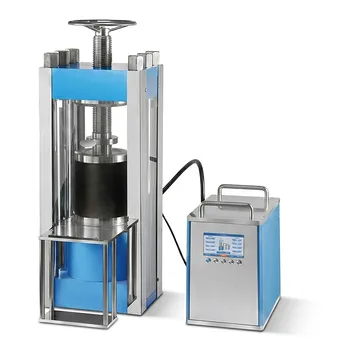
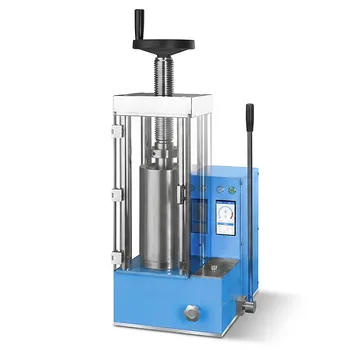
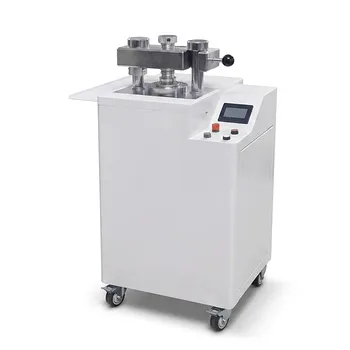
The laboratory uniaxial press is the essential tool for transforming loose powder into a standardized "green body" with precise dimensions and density. By applying high pressure through a precision mold, the press ensures that thermal decomposition specimens have a uniform surface area and volume. This geometric consistency is critical for controlling gas release paths and ensuring the specimen is perfectly centered within the furnace for accurate quantitative analysis.
The primary purpose of a laboratory uniaxial press in thermal analysis is to eliminate variables caused by irregular specimen shapes. By standardizing the specimen's geometry, researchers can ensure repeatable gas flow dynamics and precise furnace positioning, which are fundamental for high-accuracy gas chromatography.
Achieving Geometric Standardization for Analytical Precision
The Role of Precision Molds
A uniaxial press uses high-tolerance molds to apply mechanical force, typically exceeding 80 MPa, to ceramic or alumina particles. This force causes the particles to rearrange into a regular cylindrical shape with fixed diameters and lengths.
Eliminating Gas Flow Variables
In thermal decomposition analysis, the path that released gases take to reach the detector must be consistent across all tests. A standardized cylinder ensures stable gas release paths, preventing turbulent flow or stagnation that could skew the results of gas chromatography.
Precise Furnace Positioning
Standardized specimens allow for exact placement in the thermal center of an alumina tube furnace. Centering the specimen ensures uniform heating and a symmetrical environment, which is vital for the quantitative analysis of decomposition kinetics.
Creating Sustained Structural Integrity
Formation of the Green Body
The press converts loose mixed powders and binders into what is known as a green body. This transformation provides the specimen with the initial bulk density and structural strength required for handling and subsequent processing.
Providing a Foundation for Advanced Densification
For many advanced materials, uniaxial pressing serves as a preliminary step at lower pressures (around 20 MPa). This provides a basic geometric foundation that allows the specimen to undergo Cold Isostatic Pressing (CIP) for further densification without losing its shape.
Improving Particle Contact
Through mechanical force, the press reduces air gaps between particles, establishing a consistent internal structure. This uniformity ensures that thermal energy is conducted evenly through the specimen during the decomposition process.
Understanding the Trade-offs and Limitations
Density Gradients and Internal Friction
One major limitation of uniaxial pressing is the development of density gradients caused by friction between the powder and the mold walls. The pressure is rarely perfectly uniform throughout the entire cylinder, which can sometimes lead to slight variations in decomposition rates between the top and bottom of the specimen.
Geometric Constraints
Uniaxial pressing is generally limited to relatively simple geometric shapes, such as cylinders or disks. If a study requires highly complex specimens, this method may not be suitable without significant secondary machining, which can introduce surface defects.
Risks of Pressure-Induced Defects
Applying excessive pressure can lead to capping or laminations, where the specimen cracks into thin layers upon release from the mold. These microscopic defects can create unintended pathways for gas escape, potentially compromising the quantitative accuracy of the analysis.
How to Apply This to Your Project
When selecting your pressing parameters, you must align the pressure and mold design with your ultimate analytical goal.
- If your primary focus is quantitative gas analysis: Prioritize geometric uniformity and precise furnace alignment to ensure consistent gas release paths to the chromatograph.
- If your primary focus is mechanical property testing: Use the uniaxial press as a preliminary step to achieve a basic shape before moving to Cold Isostatic Pressing for maximum density.
- If your primary focus is kinetic modeling: Ensure your pressing pressure is high enough to achieve a stable green body strength, preventing the specimen from crumbling during the decomposition phase.
Standardizing your specimen geometry through uniaxial pressing remains the single most effective way to ensure that your thermal decomposition data is both repeatable and scientifically rigorous.
Summary Table:
| Key Benefit | Functional Feature | Impact on Analysis |
|---|---|---|
| Geometric Precision | High-tolerance molds | Ensures stable gas release paths and exact furnace centering. |
| Structural Integrity | Green body formation | Provides initial bulk density and strength for handling. |
| Analytical Accuracy | Uniform surface area | Eliminates variables in gas chromatography and kinetic modeling. |
| Density Foundation | Mechanical compaction | Reduces air gaps; serves as a precursor for Isostatic Pressing (CIP). |
Elevate Your Material Research with KINTEK Precision
Maximize the accuracy of your thermal analysis by ensuring perfect specimen consistency. KINTEK specializes in comprehensive laboratory pressing solutions, offering a versatile range of equipment tailored for advanced material science and battery research:
- Manual & Automatic Presses: For reliable, repeatable green body formation.
- Heated & Multifunctional Models: To handle complex material requirements.
- Glovebox-Compatible Systems: Essential for sensitive air-stable battery research.
- Cold (CIP) & Warm Isostatic Presses (WIP): For achieving maximum density and structural uniformity.
Ready to eliminate variables and enhance your analytical precision? Contact KINTEK today to find the ideal pressing solution for your laboratory needs!
References
- Toshiki Nakamura, Atsusi Nakahira. Development of Rapid Debinding Treatment Using Superheated Steam and Debinding Behavior for Alumina Molded Bodies. DOI: 10.2497/jjspm.66.275
This article is also based on technical information from Kintek Solution Knowledge Base .
Related Products
- Lab Round Bidirectional Press Mold
- Automatic Laboratory Hydraulic Press for XRF and KBR Pellet Pressing
- Laboratory Hydraulic Press Lab Pellet Press Button Battery Press
- Laboratory Hydraulic Pellet Press for XRF KBR FTIR Lab Press
- Automatic Laboratory Hydraulic Press Lab Pellet Press Machine
People Also Ask
- What is the purpose of incorporating cartridge heaters into a lab press mold for MLCC block compression? Optimize Results
- Why is precise cooling management of the lab press mold necessary? Protect Core Integrity in Thermoforming
- What is the function of a pressing tool in thermoplastic panels? Master Precision Shaping & Fusion Bonding
- Why is a high-performance laboratory molding press critical for in-situ electrolyte formation? Unlock Battery Success
- How do the design and geometric precision of pressing molds and mandrels affect the quality of PTFE composite samples?