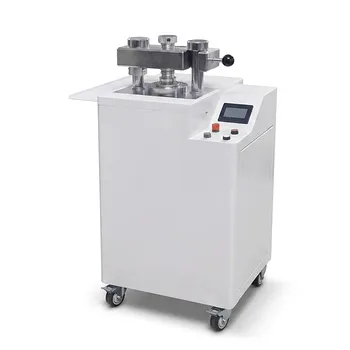
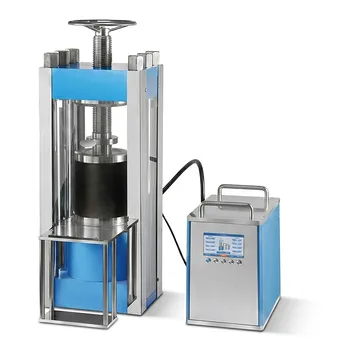
A high-precision laboratory press is the foundation for structural integrity in ceramic anodes. By providing exacting control over pressing force and holding time, the press ensures that 10NiO-NiFe2O4 green bodies achieve regular geometric shapes and the necessary mechanical strength to survive high-temperature processing. This precision minimizes molding defects that would otherwise lead to catastrophic cracking or localized material loss during aluminum electrolysis at 1233K.
Core Takeaway: The precision of a laboratory press dictates the initial density and structural uniformity of the anode, which directly determines its ability to resist corrosive electrolyte penetration and thermal stress in harsh industrial environments.
Establishing Structural and Geometric Uniformity
Precise Control of Pressing Force and Time
A high-precision press allows for the application of specific loads, such as 125MPa, held for a exact duration. This consistency ensures that every green body begins with a standardized initial density and geometric profile. Without this control, variations in the molding process introduce internal stresses that manifest as cracks during the sintering phase.
Minimizing Molding Defects
Stable pressure output eliminates the density gradients often found in lower-quality pressing operations. By ensuring a uniform distribution of particles, the press prevents the formation of "weak spots." These spots are the primary culprits for localized excessive loss when the anode is exposed to the extreme 1233K temperatures required for aluminum electrolysis.
Influence on Microstructure and Grain Growth
Optimizing Particle Packing Density
The press determines the filling state and packing density of the 10NiO-NiFe2O4 powder and its BaO dopants. High-precision management ensures that anisotropic template particles are aligned correctly without being crushed. This establishes the ideal physical environment for oriented grain growth during subsequent sintering.
Strengthening Internal Interfaces
By applying constant axial pressure, the press minimizes the distance between individual particles, including the matrix and dopants. This tight contact is essential for activated sintering, particularly when using BaO. It ensures that the solid-state reactions occur uniformly throughout the material, leading to a more cohesive final structure.
Impact on Anode Longevity and Corrosion Resistance
Reducing Internal Porosity
The relative density of the ceramic anode is the primary factor in its corrosion resistance. A high-precision press creates a dense structure that effectively blocks the penetration of cryolite electrolytes. By preventing these electrolytes from attacking grain boundaries, the press helps maintain the anode’s structural integrity over long-term use.
Minimizing Annual Wear Rates
The combination of precision molding and chemical dopants like BaO can significantly reduce the annual wear rate of the anode to approximately 3.66 cm per year. This longevity is only possible if the initial molding process creates a surface flat and parallel enough to ensure uniform current distribution and stable electrochemical performance.
Understanding the Trade-offs
Uniaxial vs. Isostatic Pressing
While a standard laboratory press typically utilizes uniaxial pressing, it may not provide the same level of uniform densification as cold isostatic pressing (CIP). Uniaxial pressing can sometimes lead to friction-induced pressure drops within the mold, resulting in slight density variations from the top to the bottom of the pellet.
Risk of Particle Damage
Applying excessive pressure in an attempt to reach maximum density can be counterproductive. If the pressure is too high, ceramic template particles can be fractured, which disrupts the intended microstructure and can actually lead to higher internal stress. Finding the "sweet spot" of pressure is a critical experimental variable.
Applying Precision Molding to Your Research
The success of your ceramic anode depends on how you calibrate your pressing parameters to meet your specific performance benchmarks.
- If your primary focus is corrosion resistance: Prioritize maximizing relative density through precise pressure control to block cryolite penetration into grain boundaries.
- If your primary focus is experimental reproducibility: Focus on the consistency of the holding time and geometric dimensions to ensure a standardized physical baseline for all samples.
- If your primary focus is microstructural orientation: Utilize moderate, stable pressure to align template particles without crushing them, facilitating oriented grain growth.
Through the rigorous application of precision pressing, you transform loose ceramic powder into a high-performance component capable of withstanding the most demanding electrochemical environments.
Summary Table:
| Pressing Parameter | Impact on Molding Quality | Performance Benefit |
|---|---|---|
| Pressing Force (125MPa) | Standardized Initial Density | Prevents cracking during high-temp sintering |
| Holding Time Control | Geometric Uniformity | Ensures repeatable experimental baselines |
| Particle Packing | Optimized Microstructure | Facilitates oriented grain growth with dopants |
| High Axial Pressure | Minimized Porosity | Enhanced resistance to cryolite corrosion |
| Stable Output | Reduced Density Gradients | Lowers annual wear rate to ~3.66 cm/year |
Maximize Your Material Research with KINTEK Precision
Unlock the full potential of your 10NiO-NiFe2O4 ceramic anodes with KINTEK’s comprehensive laboratory pressing solutions. Whether you are focused on minimizing wear rates or optimizing microstructural orientation, our equipment provides the exacting control your battery research demands.
Our Specialized Range Includes:
- Manual & Automatic Presses: For versatile, repeatable load application.
- Heated & Multifunctional Models: Ideal for complex solid-state reactions.
- Glovebox-Compatible Systems: For sensitive material handling.
- Cold & Warm Isostatic Presses (CIP/WIP): To eliminate density gradients and achieve ultimate uniformity.
Don't let molding defects compromise your electrolysis results. Contact KINTEK today to find the perfect press for your lab!
References
- Hanbing HE, Hanning Xiao. Effect of Additive BaO on corrosion resistance of 10NiO-NiFe2O4 Composite Ceramic anodes. DOI: 10.2991/emeit.2012.305
This article is also based on technical information from Kintek Solution Knowledge Base .
Related Products
- Lab Round Bidirectional Press Mold
- Lab Polygon Press Mold
- Automatic Hydraulic Hot Press with Large Plate and Precision Temperature Control for Advanced Material Sample Preparation and Industrial Research
- Special Shape Lab Press Mold for Laboratory Applications
- Automatic High Temperature Heated Hydraulic Press Machine with Heated Plates for Lab
People Also Ask
- What is the purpose of incorporating cartridge heaters into a lab press mold for MLCC block compression? Optimize Results
- Why is precise cooling management of the lab press mold necessary? Protect Core Integrity in Thermoforming
- What is the function of a pressing tool in thermoplastic panels? Master Precision Shaping & Fusion Bonding
- Why is a high-performance laboratory molding press critical for in-situ electrolyte formation? Unlock Battery Success
- How do the design and geometric precision of pressing molds and mandrels affect the quality of PTFE composite samples?