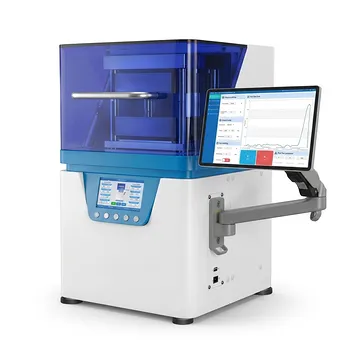
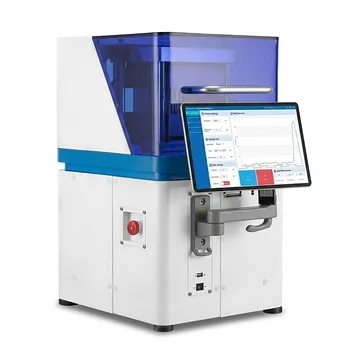
The mechanical densification of biocoke is achieved by applying continuous high pressure—often up to 22 MPa—to raw biomass within a precision mold. This process forces the expulsion of internal air, triggers the rearrangement and plastic deformation of particles, and significantly increases the contact area between material surfaces. When synchronized with heating, the press facilitates moisture reduction and molecular binding, transforming loose biomass into a high-strength, energy-dense solid fuel.
A laboratory hydraulic press facilitates biocoke molding by converting loose particles into a compact solid through the simultaneous application of high pressure and heat. The result is a fuel source with a superior energy-to-volume ratio, enhanced mechanical stability, and optimized combustion characteristics.
Structural Transformation at the Particle Level
Particle Displacement and Rearrangement
The primary role of the hydraulic press is to drive particle displacement. As pressure is applied, the individual woody particles or biochar grains shift from a loose, chaotic state into a tightly packed configuration.
This movement minimizes the voids between particles, which is the first step in increasing the material's bulk density. Without this forced rearrangement, the resulting biocoke would remain brittle and porous.
Plastic Deformation and Contact Surface
Under high pressure, the particles do not just move; they undergo plastic deformation. The edges of the particles flatten and mold against one another, dramatically increasing the interfacial contact area.
This increased contact is vital for the formation of a "green body." It allows for chemical and physical bonds to form across grain boundaries, ensuring the sample does not crack or collapse after it is removed from the mold.
The Role of Air and Moisture Removal
Expulsion of Internal Air
One of the most critical functions of the press is the effective expulsion of air. Trapped air creates internal porosity, which weakens the structural integrity of the biocoke and reduces its energy density.
By applying constant, uniform pressure, the hydraulic press forces air out of the mold. This results in a bubble-free composition that burns more consistently and resists breaking during transport or storage.
Synergy with Synchronous Heating
While pressure handles the physical structure, synchronous heating addresses the chemical state. Heating the biomass (often around 160°C to 190°C) reduces moisture content and can even trigger the melting of natural binders like lignin.
This combination of heat and pressure induces heat-triggered bonding. It transforms the material from a collection of compressed particles into a fused, high-density sheet or pellet with significantly enhanced tensile strength.
Understanding the Trade-offs and Limitations
Management of Stress Gradients
While high pressure is necessary for densification, it must be applied uniformly to avoid stress gradients. If pressure is unevenly distributed within the mold, the interior of the biocoke may have a different density than the exterior, leading to structural failure.
The Risk of Over-Pressurization
Applying pressure far beyond the material's structural limit can sometimes lead to internal micro-cracking. Each biomass blend has an optimal pressure threshold—exceeding it may improve density but compromise the overall mechanical toughness of the fuel.
Equipment Maintenance and Calibration
Precision is paramount; a laboratory press must be precisely calibrated to maintain constant pressure over long cycles. Any fluctuation in pressure during the cooling or heating phase can result in a "spring-back" effect, where the material expands slightly, reducing its final density.
How to Apply These Principles to Your Goals
To achieve the best results in biocoke molding, your approach should vary based on your specific research or production requirements.
- If your primary focus is Maximum Energy Density: Prioritize the highest allowable pressure (up to 22 MPa or more) and ensure the press is equipped with heating plates to maximize moisture expulsion.
- If your primary focus is Structural Integrity for Transport: Focus on the duration of the pressure cycle to allow for complete particle deformation and "set" time within the mold.
- If your primary focus is Combustion Efficiency: Use moderate pressure combined with precise temperature control to ensure a uniform density that promotes a steady, long-lasting burn rate.
By mastering the balance of pressure, temperature, and time, you can optimize the laboratory hydraulic press to produce biocoke that meets the most demanding industrial standards.
Summary Table:
| Process Step | Physical Mechanism | Benefit to Biocoke |
|---|---|---|
| Pressure Application | Particle Rearrangement | Minimizes voids and increases bulk density |
| High Compression | Plastic Deformation | Maximizes contact area for physical bonding |
| Synchronous Heating | Binder Activation | Triggers lignin melting for molecular fused strength |
| Air Expulsion | Internal Porosity Reduction | Improves combustion consistency and durability |
| Cycle Management | Stress Gradient Control | Ensures uniform density and prevents micro-cracking |
Elevate Your Renewable Energy Research with KINTEK Precision
Mastering biocoke densification requires the perfect balance of pressure, temperature, and precision. KINTEK specializes in comprehensive laboratory pressing solutions designed to meet the most rigorous standards in material science.
We offer a versatile range of equipment including:
- Manual & Automatic Presses for reliable, repeatable results.
- Heated & Multifunctional Models for advanced thermal processing.
- Glovebox-compatible & Isostatic Presses (Cold and Warm) tailored for specialized battery and biomass research.
Whether you are optimizing solid fuel combustion or developing next-generation energy materials, KINTEK provides the tools to enhance your lab's efficiency and sample quality. Ready to upgrade your pressing capabilities? Contact KINTEK today to find your perfect solution!
References
- Erdiwansyah Erdiwansyah, Yeggi Darnas. The Effect of Pressure and Heating on Biocoke Fuel from Empty Fruit Bunches. DOI: 10.37934/arfmts.114.1.159165
This article is also based on technical information from Kintek Solution Knowledge Base .
Related Products
- Automatic High Temperature Heated Hydraulic Press Machine with Heated Plates for Lab
- 24T 30T 60T Heated Hydraulic Lab Press Machine with Hot Plates for Laboratory
- Automatic Heated Hydraulic Lab Press 120x120mm Plate Fully Automated Material Research Press
- Automatic Large Format Laboratory Heated Hydraulic Press 400x400mm Plate Capacity
- Automatic Hydraulic Hot Press with Large Plate and Precision Temperature Control for Advanced Material Sample Preparation and Industrial Research
People Also Ask
- Function of a Laboratory Hydraulic Press with Heated Platens in SSE? Enhance Battery Density & Conductivity
- What are the requirements for electrode pressing with high-viscosity ionic liquids like EMIM TFSI? Optimize Performance
- How does a laboratory heated hydraulic press facilitate PBN sample prep for WAXS? Achieve Precise X-Ray Scattering
- What are the industrial applications of heated hydraulic presses? Master Heat & Force for Precision Manufacturing
- Why is a laboratory hydraulic press with heating plates required for PLA/TEC films? Achieve Precise Sample Integrity