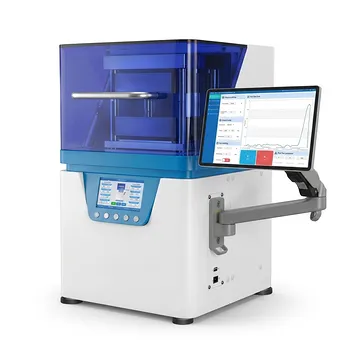
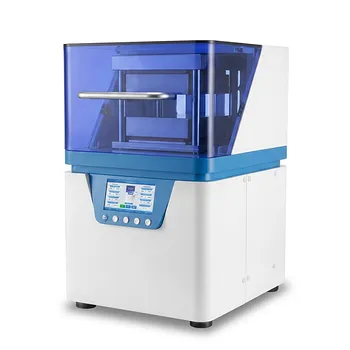
A laboratory heated plate press ensures sample quality by strictly controlling the kinetics and physical environment of the vulcanization reaction. By delivering a precise temperature of 160 °C and a stable pressure of 30 bar, the press facilitates the necessary chemical cross-linking that transforms raw Nitrile Butadiene Rubber (NBR) into a high-performance elastomer. These controlled conditions eliminate internal defects and guarantee that the final specimen meets specific dimensional standards, such as a 2 mm thickness, required for accurate mechanical testing.
The heated plate press functions as a specialized chemical reactor that uses simultaneous thermal energy and mechanical force to create a stable three-dimensional molecular network. This precision ensures that the NBR nanocomposite achieves its intended structural integrity, thermal stability, and mechanical strength.
The Role of Thermal Precision
Activating the Cross-Linking Reaction
The press provides a stable thermal environment, typically at 160 °C, which is essential for triggering cross-linking agents like dicumyl peroxide (DCP). This heat drives the chemical reaction between rubber macromolecular chains, allowing them to form the stable three-dimensional spatial network that defines vulcanized rubber.
Maintaining a Uniform Thermal Field
High-precision presses maintain a constant temperature across the entire plate surface to ensure a uniform cross-linking reaction. If the thermal field fluctuates, the NBR sample may have inconsistent properties, leading to "soft spots" or areas of incomplete vulcanization that compromise the material's flame retardancy and thermal resistance.
Determining Optimal Vulcanization Time
Precise temperature control allows researchers to accurately determine and maintain the optimal vulcanization time (s90). This ensures the chemical transformation is complete without over-processing the material, which is critical for maximizing the structural integrity of the nanocomposite in high-temperature environments.
The Impact of High-Pressure Stabilization
Eliminating Internal Defects and Voids
The application of continuous 30 bar pressure during the heating cycle forces the rubber compound to fill every cavity of the steel mold. This mechanical force eliminates internal defects and air bubbles, resulting in a dense sheet structure with a uniform internal density.
Ensuring Dimensional and Geometric Accuracy
A plate press maintains strict control over specimen thickness and geometry, which is vital for meeting international testing standards. By applying uniform pressure, the equipment produces flat, consistent sheets (often 2 mm thick) that ensure mechanical performance data is comparable and reproducible.
Enhancing Interfacial Bonding
In nanocomposites and fabric-reinforced rubbers, high pressure ensures the NBR compound penetrates the surface of fillers or fibers. This intimate contact promotes chemical bonds and physical interactions that substantially increase the interfacial peel strength and overall durability of the composite.
Understanding the Trade-offs
The Risk of Over-Vulcanization
While heat is necessary for the reaction, excessive exposure to high temperatures can lead to thermal degradation of the the NBR polymer chains. This results in a brittle sample with reduced elasticity and poor mechanical performance, highlighting the need for a press with an accurate timer and quick-cooling capabilities.
Pressure Gradients and Flashing
If the plates are not perfectly parallel or if the pressure distribution is uneven, "flashing" (excess material leaking from the mold) can occur. This leads to thickness variations across the sample, which can invalidate results in tensile and tear strength testing.
Balancing Heat-Up Rates
Rapid heating can save time but may cause thermal gradients where the exterior of the sample cures faster than the core. A high-quality press manages the ramp-up speed to ensure the nanocomposite reaches the target temperature simultaneously throughout its entire volume.
How to Apply This to Your Project
Selecting the Right Parameters
- If your primary focus is mechanical strength: Ensure the press maintains a stable pressure of at least 30 bar to guarantee a high-density, defect-free internal structure.
- If your primary focus is thermal stability: Prioritize a press with high-precision temperature control (±1°C) to facilitate a perfectly uniform 3D molecular network.
- If your primary focus is standardizing test results: Use a press with calibrated spacers or high-stiffness plates to maintain a consistent specimen thickness of 2 mm.
Precise control over the vulcanization environment is the single most important factor in translating a chemical formula into a high-performance NBR nanocomposite.
Summary Table:
| Key Factor | Parameter Value | Impact on NBR Sample Quality |
|---|---|---|
| Temperature Control | 160 °C | Activates DCP cross-linking; creates stable 3D molecular networks |
| Pressure Stabilization | 30 bar | Eliminates internal voids and ensures high-density, defect-free structure |
| Thermal Uniformity | Precise ±1°C | Prevents thermal degradation and ensures consistent flame retardancy |
| Dimensional Control | Plate Parallelism | Maintains standard 2 mm thickness and prevents material flashing |
Elevate Your Material Research with KINTEK Precision
At KINTEK, we specialize in comprehensive laboratory pressing solutions designed to meet the rigorous demands of NBR nanocomposite and battery research. Our range includes:
- Manual & Automatic Heated Presses: For ultra-precise temperature and pressure control.
- Multifunctional & Glovebox-Compatible Models: Optimized for specialized research environments.
- Cold and Warm Isostatic Presses: Widely applied in advanced battery research and material synthesis.
Ensure your samples meet the highest mechanical and thermal standards with equipment built for accuracy. Contact KINTEK today to discuss your laboratory needs and discover how our advanced pressing solutions can drive your innovation forward.
References
- Fatemeh Arabgol. Enhancing Mechanical and Thermal Properties of NBR/Nano-Silica by Proper Loading of Organoclay. DOI: 10.11159/tann22.130
This article is also based on technical information from Kintek Solution Knowledge Base .
Related Products
- Automatic High Temperature Heated Hydraulic Press Machine with Heated Plates for Lab
- Automatic Heated Hydraulic Press Machine with Heated Plates for Laboratory
- Automatic Heated Hydraulic Press Machine with Hot Plates for Laboratory
- 24T 30T 60T Heated Hydraulic Lab Press Machine with Hot Plates for Laboratory
- Automatic Hydraulic Hot Press with Large Plate and Precision Temperature Control for Advanced Material Sample Preparation and Industrial Research
People Also Ask
- Function of a Laboratory Hydraulic Press with Heated Platens in SSE? Enhance Battery Density & Conductivity
- What are the requirements for electrode pressing with high-viscosity ionic liquids like EMIM TFSI? Optimize Performance
- How does a laboratory heated hydraulic press facilitate PBN sample prep for WAXS? Achieve Precise X-Ray Scattering
- What are the industrial applications of heated hydraulic presses? Master Heat & Force for Precision Manufacturing
- Why is a laboratory hydraulic press with heating plates required for PLA/TEC films? Achieve Precise Sample Integrity