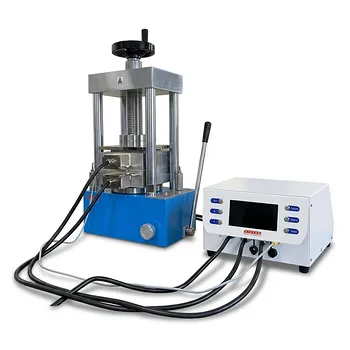
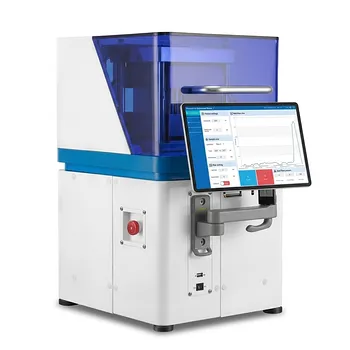
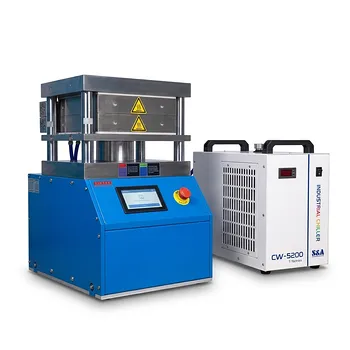
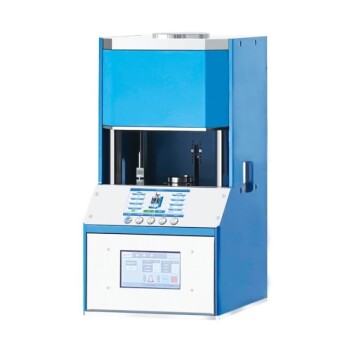
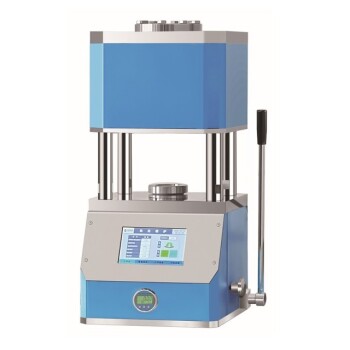
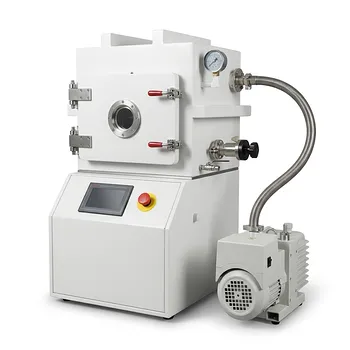
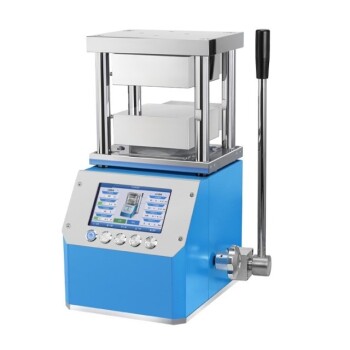
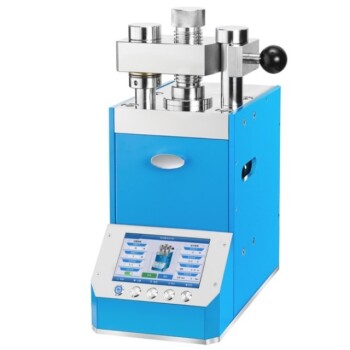
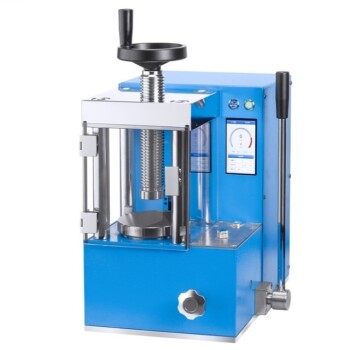
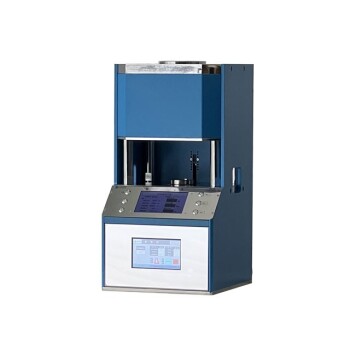
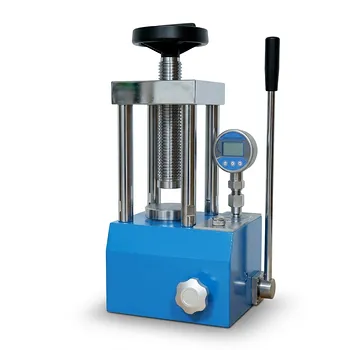
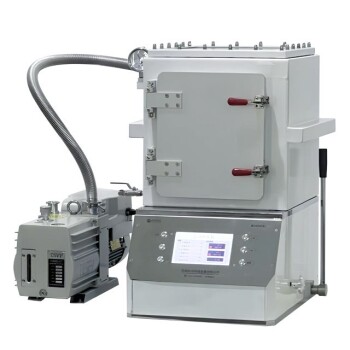
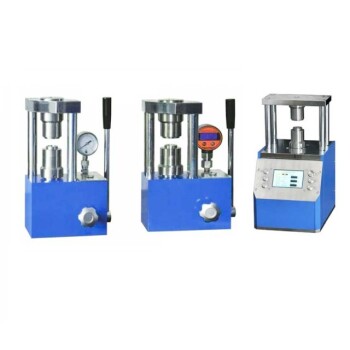
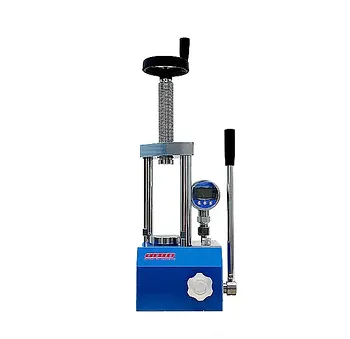
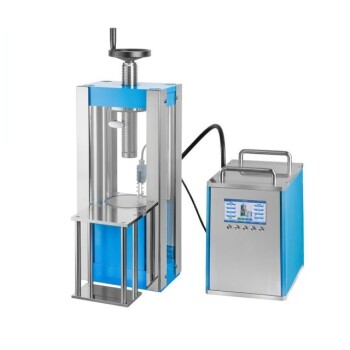
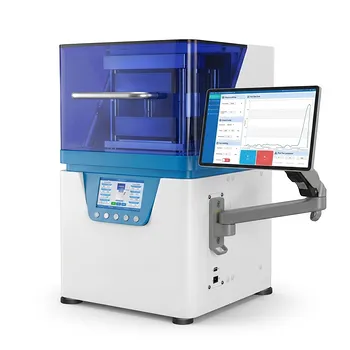
The use of a laboratory hydraulic sealing machine is a critical step in solid-state battery assembly because it provides the high-pressure mechanical force necessary to create intimate contact between solid layers. While liquid electrolytes naturally "wet" surfaces, solid electrolytes require significant, uniform pressure to bridge the physical gaps between the electrolyte, the lithium anode, and the cathode. This process directly minimizes interfacial resistance and ensures the cell is hermetically sealed against atmospheric moisture and oxygen.
Core Takeaway: A hydraulic sealing machine transforms a loose stack of materials into a functioning electrochemical system by applying precise, uniform pressure that reduces interfacial impedance and establishes a contamination-proof seal.
Overcoming the Interfacial Resistance Barrier
Achieving Intimate Physical Contact
Solid-state batteries rely on "solid-to-solid" interfaces, which are inherently prone to high resistance due to microscopic surface roughness. The hydraulic sealing machine applies stable and uniform pressure to compress these layers together, forcing the solid electrolyte to conform to the surface of the lithium metal anode and the cathode.
Reducing Interfacial Impedance
By maximizing the contact area between the components, the machine effectively minimizes interfacial contact resistance. This is essential for efficient ion transport; without this high-pressure bond, the battery would suffer from high internal resistance (ohmic resistance), leading to poor rate performance and limited capacity.
Promoting Uniform Ion Distribution
Consistent pressure across the entire surface of the electrode ensures that ions move uniformly across the interface. This uniformity prevents the formation of "hot spots" or uneven reactions, which are necessary for achieving long-term cycling stability and preventing premature cell failure.
Ensuring Structural Integrity and Environmental Isolation
Hermetic Encapsulation and Contamination Control
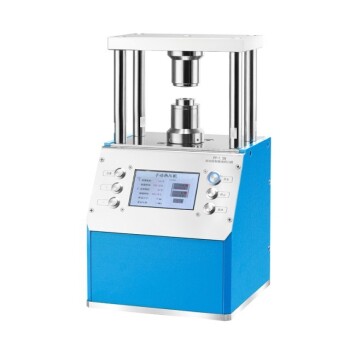
The primary function of the hydraulic crimper is to create a rigorous, airtight seal between the battery case and the sealing gasket. This isolation is vital for solid electrolytes, which are often highly sensitive to atmospheric moisture and oxygen that can degrade the material during testing.
Maintaining Internal Tension
Beyond the initial seal, the mechanical crimping process ensures that the internal components—including current collectors, electrode sheets, and spacers—remain under constant mechanical tension. This persistent pressure prevents layers from delaminating or shifting during the expansion and contraction cycles of the battery.
Guaranteeing Data Accuracy and Repeatability
In a laboratory setting, the ability to control pressure precisely allows researchers to produce consistent cells. This forming control ensures that the results of electrochemical performance evaluations are repeatable and that the data collected accurately reflects the material properties rather than assembly variations.
Understanding the Trade-offs
The Risk of Excessive Pressure
While high pressure is necessary for contact, excessive force can lead to the mechanical failure of brittle solid electrolyte pellets. Over-crimping may also cause internal short circuits if the insulating gasket is compromised or if the electrodes are pushed into direct contact.
Pressure Non-Uniformity
If the sealing die is not perfectly aligned or if the hydraulic system loses calibration, the pressure distribution becomes uneven. This results in localized impedance variations, where parts of the cell remain inactive while others are overstressed, leading to misleading test data.
Material Compatibility
Different solid electrolytes (such as sulfides vs. oxides) have different mechanical properties and pressure requirements. A "one size fits all" approach to sealing pressure can lead to cracked electrolytes or insufficient contact depending on the hardness and plasticity of the materials used.
How to Optimize Your Sealing Process
To achieve the best results when assembling lithium-ion coin cells with solid electrolytes, your approach should be dictated by your specific testing goals.
- If your primary focus is minimizing interfacial resistance: Use the maximum safe pressure recommended for your specific electrolyte material to ensure the most intimate contact possible.
- If your primary focus is long-term cycle life: Prioritize the consistency and repeatability of the sealing pressure to ensure the hermetic seal remains intact over hundreds of hours of testing.
- If your primary focus is material characterization: Calibrate your hydraulic press frequently to ensure that the pressure applied is a known variable, allowing you to isolate the electrochemical performance of the materials.
The precision of your hydraulic sealing machine is ultimately what determines whether a solid-state cell provides valid, reproducible data or fails due to avoidable mechanical gaps.
Summary Table:
| Key Benefit | Impact on Solid-State Battery Assembly |
|---|---|
| Interfacial Contact | Creates essential physical bonds between solid layers for ion transport. |
| Reduced Impedance | Minimizes contact resistance to improve cell capacity and rate performance. |
| Hermetic Sealing | Protects moisture-sensitive electrolytes from atmospheric oxygen and water. |
| Mechanical Tension | Prevents layer delamination during expansion and contraction cycles. |
| Data Consistency | Provides precise pressure control for repeatable and accurate research data. |
Optimize Your Battery Research with KINTEK Precision
Superior electrochemical performance in solid-state batteries depends on the quality of the interface. KINTEK specializes in comprehensive laboratory pressing solutions tailored to the needs of battery research. We offer a versatile range of equipment, including manual, automatic, heated, multifunctional, and glovebox-compatible models, as well as cold and warm isostatic presses for advanced material processing.
Our solutions are designed to help researchers minimize interfacial resistance and ensure the structural integrity of their cells. Ready to enhance your lab's capabilities? Contact KINTEK today to find the perfect pressing solution for your research!
References
- Junlei Qi, Lijie Dong. Mechanically Strong Active‐Site‐Enriched Polymer Composite Solid Electrolytes toward Superior Room‐Temperature Performance in Lithium Batteries. DOI: 10.1002/apxr.202400166
This article is also based on technical information from Kintek Solution Knowledge Base .
Related Products
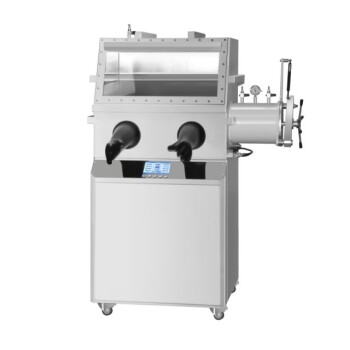
- Laboratory Hydraulic Press Lab Pellet Press Machine for Glove Box
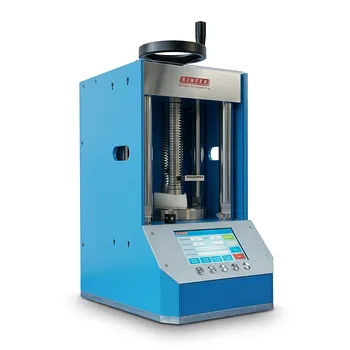
- Automatic Laboratory Hydraulic Press Lab Pellet Press Machine
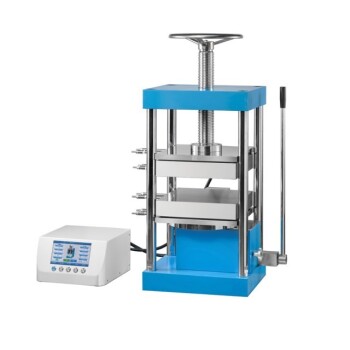
- Laboratory Split Manual Heated Hydraulic Press Machine with Hot Plates
- Button Battery Sealing Press Machine for Lab
- 24T 30T 60T Heated Hydraulic Lab Press Machine with Hot Plates for Laboratory
People Also Ask
- How does a laboratory hydraulic press contribute to the preparation of Li3-3xScxSb samples? Optimize Ionic Conductivity
- What is the function of a laboratory hydraulic press in FT-IR of curcumin-coated MWCNTs? Achieve Optical Clarity.
- Why is a laboratory hydraulic press required for compression molding boron-siloxane? Solve High-Loading Density Challenges
- What role does a laboratory hydraulic press play in reaction pellets? Optimizing Lunar Soil and Metal Fuel Density
- What role does a laboratory hydraulic press play in the preparation of piezoelectric ceramic discs for DC-PG? | KINTEK