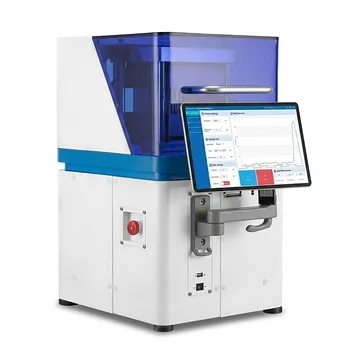
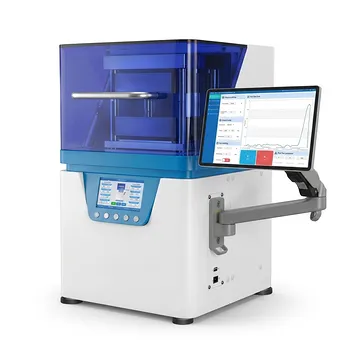
Dimensional precision in large heating platens is the primary driver of specimen uniformity, as it dictates the spatial distribution of both mechanical force and thermal energy. High-precision flatness ensures that pressure is transmitted equally across the entire surface area, eliminating density gradients and ensuring that physical constants like hardness remain consistent throughout the rubber specimen.
Core Takeaway: Superior platen flatness guarantees uniform pressure and synchronized heat conduction, which are essential for creating a stable chemical network and reducing experimental errors in subsequent material testing.
The Role of Mechanical Flatness in Pressure Distribution
Eliminating Density Gradients
High-precision flatness in large platens, such as those measuring 460 mm x 460 mm, prevents localized pressure spikes or drops. This uniformity ensures a consistent material density across the entire thickness and width of the specimen.
Ensuring Consistent Physical Constants
When pressure is distributed evenly, the resulting rubber specimens exhibit uniform hardness and physical properties. This stability is vital for producing reliable data in load-deformation studies where fluctuations in the manufacturing process would otherwise skew results.
Minimizing Experimental Error
Precision-engineered surfaces reduce the "noise" in experimental data caused by mechanical inconsistencies. By standardizing the molding environment, researchers can be confident that documented performance variations are due to material composition rather than processing artifacts.
Synchronized Heat Conduction and Chemical Uniformity
Stabilizing the Thermal Field
Dimensional precision allows for a stable thermal field when used in conjunction with high-precision electric heating. Maintaining a constant temperature, such as 160 °C, across the entire mold surface is necessary for predictable results.
Facilitating Uniform Cross-linking Reactions
Consistent heat conduction ensures that the cross-linking reaction occurs simultaneously throughout the rubber mixture. This synchronization prevents over-vulcanization or under-vulcanization in different zones of the same specimen.
Developing Stable Spatial Networks
Precise control over the heat-pressure interface facilitates the formation of a stable three-dimensional spatial network. This molecular structure is what ultimately determines the structural integrity and high-temperature performance of the rubber.
Understanding the Trade-offs and Challenges
The Cost of Dimensional Stability
Achieving and maintaining high flatness over a large surface area requires expensive materials and specialized machining. The initial capital expenditure for high-precision platens is significantly higher than standard molding equipment.
Sensitivity to Thermal Cycling
Even the most precise platens can experience thermal warping over time due to repeated heating and cooling cycles. Regular calibration and maintenance are required to ensure the dimensional precision does not degrade, which adds to operational overhead.
Mold Compatibility Issues
A high-precision platen is only as effective as the mold placed upon it. If the steel mold itself has dimensional inaccuracies or uneven wear, the benefits of the high-precision heating platen will be largely negated.
How to Apply This to Your Project
When integrating high-precision heating platens into your manufacturing or testing process, focus on your specific material goals.
- If your primary focus is experimental accuracy: Invest in platens with the highest available flatness ratings to eliminate density gradients that could invalidate load-deformation data.
- If your primary focus is high-temperature performance: Prioritize systems that offer a stable thermal field to ensure the development of a stable 3D network for maximum flame retardancy and integrity.
- If your primary focus is production consistency: Implement a rigorous calibration schedule to monitor for thermal warping, ensuring that platen precision remains within tolerance over thousands of cycles.
The precision of your equipment dictates the reliability of your results, transforming raw rubber mixtures into structurally sound, predictable engineering materials.
Summary Table:
| Key Factor | Impact on Specimen | Research Benefit |
|---|---|---|
| Mechanical Flatness | Eliminates density gradients | Ensures consistent physical constants |
| Thermal Stability | Synchronized cross-linking | Develops stable chemical networks |
| Pressure Uniformity | Prevents localized spikes | Minimizes experimental "noise" |
Optimize Your Material Testing with KINTEK Precision Presses
Consistency in material science starts with the right equipment. KINTEK specializes in comprehensive laboratory pressing solutions, offering manual, automatic, heated, multifunctional, and glovebox-compatible models, as well as cold and warm isostatic presses tailored for demanding applications like battery research.
Our high-precision platens guarantee the uniform thermal and mechanical distribution necessary to transform raw mixtures into predictable engineering materials.
Ready to elevate your lab's precision? Contact KINTEK today to discuss our range of pressing solutions and how we can support your specific research goals!
References
- B. B. Konar. Studies on the effects of cyclohexylbenzthiazyl sulfenamide accelerated sulfur vulcanization of natural rubber. Part-II. Load-deformation characteristics. DOI: 10.5281/zenodo.5833075
This article is also based on technical information from Kintek Solution Knowledge Base .
Related Products
- Automatic High Temperature Heated Hydraulic Press Machine with Heated Plates for Lab
- Infrared Heating Quantitative Flat Plate Mold for Precise Temperature Control
- Heated Hydraulic Press Machine With Heated Plates For Vacuum Box Laboratory Hot Press
- Split Automatic Heated Hydraulic Press Machine with Heated Plates
- Automatic Heated Hydraulic Lab Press Machine 200x200 Plate Size for Battery Research and Materials Science
People Also Ask
- Function of a Laboratory Hydraulic Press with Heated Platens in SSE? Enhance Battery Density & Conductivity
- What are the requirements for electrode pressing with high-viscosity ionic liquids like EMIM TFSI? Optimize Performance
- How does a laboratory heated hydraulic press facilitate PBN sample prep for WAXS? Achieve Precise X-Ray Scattering
- What are the industrial applications of heated hydraulic presses? Master Heat & Force for Precision Manufacturing
- Why is a laboratory hydraulic press with heating plates required for PLA/TEC films? Achieve Precise Sample Integrity