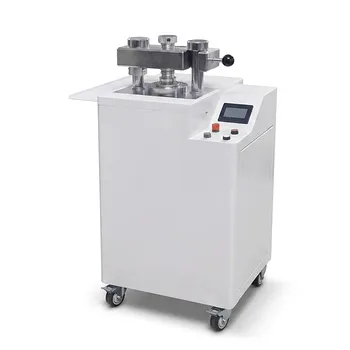
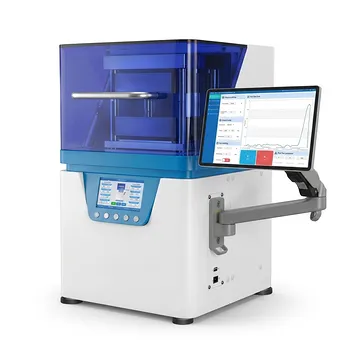
The laboratory heated press provides a cost-effective and high-throughput alternative to traditional thin-film growth for producing thermoelectric materials. By applying simultaneous axial pressure and heat, a laboratory press densifies powders into bulk pellets in as little as one hour, bypassing the high energy requirements and extreme equipment costs associated with methods like Molecular Beam Epitaxy (MBE) or Metal-Organic Chemical Vapor Deposition (MOCVD).
The heated press replaces complex, vacuum-dependent thin-film processes with a streamlined thermo-mechanical approach. This method achieves high-density bulk materials that maintain excellent thermoelectric and mechanical properties while being significantly easier to scale for industrial production.
The Mechanics of Densification vs. Atomic Growth
Simultaneous Thermal and Mechanical Activation
Unlike thin-film techniques that grow materials atom-by-atom in a vacuum, a heated press uses uniaxial pressure (up to 100 MPa) and controlled temperatures (typically 320°C to 450°C). This combination forces particles together, effectively eliminating voids and pores that would otherwise hinder electron or ion transport.
Enhanced Mass Transport and Plastic Deformation
The simultaneous application of heat and pressure accelerates mass transport and plastic deformation within the material. This "thermo-mechanical coupling" allows the material to reach its theoretical density much faster than pressureless sintering or room-temperature pressing.
Controlled Thermal Fields for Stability
A heated press operates within a controlled thermal field, which is critical for materials like biomass or polymers. By activating natural binders like lignin or ensuring the thorough mixing of polymer chains, the press creates a stable, durable structure that resists breakage during handling.
Comparative Advantages in Production and Scalability
Drastic Reduction in Energy and Capital Costs
Traditional thin-film growth techniques like MOCVD are notorious for their high energy consumption and the need for expensive, specialized precursors. In contrast, a laboratory press is far more cost-effective, requiring less power and simpler raw materials to produce high-quality bulk samples.
Operational Simplicity and Throughput
The heated press process is significantly easier to operate and requires less specialized training than maintaining a high-vacuum MBE system. Sintering can often be completed within a one-hour timeframe, allowing for rapid prototyping and higher production volumes of bulk nanomaterials.
Superior Mechanical Integrity
Because the heated press produces bulk pellets rather than fragile thin films, the resulting components exhibit much higher compressive strength and hardness. The high-density structure achieved through hot pressing also suppresses the growth of defects, such as sodium dendrites in electrolyte applications.
Understanding the Trade-offs
Precision vs. Volume
While the heated press excels at producing bulk materials, it lacks the atomic-level thickness control provided by MBE or MOCVD. If your application requires a coating that is only a few nanometers thick with specific epitaxial orientation, a heated press cannot replicate that level of precision.
Uniaxial vs. Isostatic Pressure
A standard heated press applies uniaxial (one-directional) pressure, which can sometimes lead to slight density gradients in very complex shapes. For absolute omnidirectional uniformity, techniques like Hot Isostatic Pressing (HIP) are used, though they are generally more complex than a standard lab press.
Temperature Limitations
While the heated press is faster, the high temperatures required for densification must be carefully managed to prevent abnormal grain growth. If the temperature is too high for too long, the nanostructure of the thermoelectric material may coarsen, potentially reducing its efficiency.
How to Apply This to Your Project
Making the Right Choice for Your Goal
- If your primary focus is industrial scalability and cost reduction: Use a laboratory heated press to produce bulk pellets, as it offers a significantly lower barrier to entry and faster production cycles than thin-film growth.
- If your primary focus is maximizing electrical or ionic conductivity: Leverage the high-pressure capabilities of the press (80–100 MPa) to eliminate internal pores and reduce interfacial resistance.
- If your primary focus is achieving atomic-scale layer precision: Traditional thin-film growth techniques like MBE remain the superior, albeit more expensive, choice for these specialized semiconductor applications.
By utilizing the thermo-mechanical advantages of a laboratory heated press, researchers can produce high-performance, dense thermoelectric materials that are ready for real-world mechanical and thermal environments.
Summary Table:
| Feature | Laboratory Heated Press | Thin-Film Growth (MBE/MOCVD) |
|---|---|---|
| Material Form | Bulk pellets & nanomaterials | Atomic-scale thin films |
| Sintering Time | ~1 hour | Multiple hours to days |
| Equipment Cost | Cost-effective capital investment | Very high (vacuum/precursor costs) |
| Precision | Mechanical/Density control | Atomic-layer precision |
| Mechanical Integrity | High compressive strength | Fragile, requires substrate |
| Scalability | High industrial potential | Limited for bulk production |
Upgrade Your Material Synthesis with KINTEK
Are you looking to bridge the gap between lab-scale research and industrial production? KINTEK specializes in comprehensive laboratory pressing solutions tailored for high-performance materials. Whether you need manual, automatic, heated, multifunctional, or glovebox-compatible models, our equipment ensures superior densification and mechanical integrity for your thermoelectric and battery research. We also offer cold and warm isostatic presses for unmatched uniformity.
Why Choose KINTEK?
- Accelerated Throughput: Sinter bulk samples in as little as one hour.
- Cost Efficiency: A high-performance alternative to expensive vacuum-dependent growth systems.
- Versatile Solutions: Equipment optimized for battery research, biomass, and polymer stability.
Contact KINTEK today to find the perfect pressing solution and enhance your lab's efficiency!
References
- Salman B. Inayat, Muhammad M. Hussain. Nano-materials Enabled Thermoelectricity from Window Glasses. DOI: 10.1038/srep00841
This article is also based on technical information from Kintek Solution Knowledge Base .
Related Products
- Automatic High Temperature Heated Hydraulic Press Machine with Heated Plates for Lab
- Laboratory Hydraulic Split Electric Lab Pellet Press
- Automatic Laboratory Hydraulic Press for XRF and KBR Pellet Pressing
- Laboratory Hydraulic Pellet Press for XRF KBR FTIR Lab Press
- Automatic Laboratory Hydraulic Press Lab Pellet Press Machine
People Also Ask
- Function of a Laboratory Hydraulic Press with Heated Platens in SSE? Enhance Battery Density & Conductivity
- How does a laboratory heated hydraulic press facilitate PBN sample prep for WAXS? Achieve Precise X-Ray Scattering
- What are the requirements for electrode pressing with high-viscosity ionic liquids like EMIM TFSI? Optimize Performance
- What are the industrial applications of heated hydraulic presses? Master Heat & Force for Precision Manufacturing
- Why is a laboratory hydraulic press with heating plates required for PLA/TEC films? Achieve Precise Sample Integrity