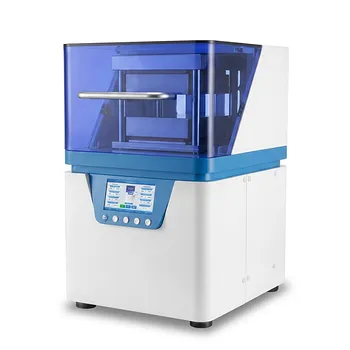
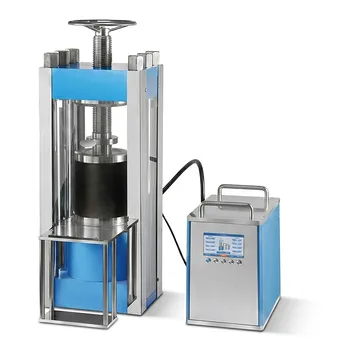
High-precision control in hot-pressing is the definitive factor in structural integrity. A computer-controlled hot press influences particleboard quality by providing real-time monitoring and exact regulation of pressure, temperature, and board thickness. This precision ensures the core layer reaches its necessary curing temperature while preventing premature surface adhesive curing, resulting in an ideal density profile and superior mechanical performance.
The core advantage of a high-precision hot press lies in its ability to synchronize thermal energy with mechanical force to create a uniform density profile. This level of control ensures that chemical bonding is consistent across the entire cross-section of the particleboard.
Achieving Structural Consistency Through Precise Pressure
Managing the Pressing Cycle Phases
High-precision systems meticulously manage the pressure increase, holding, and unloading phases of the hot-pressing cycle. By executing pre-programmed sequences, the equipment ensures that the loose mat is compressed into a dense structural board without compromising its internal structure. This level of control is essential when working with specialized materials, such as recycled particles or waste plywood.
Optimizing the Internal Density Profile
Uniform density is achieved through complex displacement sequences that minimize the density gradients found in traditional pressing methods. High-precision hydraulic systems allow researchers and manufacturers to maintain consistent density throughout the board's thickness. This consistency is critical for stabilizing the final product's thickness and modulus of elasticity.
Eliminating Mechanical Error
In a laboratory or industrial setting, automatic control eliminates mechanical error and ensures the accuracy of experimental data. By accurately setting press closing and heating times, the system provides a reliable foundation for establishing technical parameters. This repeatability is vital when scaling experimental results to large-scale industrial production.
Precise Thermal Management for Adhesive Performance
Balancing Core and Surface Temperatures
The press must provide stable, high temperatures (often between 150°C and 200°C) to drive the chemical cross-linking of adhesives like urea-formaldehyde. Precise control ensures the core reaches the curing threshold in a timely manner. Without this precision, the surface layers might cure prematurely, leading to a weak core and poor internal bond strength.
Driving Chemical Cross-Linking
High-precision systems maintain the pressing factor—the time allotted for each millimeter of board thickness (e.g., 20 seconds per mm). This specific timing is necessary for the resin to fully penetrate the wood fibers and establish high-strength mechanical anchoring. Proper thermal management facilitates the reorganization of wood fibers under pressure, resulting in high peel resistance.
Managing Advanced Material Interactions
When adding materials like metal oxide nanoparticles, the hot press must transfer heat more effectively to the board's core to accelerate polymerization. Advanced control systems manage these specific temperature-rise curves to optimize the "thermoelectric figure of merit" or mechanical properties. This precision preserves nanofeatures within the material that would be lost under less regulated conditions.
Understanding the Trade-offs
The Cost of Technical Complexity
While computer-controlled systems offer superior precision, they require a significantly higher initial capital investment compared to manual or semi-automatic models. The sophistication of the sensors and hydraulic actuators also demands specialized maintenance and calibration to remain accurate over time.
Sensitivity to Material Variability
High-precision programs are often optimized for specific moisture contents or particle sizes. If the raw material input (such as the moisture level of the wood chips) varies unexpectedly, the pre-programmed pressure sequence may fail to produce the desired density. This requires the operator to have a deep understanding of how to adjust the software parameters to compensate for inconsistent inputs.
How to Apply High-Precision Pressing to Your Project
When integrating a high-precision hot press into your production or research workflow, your focus should shift according to your specific quality requirements.
- If your primary focus is mechanical strength (IB, MOR): Prioritize systems with the highest thermal stability to ensure the core reaches the 150°C-200°C range without overheating the surface.
- If your primary focus is dimensional stability: Focus on the precision of the displacement control and the "unloading phase" to prevent board "spring-back" or thickness swelling.
- If your primary focus is research and development: Select a press that allows for the recording and repetition of specific temperature-rise curves to isolate variables like particle size or adhesive type.
By mastering the synchronization of pressure and temperature through precision technology, you ensure every particleboard produced meets the highest standards for structural performance and durability.
Summary Table:
| Feature | Influence on Quality | Key Benefit |
|---|---|---|
| Pressure Control | Uniform density profiles | Stabilized thickness & modulus |
| Thermal Management | Precise adhesive curing | High internal bond strength |
| Cycle Automation | Eliminates mechanical error | Repeatable data & scalability |
| Displacement Sequences | Minimizes density gradients | Enhanced dimensional stability |
Elevate Your Research with KINTEK’s Precision Pressing Solutions
Precision is the definitive factor in structural integrity. KINTEK specializes in comprehensive laboratory pressing solutions tailored to your specific material research needs.
Whether you are developing advanced particleboards or conducting cutting-edge battery research, our extensive range of equipment provides the exact regulation required for success. Our offerings include:
- Manual & Automatic Hot Presses: For exact pressure and temperature control.
- Heated & Multifunctional Models: Versatile tools for complex material interactions.
- Glovebox-Compatible Systems: Optimized for sensitive research environments.
- Cold & Warm Isostatic Presses: Widely applied in advanced battery research and ceramic development.
Ready to optimize your pressing process for superior mechanical performance? Contact us today to discover how KINTEK can bring precision and repeatability to your laboratory.
References
- Agnieszka Laskowska. Characteristics of the Pressing Process and Density Profile of MUPF-Bonded Particleboards Produced from Waste Plywood. DOI: 10.3390/ma17040850
This article is also based on technical information from Kintek Solution Knowledge Base .
Related Products
- Automatic Hydraulic Hot Press with Large Plate and Precision Temperature Control for Advanced Material Sample Preparation and Industrial Research
- Automatic Heated Hydraulic Lab Press with Programmable Touch Screen Controls and Precision Temperature Regulation
- Automatic High Temperature Heated Hydraulic Press Machine with Heated Plates for Lab
- Warm Isostatic Press for Solid State Battery Research Warm Isostatic Press
- Automatic Heated Hydraulic Lab Press 120x120mm Plate Fully Automated Material Research Press
People Also Ask
- What are the specific features and applications of hydraulic hot press machines? Precision Solutions for Modern Labs
- How does an automatic hydraulic press operate? Achieve Precision and Consistency in Lab Pelleting
- What are the advantages and common applications of an automatic hydraulic press? Elevate Your Lab's Precision
- What is the technical significance of setting a precise dwell time? Achieve Peak Material Density and Stability
- When is an automatic hydraulic press more suitable than a manual press? Scale Your Lab with Precision & Speed