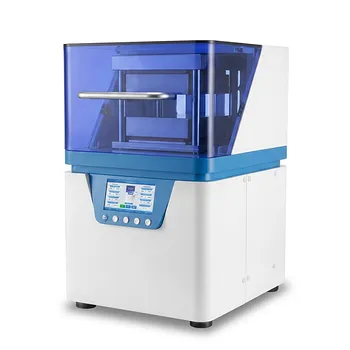
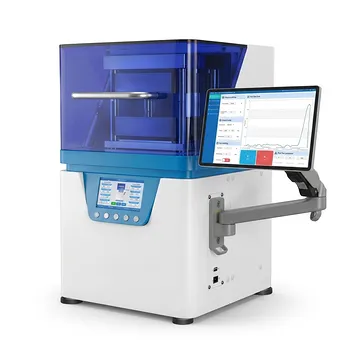
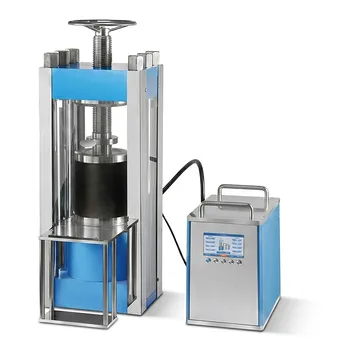
The heated press is the fundamental tool for converting bulk material into a microscopically viable sample. It transforms composite granules into thin, uniform films by applying a specific combination of heat (typically 190°C) and pressure (approximately 3 MPa). This process flattens the recycled High-Density Polyethylene (rHDPE) and coffee ground mixture, creating a standardized geometry that allows for the clear visualization of filler distribution and dispersion under optical or scanning electron microscopy.
The core function of a heated press is to eliminate structural irregularities and air pockets to create a "transparent" look into the material's internal morphology. By precisely controlling the transition from solid granules to a flattened film, it ensures that microscopic analysis reflects the true state of the composite rather than preparation artifacts.
Achieving Optical Clarity for Microscopic Imaging
The Role of Controlled Melting
At temperatures around 190°C, the recycled HDPE matrix reaches a molten state, allowing it to flow around the coffee ground particles. This encapsulation is vital because it creates a continuous phase that allows light or electron beams to interact with the sample consistently. Without this phase change, the material would remain a collection of discrete granules, making microscopic focus impossible.
Uniformity and Dimensional Stability
The application of pressure, such as 3 MPa, ensures the film reaches a uniform thickness across its entire surface. For optical microscopy, inconsistent thickness leads to depth-of-field issues, where only parts of the sample are in focus at one time. A flat, uniform film provides a stable plane for high-resolution imaging and accurate measurement of filler particles.
Improving Data Accuracy through Structural Integrity
Elimination of Voids and Air Pockets
During the blending of recycled plastics and organic fillers like coffee grounds, air is often trapped within the mixture. The heated press forces these internal air pockets out of the sample, preventing them from being misidentified as pores or defects during microscopic analysis. This ensures the resulting images provide an accurate representation of the interfacial bonding between the matrix and the filler.
Optimizing Filler Dispersion Visualization
Coffee grounds tend to cluster, and a bulk sample hides the extent of this agglomeration. The pressing process flattens these clusters into a single, observable layer, allowing researchers to quantify the dispersion state of the filler. This is critical for understanding how well the coffee grounds have integrated into the rHDPE, which directly impacts the mechanical properties of the final product.
Understanding the Trade-offs and Pitfalls
Thermal Degradation Risks
Applying heat for too long or at too high a temperature can degrade the recycled polymer chains or char the organic coffee grounds. Thermal degradation can change the color and texture of the sample, potentially obscuring the very features the researcher is trying to observe. Precision in temperature control is mandatory to avoid "cooking" the sample instead of simply melting it.
Pressure-Induced Morphological Distortion
While pressure is necessary for a thin film, excessive force can crush or deform the coffee ground particles. If the pressure is too high, the microscopic analysis may show fractured fillers that were actually intact in the original composite. It is a delicate balance to apply enough pressure for a thin film without altering the physical morphology of the reinforcement.
How to Apply This to Your Material Analysis
When preparing rHDPE and coffee ground composites for microscopic review, your press parameters must align with your specific research objectives.
- If your primary focus is optical transparency: Use a temperature slightly above the HDPE melting point (190°C) and hold the pressure long enough to ensure a glass-like finish on the film surface.
- If your primary focus is particle size analysis: Minimize the dwell time under high pressure to prevent the mechanical crushing of the coffee ground fillers.
- If your primary focus is void detection: Prioritize a slow ramp-up of pressure to allow trapped gases to escape the molten matrix before the film solidifies.
Effective sample preparation via a heated press is the bridge between raw recycled waste and the high-fidelity data required for material innovation.
Summary Table:
| Feature | Function in Microscopic Analysis | Typical Parameters |
|---|---|---|
| Controlled Heating | Melts rHDPE matrix to encapsulate coffee fillers | ~190°C |
| Pressure Application | Flattens granules into thin, uniform films | ~3 MPa |
| Void Elimination | Removes trapped air to prevent imaging artifacts | High-pressure dwell |
| Film Uniformity | Ensures consistent depth-of-field for SEM/Optical imaging | Precision platens |
Elevate Your Composite Research with KINTEK Precision
Achieve flawless sample preparation and high-fidelity microscopic data with KINTEK’s comprehensive range of laboratory pressing solutions. Whether you are analyzing sustainable rHDPE/coffee ground composites or conducting advanced battery research, our equipment provides the precision you need.
Our Solutions Include:
- Manual & Automatic Heated Presses: For perfect film thickness and uniform melt flow.
- Multifunctional & Glovebox-Compatible Models: Specialized for sensitive material environments.
- Cold & Warm Isostatic Presses: Widely applied in high-density material and battery research.
Don't let preparation artifacts obscure your results. Transition from raw recycled waste to transparent, viable samples with KINTEK's industry-leading technology.
Contact KINTEK Today to Find Your Ideal Press Solution
References
- Sibele Piedade Cestari, Jan-Hendrik Keller. Properties of recycled high density polyethylene and coffee dregs composites. DOI: 10.4322/polimeros.2014.011
This article is also based on technical information from Kintek Solution Knowledge Base .
Related Products
- Heated Hydraulic Press Machine with Heated Plates for Vacuum Box Laboratory Hot Press
- Automatic Hydraulic Heat Press Machine with Multi Stage Programmable Control and Integrated Water Cooling Plate Size 180x180mm
- Automatic Hydraulic Hot Press with Large Plate and Precision Temperature Control for Advanced Material Sample Preparation and Industrial Research
- Automatic High Temperature Heated Hydraulic Press Machine with Heated Plates for Lab
- Heated Hydraulic Press Machine With Heated Plates For Vacuum Box Laboratory Hot Press
People Also Ask
- How does a laboratory heated hydraulic press facilitate PBN sample prep for WAXS? Achieve Precise X-Ray Scattering
- What are the requirements for electrode pressing with high-viscosity ionic liquids like EMIM TFSI? Optimize Performance
- What are the industrial applications of heated hydraulic presses? Master Heat & Force for Precision Manufacturing
- Function of a Laboratory Hydraulic Press with Heated Platens in SSE? Enhance Battery Density & Conductivity
- How are heated hydraulic presses utilized in the preparation of thin films? Key Mechanisms and Applications