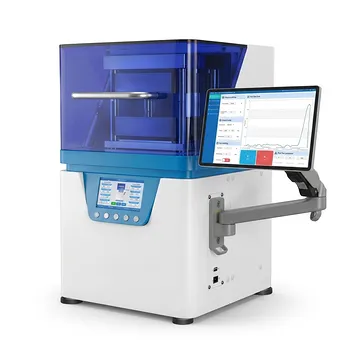
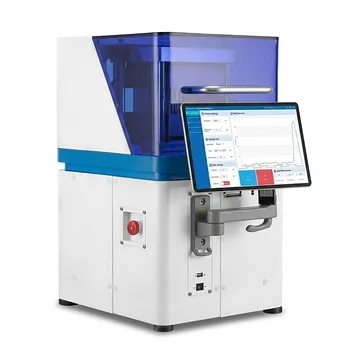
The laboratory electrically heated hydraulic press is the primary instrument used to convert raw rubber-pigment mixtures into stable, standardized test specimens through controlled vulcanization. By subjecting a rubber mixture containing phthalocyanine pigments to simultaneous high temperature and high mechanical pressure, the press triggers a chemical cross-linking reaction. This process transforms the material from a pliable, thermoplastic state into a durable, three-dimensional thermoset elastomer suitable for rigorous physical and colorimetric testing.
The core function of the heated hydraulic press is to provide a highly controlled environment that ensures chemical cross-linking is uniform and that the resulting test plaque is free of internal voids. This standardization is essential for isolating the performance of phthalocyanine pigments from variables introduced during the molding process.
Facilitating the Chemical Vulcanization Reaction
Triggering the Molecular Cross-Linking
The press utilizes electric heating plates to provide the thermal energy necessary to initiate chemical reactions between curing agents, such as sulfur or peroxides, and the rubber macromolecules. This energy facilitates the formation of a three-dimensional network, which locks the phthalocyanine pigment particles into a stable matrix.
Precision Temperature Control
Maintaining a constant high temperature, typically between 150°C and 165°C, is critical for ensuring the vulcanization reaction reaches completion within a specific timeframe. Consistent heat prevents "under-curing," which can lead to unstable physical properties, or "over-curing," which can degrade the rubber and affect the pigment's perceived color strength.
Ensuring Structural Integrity and Precision
Elimination of Internal Voids and Air Pockets
The application of high mechanical pressure, often ranging from 4.9 MPa to 300 KN, forces the rubber mixture to fill the steel mold cavity completely. This pressure is vital for eliminating internal air bubbles and pores that would otherwise cause density gradients and compromise the accuracy of mechanical tests.
Dimensional Standardization
The hydraulic press ensures that test specimens meet exact geometric requirements, such as standardized 2 mm thickness or specific dumbbell shapes. This geometric precision is a prerequisite for obtaining repeatable measurements of tensile strength, hardness, and Young’s modulus, allowing for direct comparison between different pigment batches.
Locking Micro-Morphology
By applying uniform pressure during the cooling and setting phase, the press preserves the pigment dispersion achieved during the initial mixing stage. This "locks in" the micro-morphology of the phthalocyanine within the rubber, ensuring that color evaluations reflect the true quality of the pigment dispersion rather than processing inconsistencies.
Understanding the Trade-offs
Managing Thermal Gradients
One significant challenge is the potential for temperature gradients across the heating plates, which can lead to uneven vulcanization across a single test sheet. If the center of the plate is hotter than the edges, the cross-link density will vary, rendering the standardized sample unreliable for comparative testing.
Balancing Pressure and Flash
While high pressure is necessary to eliminate voids, excessive pressure can lead to "flash"—the leakage of rubber out of the mold boundaries. This can result in specimens with inconsistent thickness or reduced density, undermining the goal of producing a standardized reference sample.
Applying This Equipment to Your Project
Recommendations for Targeted Results
- If your primary focus is Color Stability and Strength: Prioritize precise temperature calibration and dwell time to ensure the pigment's thermal stability is tested against a fully and uniformly cured rubber matrix.
- If your primary focus is Mechanical Performance Evaluation: Ensure the hydraulic pressure is stepped correctly to eliminate all interlaminar boundaries, providing a fully dense sample that reveals the material's intrinsic mechanical parameters.
- If your primary focus is Comparative Pigment Testing: Use a standardized mold and a consistent pressure-forming protocol (e.g., 160°C at 150 bar for 15 minutes) to ensure that differences in results are due to pigment variance rather than molding artifacts.
The laboratory heated hydraulic press acts as the definitive bridge between raw material mixing and standardized analytical testing, ensuring every specimen is a true representation of the composite’s properties.
Summary Table:
| Key Feature | Process Specification | Impact on Sample Quality |
|---|---|---|
| Temperature Control | 150°C - 165°C | Ensures uniform chemical cross-linking and pigment stability. |
| Mechanical Pressure | 4.9 MPa - 300 KN | Eliminates internal voids and air pockets for structural integrity. |
| Dimensional Precision | Standardized 2mm Molds | Guarantees repeatable tensile, hardness, and colorimetric data. |
| Material Conversion | Vulcanization | Transforms raw mixtures into stable, thermoset test elastomers. |
Enhance Your Material Research with KINTEK Precision Pressing Solutions
Achieve unmatched accuracy in your standardized testing with KINTEK’s advanced laboratory equipment. Specialized in comprehensive laboratory pressing solutions, we provide the tools necessary to lock in micro-morphology and ensure sample uniformity for battery research and specialized pigment testing.
Our Versatile Range Includes:
- Manual, Automatic, and Heated Hydraulic Presses
- Multifunctional and Glovebox-Compatible Models
- Cold and Warm Isostatic Presses (CIP/WIP)
Don't let processing variables compromise your data. Contact KINTEK today to find the perfect press for your laboratory requirements and ensure your samples meet the highest industry standards.
References
- Agnieszka Katarzyna Pająk, Agnieszka Kucharska-Jastrząbek. The thermal properties and the flammability of pigmented elastomeric materials. DOI: 10.1007/s10973-014-3739-x
This article is also based on technical information from Kintek Solution Knowledge Base .
Related Products
- 24T 30T 60T Heated Hydraulic Lab Press Machine with Hot Plates for Laboratory
- Automatic Heated Hydraulic Press Machine with Hot Plates for Laboratory
- Automatic Heated Hydraulic Press Machine with Heated Plates for Laboratory
- Automatic Large Format Laboratory Heated Hydraulic Press 400x400mm Plate Capacity
- Automatic Heated Hydraulic Lab Press 120x120mm Plate Fully Automated Material Research Press
People Also Ask
- What is the primary function of a laboratory heated hydraulic press? Mastering Thermoplastic Carbon Fiber Composites
- Why Use a Laboratory Heated Hydraulic Press for SSAB CCM? Optimize Solid-State Battery Interfacial Bonding
- What role does a laboratory heated hydraulic press play in LTCC? Essential for High-Density Ceramic Lamination
- Why is a laboratory hydraulic press with heating plates required for PLA/TEC films? Achieve Precise Sample Integrity
- What is the critical role of a laboratory heated hydraulic press? Mastering PVC Sample Prep for Testing