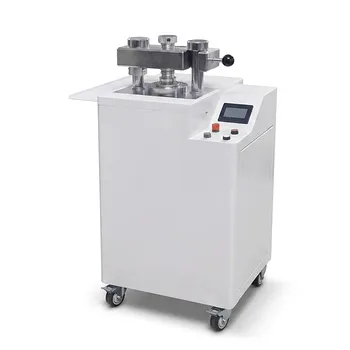
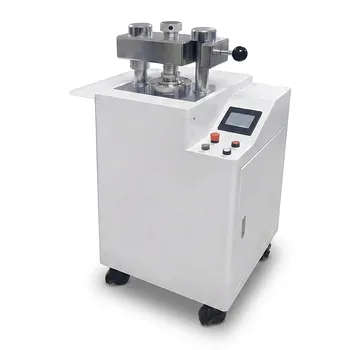
The laboratory hydraulic press is the critical tool used to consolidate high-purity silicon powder into dense, manageable blocks. This pre-forming process allows for the precise addition of silicon into molten aluminum within a furnace. By transforming loose powder into a solid compact, the press ensures an accurate chemical composition in the final Al-9Si alloy and prevents the significant material loss that would occur if loose powder were introduced to the melt.
Core Takeaway: The laboratory hydraulic press transforms volatile silicon powder into standardized solid compacts, ensuring precise alloying, reducing material waste, and providing the structural integrity necessary for efficient metallurgical processing.
Facilitating Precise Alloy Composition
Prevention of Material Loss
Introducing loose silicon powder into a high-temperature aluminum melt often results in "powder loss" due to thermal currents or oxidation. The hydraulic press mitigates this by compressing the powder into compact blocks that submerge easily and react predictably.
Standardization of Raw Materials
The press enables the creation of standardized raw materials with uniform weight and volume. This consistency is vital for calculating the exact ratios needed to achieve a perfect 9% silicon balance in the aluminum matrix.
Enhanced Handling and Storage
Solid compacts created by the press are much easier to handle and transport than loose powders. These green bodies possess enough structural strength to resist crumbling during the charging process of the resistance furnace.
The Mechanics of Powder Consolidation
Particle Rearrangement and Void Filling
A laboratory hydraulic press applies controlled axial pressure to force individual silicon particles to rearrange. In the initial stages, this movement fills internal voids and expels trapped air, significantly increasing the density of the material.
Mechanical Interlocking and Plastic Deformation
Under high pressure, often ranging from 50 to 700 MPa, the particles undergo plastic deformation. This forces the particles to mechanically interlock, creating physical bonds that transform loose material into a structured compact with defined density.
Establishing the Foundation for Diffusion
By reducing porosity and increasing the contact surface area between particles, the press creates a densification foundation. This proximity is essential for the rapid and uniform diffusion of silicon into the aluminum once the compact reaches its melting point.
Understanding the Trade-offs and Challenges
Pressure Sensitivity and Tooling Wear
Applying excessive pressure can lead to die wear or "spring-back" effects, where the compact expands and cracks upon release. Finding the optimal pressure—high enough for integrity but low enough to preserve the mold—is a delicate balance for the operator.
Consistency of Green Strength
If the pressure is inconsistent, the resulting green strength may be insufficient, causing the silicon block to disintegrate before it reaches the melt. This leads to the very powder loss and composition inaccuracies the process is intended to prevent.
Limitations of Unidirectional Pressing
Standard laboratory presses often use unidirectional cold pressing, which can lead to density gradients within the block. The top of the compact may be denser than the bottom, potentially affecting the rate at which it dissolves into the molten aluminum.
Applying This Process to Your Laboratory Goals
To achieve the best results when preparing master alloys, the use of the hydraulic press should be tailored to your specific output requirements.
- If your primary focus is Maximum Composition Accuracy: Ensure the silicon powder is weighed precisely before pressing and use consistent pressure to ensure every block added to the melt has identical properties.
- If your primary focus is Production Throughput: Utilize an automatic laboratory hydraulic press to maintain a high cycle rate and ensure uniform green strength across large batches of silicon compacts.
- If your primary focus is Reducing Oxidation: Increase the compaction pressure to minimize internal porosity, thereby reducing the surface area of the silicon exposed to air before it is submerged in the aluminum melt.
By mastering the use of the laboratory hydraulic press, you transition from unpredictable powder mixing to a controlled, professional metallurgical process.
Summary Table:
| Key Feature | Benefit for Al-9Si Preparation | Impact on Process |
|---|---|---|
| Powder Consolidation | Transforms loose Si into dense solid blocks | Prevents material loss and oxidation |
| Controlled Pressure | Applies 50-700 MPa for high density | Ensures uniform silicon distribution |
| Standardization | Creates uniform weight and volume compacts | Guarantees precise 9% silicon balance |
| Structural Integrity | Increases green strength of compacts | Facilitates safe furnace charging |
Elevate your metallurgical precision and battery research with KINTEK’s comprehensive laboratory pressing solutions. Whether you need manual, automatic, heated, or multifunctional models, or advanced cold and warm isostatic presses, our equipment is designed to deliver the uniform density and structural integrity your samples require. Contact KINTEK today to discover the ideal press for your laboratory goals!
References
- Jianjun Guo, Lin Zhu. Effect of High-Frequency Electric Pulse on the Solidification Microstructure and Properties of Hypoeutectic Al-Si Alloy. DOI: 10.3390/ma17020468
This article is also based on technical information from Kintek Solution Knowledge Base .
Related Products
- Automatic Hydraulic Hot Press with Large Plate and Precision Temperature Control for Advanced Material Sample Preparation and Industrial Research
- 24T 30T 60T Heated Hydraulic Lab Press Machine with Hot Plates for Laboratory
- Automatic Heated Hydraulic Press Machine with Heated Plates for Laboratory
- Laboratory Hydraulic Press 2T Lab Pellet Press for KBR FTIR
- Automatic Heated Hydraulic Press Machine with Hot Plates for Laboratory
People Also Ask
- What are the specific features and applications of hydraulic hot press machines? Precision Solutions for Modern Labs
- How does an automatic hydraulic press operate? Achieve Precision and Consistency in Lab Pelleting
- What are the advantages and common applications of an automatic hydraulic press? Elevate Your Lab's Precision
- What is the technical significance of setting a precise dwell time? Achieve Peak Material Density and Stability
- When is an automatic hydraulic press more suitable than a manual press? Scale Your Lab with Precision & Speed