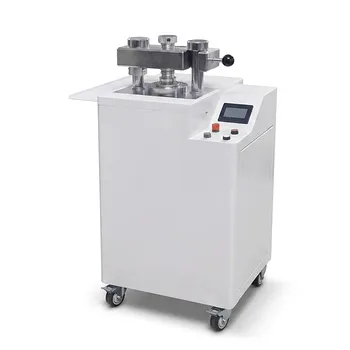
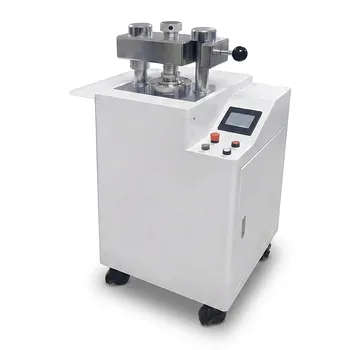
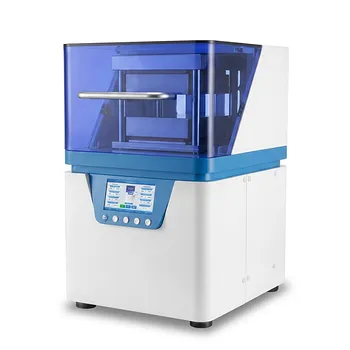
The primary purpose of using an automatic pellet press is to transform loose powder into standardized, high-density disks with perfectly flat surfaces. This process is essential for X-ray fluorescence (XRF) testing of geopolymer raw materials because it minimizes X-ray scattering interference, ensuring an accurate and repeatable determination of the material’s oxide composition.
Core Takeaway: An automatic pellet press provides the precise pressure and dwell time control necessary to eliminate human error and physical inconsistencies. This standardization is the critical foundation for high-fidelity spectroscopic analysis and reliable material characterization.
Enhancing Analytical Precision and Accuracy
Minimizing X-ray Scattering
In X-ray fluorescence (XRF) analysis, the geometry of the sample surface dictates the quality of the data. Loose powder creates irregular surfaces that scatter radiation unpredictably, leading to significant measurement errors. By compressing the powder into a dense disk with a flat surface, the press ensures that the analytical beam interacts uniformly with the sample.
Improving Signal-to-Noise Ratios
For infrared spectroscopy (FTIR), the press eliminates light scattering between individual powder particles. By creating a uniformly thick, often transparent pellet, the tool improves the signal-to-noise ratio. This clarity allows researchers to more accurately identify chemical bonding within the aluminosilicate structures of geopolymers.
Accurate Oxide Determination
The quantification of oxides in metakaolin-based materials relies on a stable and representative sample. High-pressure compression ensures the mass distribution is consistent across the disk. This stability is a prerequisite for achieving the high-precision results required for rigorous scientific research.
The Role of Automation in Sample Integrity
Elimination of Human Variable
Manual pressing operations are prone to variations in applied force and timing, which lead to inconsistent sample density. Automatic lab presses use programmed parameters to ensure every pellet is produced under identical conditions. This repeatability is essential for comparative studies and quality control environments.
Preventing Structural Defects
Metakaolin powders can be difficult to bind, often leading to sample cracking or "capping" when handled manually. Automatic systems apply and release pressure at controlled rates, maintaining the structural integrity of the disk. This results in pellets with high mechanical strength that can withstand handling and analysis without crumbling.
Optimizing Internal Densification
High-tonnage pressure forces particles into closer contact, creating a uniform internal structure. This densification is particularly important in experiments like microwave heating, where a uniform internal structure prevents uneven energy absorption. Consistent density ensures that the reaction efficiency remains stable across different experimental batches.
Understanding the Trade-offs
One significant challenge with automatic presses is the initial capital investment and maintenance of the hydraulic and electronic systems compared to manual alternatives. Sophisticated systems require regular calibration to ensure that the sensor readings match the actual pressure applied to the powder.
Furthermore, improper programmed parameters can lead to die damage or sample contamination. If the pressure is too high for a specific material or if the die is not properly cleaned, the resulting pellet may be structurally unsound or chemically compromised. Users must carefully balance dwell time and tonnage to avoid "over-pressing," which can cause certain minerals to undergo unwanted phase changes or structural deformations.
Applying This Technology to Your Workflow
When integrating an automatic pellet press into your geopolymer research or quality control laboratory, your choice should be dictated by your specific analytical goals.
- If your primary focus is Chemical Characterization (XRF/FTIR): Prioritize a press that offers fine-tuned control over dwell time and pressure to ensure maximum transparency and minimal surface scattering.
- If your primary focus is Repeatability and High Throughput: Invest in a fully programmable automatic model to eliminate operator-induced variability and ensure consistent sample density across hundreds of cycles.
- If your primary focus is Mechanical or Thermal Testing: Select a high-tonnage press capable of achieving maximum densification to simulate the structural properties of bulk geopolymer materials.
Standardizing your sample preparation through automated pressure control is the single most effective way to ensure the integrity and reproducibility of your geopolymer analysis.
Summary Table:
| Feature of Automatic Press | Benefit for Geopolymer Analysis |
|---|---|
| Precise Pressure Control | Eliminates human error and ensures uniform pellet density. |
| Standardized Dwell Time | Prevents structural defects like cracking or capping in metakaolin. |
| High-Density Compaction | Minimizes X-ray scattering for accurate oxide determination. |
| Flat Surface Finishing | Improves signal-to-noise ratios in FTIR spectroscopy. |
| Programmable Cycles | Ensures repeatability across large batches for reliable research. |
Elevate Your Material Research with KINTEK Precision
Inconsistent sample preparation can compromise your entire analytical workflow. KINTEK specializes in comprehensive laboratory pressing solutions designed to meet the rigorous demands of geopolymer and battery research.
Whether you need manual, automatic, heated, multifunctional, or glovebox-compatible models, our equipment provides the stability and precision required for high-fidelity spectroscopic analysis. We also offer cold and warm isostatic presses for specialized densification needs.
Ready to standardize your results and eliminate human variables?
Contact KINTEK Today to Find Your Perfect Pressing Solution
References
- Shriram Marathe, Murugan Muthu. Degradation Potential of Metakaolin-Based Geopolymer Composites Immersed in Real and Simulated Acidic Environments. DOI: 10.3390/su17020468
This article is also based on technical information from Kintek Solution Knowledge Base .
Related Products
- Automatic XRF Pellet Press for Laboratory Spectrometry Sample Preparation
- Automatic Fluorescence Sample Preparation Press 40 Ton Lab Pellet Press for XRF Analysis
- Automatic Laboratory Hydraulic Press Lab Pellet Press Machine
- Automatic Laboratory Hydraulic Press for XRF and KBR Pellet Pressing
- Manual Cold Isostatic Pressing CIP Machine Pellet Press
People Also Ask
- What is the role of a laboratory press in COF electrolyte prep? Achieving High-Performance Pellet Densification
- What are the different types of pellet-making tools available for labs? Choose the Right Press for Your Sample
- What are the different methods for preparing a sample pellet for XRF analysis? Expert Guide to Superior XRF Results
- How are pellets prepared for XRF analysis and what is a potential drawback? Master XRF Sample Prep and Accuracy
- How can contamination occur during the preparation of pressed pellets for XRF analysis? Expert Prevention Guide