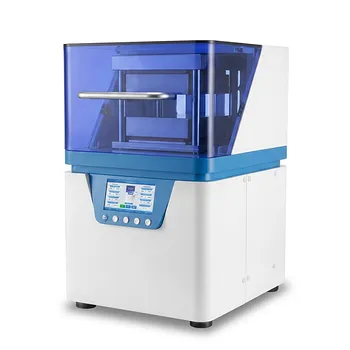
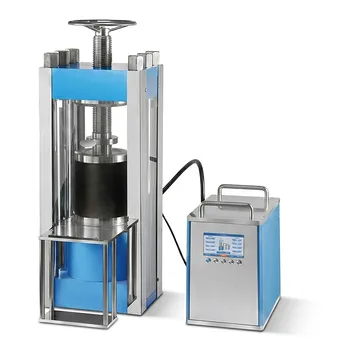
The heated press serves as the primary mechanism for transforming loose 3D braided fibers into a structurally stable, handleable "preform." It provides the controlled thermal and mechanical environment necessary to melt the powder binder, drive it into the fabric surface, and then solidify it through forced cooling. This process locks the dry carbon fiber bundles into their intended geometry while significantly enhancing edge stability.
The heated press is the critical tool for powder binder stabilization, using synchronized heat and pressure to bond dry 3D braided fibers into a cohesive unit. This process ensures dimensional accuracy and reduces internal defects, laying the essential foundation for high-performance composite manufacturing.
Thermal Management and Binder Integration
Precise Melting via Controlled Heating Curves
The heated press utilizes its upper and lower platens to create a uniform thermal field across the 3D braided fabric. By following a specific heating curve, the press ensures the powder binder reaches its melting point evenly without degrading the carbon fibers. This controlled heat allows the binder to transition into a liquid state, facilitating its penetration into the surface layers of the 3D structure.
Consolidation Through Forced Cooling
Once the binder has effectively wetted the fiber surfaces, the press initiates a forced cooling process. This rapid temperature drop solidifies the binder, effectively acting as a temporary "glue" for the dry fibers. This solidification is what locks the fiber bundles in their precise positions, preventing shifting during transport or further resin infusion.
Enhancing Structural Edge Stability
One of the most vital roles of the heated press is increasing the edge stability of the braided material. By applying heat and pressure simultaneously to the boundaries of the preform, it prevents fraying and maintains the integrity of the 3D braid's complex architecture. This ensures that the preform retains its exact shape when removed from the press.
Mechanical Consolidation and Air Removal
Eliminating Porosity and Voids
The press applies constant mechanical pressure to force the composite mixture into every corner of the mold cavity. This pressure is essential for expelling residual air that may be trapped between the braided layers. Removing this air is critical, as any remaining pockets create porosity defects that significantly weaken the final component.
Optimizing Fiber Density
For high-fill composites, the heated press is indispensable for increasing material density to meet design specifications. The mechanical force compresses the dry fibers to the target fiber volume fraction, ensuring the final part is as dense and strong as required. This compaction is necessary to achieve the specific mechanical properties demanded by aerospace or automotive standards.
Understanding the Trade-offs and Pitfalls
Thermal Gradients and Non-Uniformity
If the heated press platens are not perfectly calibrated, thermal gradients can occur across the preform. This leads to uneven binder melting, where some areas are over-saturated while others remain loose and unstable. Consistent temperature monitoring is required to prevent "dry spots" within the 3D structure.
Over-Compression and Fiber Damage
Applying excessive pressure can lead to fiber crushing or distortion of the 3D braid pattern. While high pressure reduces porosity, it can also force the binder out of the preform entirely, leaving the edges brittle. Finding the balance between consolidation and structural deformation is the most significant challenge in the stabilization process.
How to Apply This to Your Manufacturing Process
The role of the heated press is to bridge the gap between a flexible fabric and a rigid structural component. To maximize its effectiveness, you should tailor your press parameters to your specific material goals.
- If your primary focus is Dimensional Accuracy: Prioritize the heating curve and forced cooling phases to ensure the binder locks the fibers into the exact mold geometry before the press opens.
- If your primary focus is High Mechanical Strength: Focus on the constant pressure application to maximize material density and eliminate internal porosity that could lead to structural failure.
- If your primary focus is Complex Edge Geometries: Ensure the platen uniformity is optimized to provide consistent stabilization across the entire surface, preventing fraying at the boundaries.
By mastering the balance of uniform heat and constant pressure, you ensure your 3D braided preforms are defect-free and ready for final production.
Summary Table:
| Function | Key Mechanism | Manufacturing Benefit |
|---|---|---|
| Thermal Management | Controlled Heating Curves | Uniform binder melting & fiber wetting |
| Mechanical Consolidation | Constant Pressure | Elimination of voids & air pockets |
| Structural Locking | Forced Cooling | Rapid solidification for dimensional accuracy |
| Integrity Enhancement | Simultaneous Heat/Pressure | Increased edge stability & reduced fraying |
| Compaction Control | Platen Calibratons | Optimized fiber density for high-fill composites |
Elevate Your Preform Manufacturing with KINTEK Precision
Achieving the perfect balance of heat and pressure is essential for high-performance 3D braided composites. KINTEK specializes in comprehensive laboratory pressing solutions tailored to ensure your preforms meet the highest standards of stability and accuracy.
Our extensive range includes:
- Manual & Automatic Heated Presses for precise thermal control.
- Multifunctional & Glovebox-Compatible Models for sensitive research environments.
- Cold and Warm Isostatic Presses (CIP/WIP) widely applied in battery research and advanced material density optimization.
Don’t let thermal gradients or porosity undermine your results. Let KINTEK provide the high-precision equipment your laboratory needs for superior material stabilization.
Contact us today to find the ideal pressing solution for your lab!
References
- Alice E. Snape, Richard J. Scaife. Stabilising and Trimming 3D Woven Fabrics for Composite Preforming Applications. DOI: 10.1007/s10443-018-9717-x
This article is also based on technical information from Kintek Solution Knowledge Base .
Related Products
- Heated Hydraulic Press Machine with Heated Plates for Vacuum Box Laboratory Hot Press
- Automatic Hydraulic Heat Press Machine with Multi Stage Programmable Control and Integrated Water Cooling Plate Size 180x180mm
- Automatic Hydraulic Hot Press with Large Plate and Precision Temperature Control for Advanced Material Sample Preparation and Industrial Research
- Automatic High Temperature Heated Hydraulic Press Machine with Heated Plates for Lab
- Heated Hydraulic Press Machine With Heated Plates For Vacuum Box Laboratory Hot Press
People Also Ask
- How does a laboratory heated hydraulic press facilitate PBN sample prep for WAXS? Achieve Precise X-Ray Scattering
- What are the requirements for electrode pressing with high-viscosity ionic liquids like EMIM TFSI? Optimize Performance
- What are the industrial applications of heated hydraulic presses? Master Heat & Force for Precision Manufacturing
- Function of a Laboratory Hydraulic Press with Heated Platens in SSE? Enhance Battery Density & Conductivity
- How are heated hydraulic presses utilized in the preparation of thin films? Key Mechanisms and Applications